

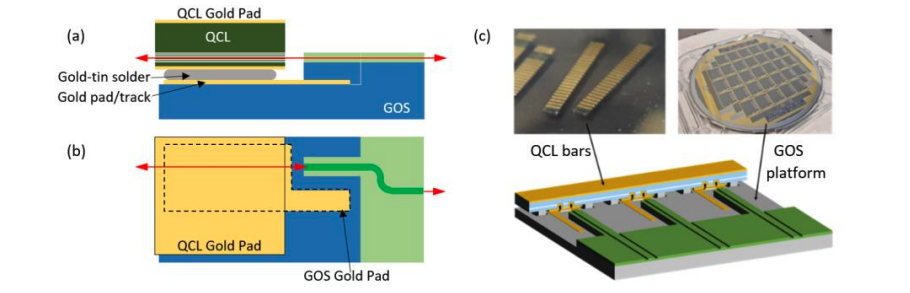
Mid-infrared sensing stands to benefit from more compact and efficient photonic systems, and researchers are now demonstrating a significant step towards that goal. Colin J. Mitchell, Longqi Zhou, and Ke Li, from the University of Southampton and the University of Sheffield respectively, alongside their colleagues, have pioneered a new method for integrating quantum cascade lasers with germanium-on-silicon waveguides. This hybrid integration scheme achieves surprisingly high coupling efficiency, up to 45%, without the need for precise, active alignment during manufacturing, representing a considerable simplification of current approaches. The team’s work paves the way for scalable, fully integrated mid-infrared photonic systems with potential applications in sensing, free-space communications, and the development of novel light sources.
Mid-IR Laser Integration for Silicon Photonics Sensing
This research details the successful combination of quantum cascade lasers with silicon photonics for mid-infrared sensing, representing a notable advance in integrated photonics. The authors demonstrate a reliable and scalable method for integrating these lasers onto a silicon-on-insulator (SOI) platform utilising flip-chip technology and gold-tin solder bumps, creating compact, low-cost, and low-power light sources for diverse sensing applications, including therapeutic drug monitoring, environmental analysis, and cancer metastasis detection. Silicon photonics leverages silicon as a material for creating optical circuits, offering advantages in fabrication cost and compatibility with existing CMOS manufacturing processes; however, silicon itself does not emit light efficiently in the mid-infrared, necessitating the integration of external light sources like quantum cascade lasers. Quantum cascade lasers are semiconductor lasers that emit light in the mid to far-infrared region through intersubband transitions in quantum wells, offering tunability and relatively high power output, making them ideal for molecular spectroscopy where many substances exhibit strong absorption features.
Detailed characterization confirms the performance of the integrated devices, including measurements of optical power coupled into the silicon waveguides and assessment of propagation losses within the waveguide structures. The team achieves efficient light coupling, crucial for maximising signal strength in sensing applications, and minimises waveguide losses, ensuring signal integrity over longer propagation distances. This integrated platform holds significant promise for several sensing applications, extending beyond those initially stated. It enables precise monitoring of drug levels in patients, facilitating personalised medicine through optimised dosage regimes, and allows for the detection of pollutants and toxins in water and air, improving environmental monitoring efforts and public health initiatives. Furthermore, it offers a pathway to identify circulating tumor cells (CTCs), aiding in the early detection of cancer metastasis and enabling more effective treatment strategies; the ability to detect CTCs with high sensitivity is particularly valuable as these cells are responsible for the spread of cancer to other parts of the body. The flip-chip bonding process effectively dissipates heat, which is essential for maintaining consistent laser performance and preventing device degradation; thermal management is a critical consideration in laser integration, as excessive heat can reduce laser efficiency and lifetime.
The researchers address the challenges posed by differing thermal expansion rates between the laser material, typically gallium arsenide and aluminium arsenide, and silicon by fabricating quantum cascade lasers using molecular beam epitaxy (MBE) and silicon waveguides on silicon-on-insulator wafers using standard lithographic processes. MBE allows for precise control over the layer thickness and composition of the semiconductor materials, crucial for achieving the desired laser performance; lithography, a technique used to pattern materials with high precision, enables the creation of the intricate waveguide structures. The lasers were then carefully bonded to the waveguides using gold-tin solder bumps, providing both electrical and thermal contact, and the devices underwent thorough characterization using various optical and electrical measurements to assess their performance, including spectral analysis and power-dependent measurements. This research marks a significant advancement towards practical and affordable mid-infrared sensing systems; previous attempts at integrating mid-infrared lasers with silicon photonics often suffered from low coupling efficiency or complex fabrication processes. By combining quantum cascade lasers with silicon photonics, the authors have created a platform with the potential to transform healthcare, environmental monitoring, and security; the ability to miniaturise and reduce the power consumption of these sensing systems opens up new possibilities for portable and real-time monitoring. The scalability and cost-effectiveness of the flip-chip approach make this technology particularly promising for widespread adoption, envisioning portable, low-power devices that can address critical challenges in areas like climate change and medical diagnosis; the potential for mass production lowers the barrier to entry for various applications, accelerating the development of innovative sensing solutions. The team is currently exploring the integration of on-chip spectrometers to further enhance the functionality of the platform, enabling more detailed spectral analysis and improved sensing capabilities.
🗞 Hybrid Integration of Quantum Cascade Lasers with Germanium-on-Silicon waveguides for Mid-Infrared Sensing Applications
🧠 DOI: https://doi.org/10.48550/arXiv.2507.14003


