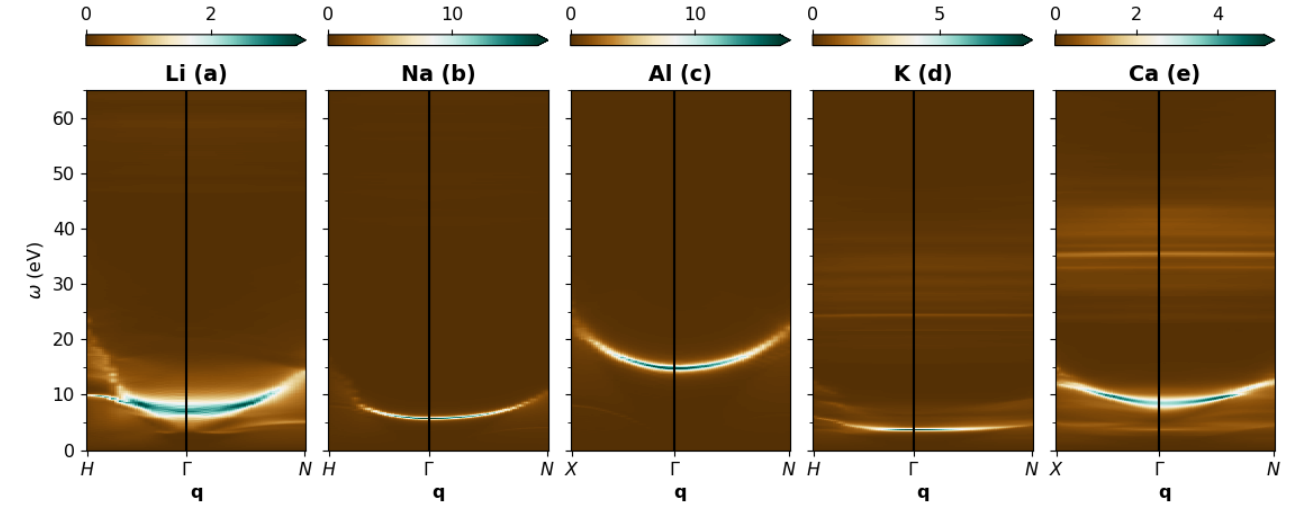
The behaviour of collective electron oscillations, known as bulk plasmons, fundamentally governs how metals interact with light and energy, yet a comprehensive understanding of these interactions across different elemental metals has remained a challenge. Dario A. Leon, Claudia Cardoso, and Kristian Berland, from the Norwegian University of Life Sciences and Istituto Nanoscienze, CNR, now present detailed calculations of these plasmons in 25 elemental metals, revealing complex behaviours previously hidden. Their work constructs a comprehensive picture of plasmon energy and momentum relationships, identifying features like unusual energy dispersions and band crossings, and importantly, validates these findings against existing experimental data. This detailed analysis establishes a crucial reference point for both fundamental research into metallic properties and the development of advanced technologies in areas like plasmonics and spectroscopy.
Metal Optics and Many-Body Perturbation Theory
This extensive collection of references details research into the optical properties of metals, particularly aluminum, gold, silver, and copper. The core focus lies in understanding how these metals interact with light, including the absorption, reflection, and excitation of plasmons, collective oscillations of electrons within the material. A significant portion of the research employs many-body perturbation theory, a sophisticated theoretical method crucial for accurately describing the complex interactions between electrons and their impact on optical behavior. This computational approach allows for detailed modeling of the materials’ electronic structure. The research emphasizes achieving high accuracy and validating computational results against experimental data obtained through techniques like electron energy loss spectroscopy. Validation against experimental data ensures the reliability and accuracy of the theoretical models and calculations.
Plasmonic Excitations in Elemental Metals Calculated
This work presents a detailed investigation into the collective electronic excitations, known as plasmons, within 25 elemental metals. Researchers performed first-principles calculations using the random-phase approximation to construct spectral band structures, revealing how these excitations behave at different energies and momenta. To accurately model these complex excitations, the team developed an advanced analytical representation, extending a previous model based on multipole-Padé approximants to incorporate both momentum and frequency dependence. The calculations determine the dielectric function, which governs a material’s response to electromagnetic fields, by using density functional theory.
This approach determines the microscopic polarizability, a measure of how easily a material’s electron cloud distorts, by considering transitions between electronic states within the material. Researchers separated intra-band transitions, occurring within a single electron band, from inter-band transitions, involving electrons moving between different bands, to fully capture the complexity of the dielectric response. To further analyze the results, the team defined key quantities like the intra-band, inter-band, and plasma frequencies using f-sum rules, providing a quantitative framework for understanding the distribution of electronic excitations. The team extended the single plasmon-pole approximation, a simplified model often used to describe plasmons, by incorporating a multipole approach.
This innovative technique allows for a more accurate representation of the complex frequency dependence of the dielectric function. By carefully analyzing the calculated dielectric function and employing this advanced analytical representation, scientists identified complex features in the plasmonic quasiparticle dispersions, including non-parabolic energy and intensity distributions, discontinuities arising from material anisotropy, and band crossings indicative of strong interactions between electronic excitations. This detailed analysis provides a fundamental reference point for both theoretical studies and practical applications in plasmonics and spectroscopy.
Metal Dielectric Functions and Collective Excitations
This work presents a comprehensive investigation into the dielectric properties of 25 elemental metals, achieved through first-principles calculations within the random phase approximation. Scientists computed the frequency and momentum dependent inverse dielectric functions, establishing a detailed understanding of how these materials respond to electromagnetic fields. The research delivers a foundational dataset for both fundamental studies and practical applications in plasmonics and spectroscopy. The team developed an effective analytical representation of collective excitations, extending a previous model based on multipole-Padé approximants to incorporate both momentum and frequency dependence.
This generalized model, termed MPA(q), accurately describes the complex spectral properties of plasmonic excitations. Results demonstrate the presence of non-parabolic energy and intensity dispersions in these quasiparticles, alongside discontinuities arising from material anisotropy. Overlapping effects were also observed, leading to band crossings and anti-crossings, revealing intricate details of the electronic structure. Calculations in the optical limit, where momentum approaches zero, provide a robust foundation for comparison with existing experimental data. The team found good agreement between computed results and available spectra, validating the accuracy of the theoretical approach.
Deviations from the free-electron gas model were also carefully analyzed, highlighting the influence of material-specific electronic structures on plasmonic behavior. Furthermore, the research extends beyond the optical limit, constructing spectral band structures at finite momentum. These structures reveal the detailed momentum-dependent behavior of plasmonic excitations, providing insights into their propagation and interaction within the material. The MPA(q) model effectively captures these spectral features, demonstrating its ability to accurately represent the complex interplay between momentum, frequency, and electronic structure. This work establishes a reference point for understanding and engineering plasmonic materials, paving the way for advancements in nanophotonics, spectroscopy, and emerging quantum technologies.
Plasmons Reveal Mixed Electronic Transitions in Metals
This research presents a comprehensive investigation into the collective electronic excitations, known as plasmons, within 25 elemental metals. By employing first-principles calculations and the random-phase approximation, scientists have constructed detailed spectral band structures that reveal the behavior of these excitations across different energies and momenta. The team extended a previous theoretical model to accurately capture the complex features of plasmonic quasiparticles, including non-parabolic energy dispersions, discontinuities arising from material anisotropy, and the overlapping of excitations that lead to band crossings. The results demonstrate that these plasmons are a mixture of both intra-band and inter-band electronic transitions, and the team developed a method to separate and analyze these contributions.
Importantly, the calculated spectra show good agreement with available experimental data, validating the accuracy of the approach. The work establishes a foundational reference point for understanding plasmonic behavior in elemental metals, which will be valuable for both fundamental studies and the development of practical applications in areas like plasmonics and spectroscopy. The authors acknowledge that the model relies on approximations within the random-phase approximation and does not account for more complex many-body effects. Future research directions include extending the calculations to incorporate these effects and applying the developed theoretical framework to investigate plasmonic excitations in more complex materials, such as alloys and nanostructures. The team also plans to explore the implications of these findings for controlling and manipulating light at the nanoscale.