
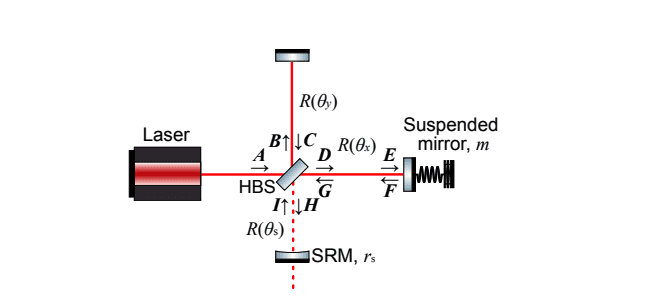
On April 25, 2025, researchers led by Kaido Suzuki reported the first observation of an optical spring effect in a signal-recycled Michelson interferometer without arm cavities, demonstrating a novel approach to enhancing high-frequency sensitivity in gravitational wave detection instruments.
The study demonstrates the first optical spring effect in a signal-recycled Michelson interferometer without arm cavities. Previous observations required configurations with arm cavities, but this experiment achieved the effect using multiple laser fields for stable detuning and a suspension system of double-spiral springs. These findings suggest potential for developing optical spring-enhanced interferometers with intracavity amplification, improving high-frequency sensitivity in next-generation detection instruments.
Gravitational waves, ripples in spacetime caused by massive cosmic events like black hole mergers, have revolutionized our understanding of the universe since their first detection in 2015. While detectors such as LIGO and Virgo have provided unprecedented insights into astrophysics and cosmology, they face limitations in sensitivity, particularly at certain frequency ranges. This challenge has driven innovative research to enhance detection capabilities.
A significant advancement in this field is the use of optical springs. An optical spring refers to a system where light exerts a force on a mirror, creating a restoring force similar to a mechanical spring. This concept allows for the trapping and stabilization of mirrors used in interferometers, crucial components of gravitational wave detectors.
Researchers have employed methods like optical parametric amplifiers (OPAs) and signal recycling to refine these systems. OPAs amplify specific light frequencies, enhancing detector sensitivity. Signal recycling involves re-injecting a portion of the detected signal back into the system, improving its ability to detect faint waves.
Recent studies have demonstrated significant improvements in detector performance using optical springs. Experiments with gram-scale mirrors trapped by light have shown reduced quantum noise, a major source of interference. This reduction enhances measurement precision, allowing detectors to capture weaker signals previously undetectable. Additionally, advancements in signal recycling have extended the operational bandwidth of detectors, making them more effective across a broader range of frequencies.
These improvements hold profound implications for astronomy. Enhanced sensitivity could lead to discovering new astrophysical phenomena, such as intermediate-mass black holes or neutron star mergers at greater distances. This would expand our understanding of the universe’s dynamics and provide more data for testing theories like general relativity.
Moreover, improved detectors could facilitate multi-messenger astronomy, where observations from gravitational waves are combined with electromagnetic signals (like light or radio waves) to provide a comprehensive view of cosmic events.
The integration of optical springs into gravitational wave detection represents a significant step forward. By reducing noise and increasing sensitivity, these innovations promise new discoveries in astronomy. As research continues, the potential for further advancements remains, ensuring that gravitational wave astronomy remains at the forefront of scientific exploration.
👉 More information
🗞 Observation of an Optical Spring in a Robustly Controlled Signal-Recycled Michelson Interferometer
🧠 DOI: https://doi.org/10.48550/arXiv.2504.18374