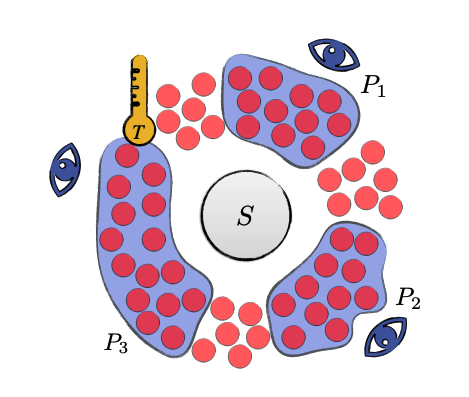
The fundamental limits of measurement and information acquisition are explored in new research examining how multiple observers can reach a shared understanding of a quantum system, a concept known as intersubjectivity. Alessandro Candeloro from Trinity College Dublin, Tiago Debarba from the Universidade Tecnológica Federal do Paraná, and Felix C. Binder, also from Trinity College Dublin, demonstrate that achieving perfect agreement between observers is fundamentally constrained by the laws of thermodynamics. The team investigates how limited resources, stemming from the third law, impact the ability to establish this shared understanding, revealing a trade-off between precision and the energetic cost of measurement. Their work establishes a new metric to quantify deviations from ideal intersubjectivity and identifies strategies, such as cooling or simplifying observations, to approximate perfect agreement even when resources are limited, offering insights into the emergence of classicality from the quantum realm.
Technische Universität Wien, Stadionallee 2, Vienna, Austria, and Trinity Quantum Alliance, Unit 16, Trinity Technology and Enterprise Centre, Pearse Street, Dublin 2, Ireland. Achieving perfect quantum measurement requires substantial resources, a consequence of the third law of thermodynamics which prevents completely resetting the measurement process. This research investigates how limited resources affect the ability of multiple observers to reach a shared understanding of a quantum system, a concept termed ‘intersubjectivity’. The study establishes a framework for understanding measurement not as a purely technical process, but one shaped by physical limitations and the collective interpretation of observers.
Spin Interactions, Agreement and Measurement Bias
Researchers have explored a model of interacting quantum spins to understand how measurements are affected by grouping individual components together, a technique called coarse-graining. This approach examines the relationship between agreement, how well measurements align with predictions, and bias, systematic deviations from true values. The team investigated how varying the level of coarse-graining impacts both agreement and bias in the measurements of the system. The results demonstrate that increasing the level of coarse-graining generally improves agreement and reduces bias, leading to more consistent and reliable measurements.
However, this improvement plateaus at a certain point, beyond which further coarse-graining offers diminishing returns. Larger coarse-graining levels also allow measurements to stabilize more quickly. This work highlights that coarse-graining can be a powerful technique for reducing noise and improving the accuracy of measurements in complex quantum systems, acknowledging a trade-off between detail and accuracy.
Thermodynamic Limits to Shared Quantum Observation
Researchers have investigated the fundamental limits of achieving objective, shared observations of a quantum system, a concept they term ‘ideal intersubjectivity’. This work addresses a core challenge in quantum measurement: the third law of thermodynamics prevents completely resetting the measurement process, introducing unavoidable limitations on how accurately information can be shared between observers. The team demonstrates that achieving complete agreement among observers is fundamentally constrained by these thermodynamic limits. The research establishes that when resources are limited, maximizing agreement between observers inevitably introduces a degree of bias in the information being broadcast about the system.
However, the team also identifies strategies to mitigate these limitations, specifically through ‘coarse-graining’ the environment, grouping together similar states, which allows for increasingly accurate shared observations as the grouping becomes more refined. The study provides a quantifiable measure of deviation from ideal intersubjectivity, linking it directly to the initial resources available. They demonstrate that the achievable level of agreement between observers improves exponentially with the size of these coarse-grained groupings, suggesting a pathway to approximate ideal objectivity even with finite resources. By comparing their findings to a standard model, researchers show that their approach, particularly when combined with coarse-graining, offers a means to improve the accuracy and reliability of shared observations, bridging fundamental principles of thermodynamics with the emergence of classicality.
Intersubjectivity Limited by Thermodynamics and Resources
This work investigates the fundamental limits of objective measurement, framing it as a problem of achieving ‘intersubjectivity’, a condition where multiple observers agree on an observed outcome and independently reproduce the original system’s information. Researchers demonstrate that perfect intersubjectivity is unattainable due to the third law of thermodynamics, which restricts the complete erasure of information necessary for ideal measurement. Instead, the degree of intersubjectivity is fundamentally limited by available resources, specifically the initial state of the environment interacting with the system. The team developed a metric to quantify the deviation from ideal intersubjectivity, establishing bounds on both the level of agreement between observers and the potential for bias in their measurements.
They show that while perfect objectivity remains elusive, approximations can be achieved through techniques like cooling the environment or employing ‘coarse-graining’ methods, effectively reducing the level of detail observed. Importantly, comparisons with existing models reveal that these alternative approaches can improve the levels of agreement and reduce bias. The authors acknowledge that their analysis focuses on specific conditions and that further research is needed to explore the implications of these findings in more complex scenarios and different physical systems.
🗞 Thermodynamic Constraints on the Emergence of Intersubjectivity in Quantum Systems
🧠 ArXiv: https://arxiv.org/abs/2507.20736