Neutral atom arrays represent a promising platform for quantum technologies, but creating and maintaining complex quantum states remains a significant challenge. Researchers, led by F. Q. Guo, Shi-Lei Su, and Weibin Li, alongside X. Q. Shao, now demonstrate a new method for generating stable, multi-particle entanglement within these arrays. The team achieves this through a technique called ‘stabilizer pumping’, which uses precisely timed laser pulses to actively guide the system towards a desired quantum state. This approach bypasses limitations of previous methods, offering a faster and more robust way to prepare complex entangled states, even at varying temperatures, and importantly, provides a pathway towards scalable quantum computation with inherent error correction capabilities.
Cold Atom Cluster State Entanglement Generation
This research details the theoretical and experimental groundwork for creating and manipulating entangled states, specifically cluster states, using cold atoms. The overarching goals are to efficiently generate entanglement, purify these entangled states by addressing imperfections and noise, and propose a realistic experimental setup leveraging engineered dissipation to drive the system towards the desired entangled state. The fidelity and purity of the resulting states are key metrics to evaluate the purification process, with purification speed dependent on the initial state’s purity and maximized at a specific angle. The proposal details an experimental setup utilizing 87 Rb atoms, specifically the 5S 1/2 and 79D 5/2 states, defining ground states |0⟩ and |1⟩ and choosing a Rydberg state |r⟩ for entanglement generation.
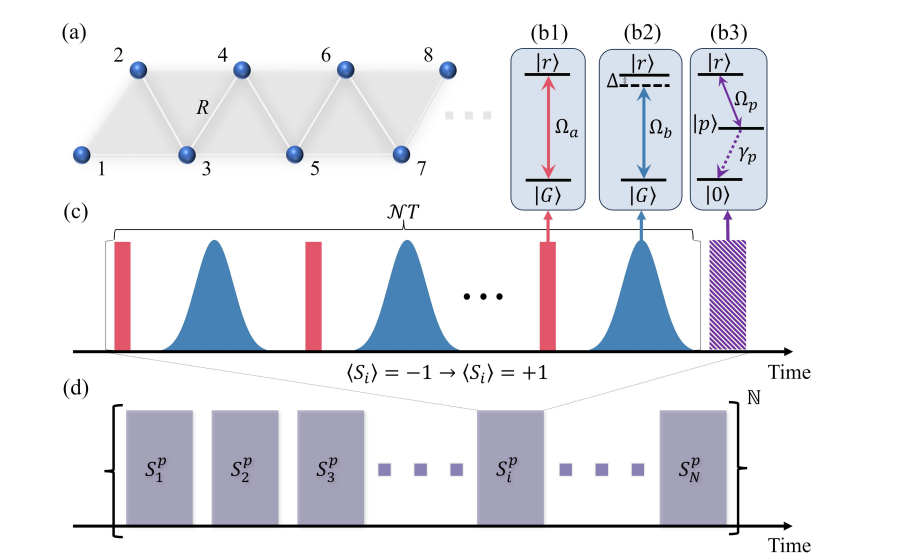
The scheme relies on two-photon excitation to reach the Rydberg state, utilizing an intermediate state |p’⟩. Engineered dissipation is achieved by using another intermediate state |p⟩, which decays exclusively to the |0⟩ ground state. Maximally circularly polarized light simplifies the system dynamics and ensures uniform atomic phases. This work demonstrates a robust and efficient way to generate and manipulate entangled states using cold atoms, with dissipation-driven entanglement as a key feature, potentially scalable to larger systems.
Dissipative Rydberg Excitation for Fast Entanglement
Scientists have developed a novel dissipative protocol for preparing nonequilibrium steady-state entanglement in neutral atom arrays. This method employs a Floquet-Lindblad framework to control atomic interactions, utilizing non-instantaneous laser kicks consisting of a short resonant pulse immediately followed by a detuned, strong pulse that couples the atomic ground state to a Rydberg state, inducing controlled dissipation. This approach is intrinsically fast and robust against common experimental challenges, specifically Doppler shifts and fluctuations in the spatial arrangement of atoms. The research engineers carefully designed dissipation channels that dramatically accelerate convergence toward the desired entangled steady states, enabling the scalable preparation of arbitrary multipartite graph states at both zero and finite temperatures.
The team implemented stabilizer pumping, a technique that actively stabilizes the quantum state, through precise control of the laser pulses, ensuring high-fidelity entanglement preparation. This method facilitates the creation of resource states essential for measurement-based quantum computation, and provides a passive error-correction mechanism during computation, suppressing local errors and decoherence. This study pioneered a method uniquely immune to Doppler shifts and spatial fluctuations, while simultaneously purifying the generated graph states, effectively hybridizing fast gate operations with passive dissipative purification for fault-tolerant protection. Scientists achieved high-fidelity preparation of entangled states, and the method is compatible with stabilizer-based quantum error correction codes, offering autonomous error correction within the neutral atom platform. The team envisions integrating this neutral atom array with cavity quantum electrodynamics settings to deterministically map atomic cluster states onto photon states, opening avenues for scalable photonic entanglement distribution and advanced photonic quantum information processing.
Stabilizer Pumping Creates Robust Quantum States
Scientists have developed a novel method for preparing specific quantum states in neutral atom arrays, utilizing a carefully orchestrated sequence of laser pulses within a Floquet-Lindblad framework. This technique focuses on establishing a stable, non-equilibrium condition within the array, enabling the creation of complex quantum configurations. The core of the method involves “stabilizer pumping,” achieved through non-instantaneous laser kicks, where each cycle consists of a resonant pulse followed by a detuned, strong pulse that excites atoms to a Rydberg state. This approach circumvents the need for precise control over laser timing and atom positioning, proving robust against common experimental imperfections.
Experiments demonstrate that engineered dissipation dramatically accelerates the convergence toward the desired steady states. Researchers observed that the system’s dynamics are governed by an effective Hamiltonian, which selectively excites atoms in the ground state when their neighbors are in a decoupled state. This precise control is verified through simulations of the Floquet Hamiltonian, revealing a quasienergy spectrum with avoided crossings that indicate hybridization between atomic ground and Rydberg states. The team confirmed that the pumping scheme effectively isolates and manipulates individual atoms within the array, suppressing unwanted evolution and preparing the system for subsequent quantum operations.
Further analysis focused on accelerating the dissipation process by manipulating the coupling between the Rydberg state and an intermediate level. By carefully controlling the Rabi frequency of the coupling laser, scientists discovered a controllable spectral gap in the system’s Liouvillian, influencing the decay rate. Simulations reveal that the decay rate is maximized when the Rabi frequency significantly exceeds the decay rate of the intermediate level, achieving exponential convergence toward the ground state with a rate proportional to the laser’s decay rate. This optimization results in a submicrosecond timescale for convergence, significantly faster than conventional methods and enabling rapid preparation of stable quantum states for computation. This breakthrough delivers a powerful tool for building and manipulating complex quantum systems with unprecedented speed and precision.
Dissipative Preparation of Entangled Atom Arrays
Scientists have developed a new method for preparing complex, entangled states in neutral atom arrays, achieving high fidelity and scalability. This research introduces a dissipative protocol, implemented through precisely timed laser pulses, that rapidly drives the system towards a desired steady state, overcoming limitations posed by atomic motion and variations in experimental conditions. The technique uniquely combines fast state preparation with a passive purification process, effectively suppressing errors and maintaining entanglement during quantum computations. This approach enables the creation of arbitrary multipartite graph states, essential resources for measurement-based quantum computation, and offers inherent resilience against noise.
🗞 Scalable Steady-State Entanglement with Floquet-Engineered Stabilizer Pumping in Neutral Atom Arrays
🧠 ArXiv: https://arxiv.org/abs/2509.18379