

The quest to create and refine highly entangled states is fundamental to advances in quantum technologies, and researchers are now demonstrating a new method for purifying these crucial resources. Saeet Ahmad from East China Normal University, alongside Shuang Li and Jonathan Raghoonanan from New York University, with colleagues including Kaixuan Zhou, Valentin Ivannikov, and Tim Byrnes from New York University Abu Dhabi, present a protocol for distilling supersinglet states, complex arrangements of multiple qubits exhibiting total spin zero. This achievement overcomes significant hurdles in entanglement purification, as the team’s method avoids complex transformations and relies only on local operations and classical communication, paving the way for practical applications in areas such as secure communication and precise clock synchronisation over long distances. The researchers successfully demonstrate how multiple imperfect initial states can be refined into a higher-fidelity supersinglet state through a carefully designed measurement process, representing a significant step towards robust and scalable quantum networks.
Entanglement Purification and Fidelity Enhancement
This research explores entanglement purification, a process that takes multiple imperfectly entangled particles and, through specific operations and communication, creates fewer particles with a much stronger, more reliable entanglement. The work investigates the theoretical foundations of this purification, employing mathematical tools to understand the limits of what is achievable and how to maximize the quality of the resulting entangled state. Scientists examined various types of entangled states, including those based on single pairs of particles and more complex systems involving multiple particles and continuous properties like the amplitude and phase of light. The research details key concepts and techniques central to entanglement purification, including protocols like the Bennett-Brassard-Popescu-Smolin-Wootters method, and techniques like superdense coding and entanglement swapping.
Singlet states, a fundamental type of entanglement, and their more complex counterparts, supersinglets, are highlighted for their importance in specific applications. A crucial constraint throughout this work is the use of local operations and classical communication, vital for practical applications, particularly long-distance quantum communication. Scientists have demonstrated experimental progress in entanglement purification using various physical systems, including atomic ensembles, superconducting qubits, and photonic systems. Experiments have also focused on distributing entangled states over long distances using fiber optic links and even satellite-based systems, paving the way for a future quantum internet. This research contributes to the field by developing new purification techniques, demonstrating experimental feasibility, and enabling the development of quantum communication, computation, and other advanced quantum technologies.
Supersinglet Distillation via Local Operations and Postselection
Scientists have developed a new method for refining supersinglet states, which are highly entangled configurations involving multiple qubits. This technique distills entanglement from three copies of an initial state by measuring them in a specific way and then selecting only those outcomes that correspond to a higher-quality supersinglet state. The team prepared the initial state using established techniques for purifying entanglement between pairs of particles, carefully aligning the process with the inherent symmetries of supersinglet states. This protocol relies solely on local operations and classical communication, making it suitable for long-distance applications like quantum clock synchronization and cryptography. By focusing on supersinglets, which exhibit complete correlation between qubits, the team achieved a breakthrough in purifying entanglement for systems where strong, reliable connections are paramount. This approach avoids the complexities of advanced mathematical transformations, broadening its potential use for tasks like quantum metrology, which demands precise measurements.
Supersinglet State Purification via Distillation Protocol
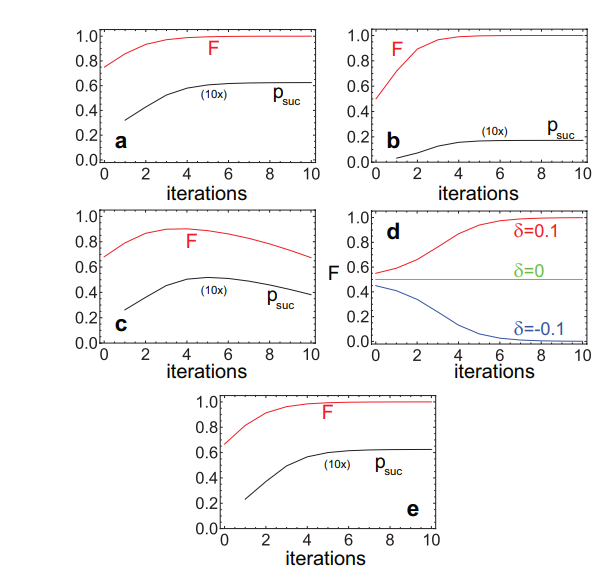
Scientists have created a new protocol to purify supersinglet states, which are fully entangled configurations involving multiple qubits. This work introduces a distillation process that begins with a specially prepared product state of entangled pairs, rather than a noisy version of the target supersinglet state itself. The protocol measures three copies of the initial state in a specific way, and then selects only those outcomes that correspond to a higher-fidelity supersinglet state. Experiments demonstrate that this method effectively projects onto the desired state, improving its quality with repeated application of the process.
Tests with both four- and six-qubit systems, prepared with supersinglet symmetries, showed promising convergence towards a high-fidelity state. Scientists found that purifying the initial state first eliminates undesired components, ensuring successful convergence. The results demonstrate that the protocol is effective for applications in quantum cryptography, precise clock synchronization, and advanced quantum metrology.
Supersinglet Purification via Symmetrized Bell States
Scientists have developed a new method for purifying supersinglet states, which are highly entangled configurations of multiple qubits. This achievement centers on a distillation process where three copies of an initial state are measured and, through postselection, a higher-fidelity supersinglet state is generated. The team demonstrated that this protocol effectively converges towards a perfect supersinglet state, achieving significant improvements in fidelity with each iteration. Notably, this method begins with a specially prepared product state of entangled pairs, rather than a noisy version of the target supersinglet state, simplifying the process and leveraging existing techniques for entanglement distribution and purification.
This approach avoids the need for complex transformations required when starting with noisy states, making the protocol more practical for implementation. The successful development of this purification method opens avenues for utilizing supersinglet states in applications such as quantum cryptography, precise clock synchronization, and advanced quantum metrology. Future research will focus on optimizing the initial state preparation and distribution, as well as exploring the scalability of the protocol to larger numbers of qubits.


