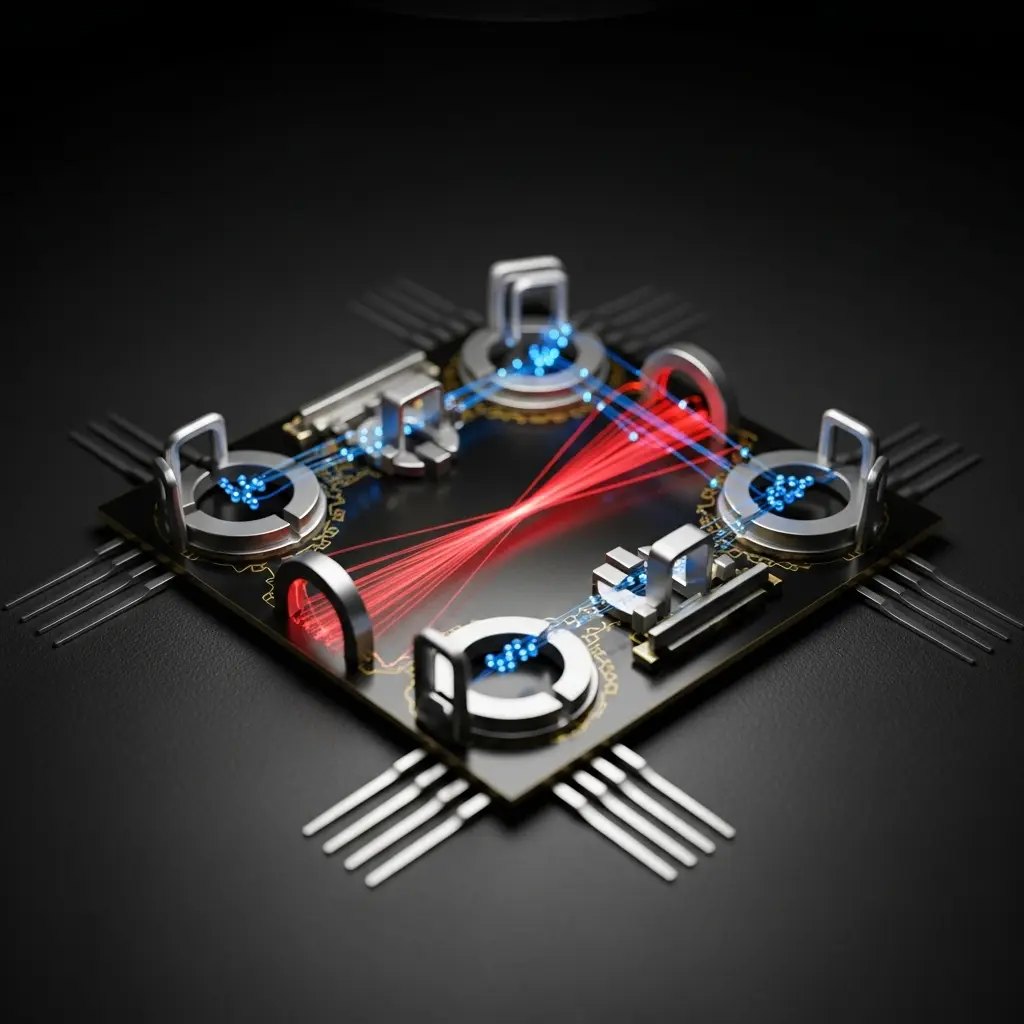
The creation of large Fock states represents a significant challenge in quantum science, with potential applications spanning secure communication and complex simulations. Mo Xiong, Jize Han, and Chuanzhen Cao, alongside colleagues from institutions including Nanjing University and China Mobile (Suzhou) Software Technology Co., Ltd., have now demonstrated a scalable protocol for generating these states with unprecedented fidelity. Their research achieves Fock states with fidelities exceeding 0.9 for photon numbers reaching approximately 100, utilising only standard control operations and an optional post-selection process. By employing a novel hybrid optimisation framework combining genetic algorithms and adaptive methods, the team designed control sequences that are both highly accurate and resilient to experimental imperfections, paving the way for advanced quantum technologies.
High-Fidelity Large Fock States Demonstrated
Scientists demonstrate a scalable and deterministic method for generating large Fock states, quantum states with a precisely defined number of excitations, achieving fidelities exceeding 0.9 for photon numbers on the order of 100. This breakthrough addresses a long-standing challenge in quantum science, with significant implications for advancements in quantum metrology, communication, and simulation. The research team developed a novel protocol that utilises only native control operations, alongside an optional post-selection step, to create these high-fidelity states. This approach circumvents the limitations of previous methods that often relied on probabilistic processes or complex, error-prone sequential operations.
The study unveils a hybrid optimisation framework, combining the strengths of genetic algorithms and the adaptive convergence of Adam, to engineer multi-pulse control sequences. These sequences comprise Jaynes-Cummings interactions and displacement operations, both readily implemented on leading experimental platforms. Crucially, the resulting control protocols achieve high fidelities while maintaining shallow circuit depths, minimising the accumulation of control errors and decoherence. Experiments show the robustness of this method against variations in system parameters, ensuring reliable performance even under imperfect conditions.
This work establishes an efficient pathway towards generating high-fidelity non-classical states, essential resources for precision measurement and fault-tolerant quantum technologies. Researchers formulated large-Fock-state preparation as a task of engineering interference through time-structured, photon-number, dependent dynamics, shifting the focus from population engineering to coherent interference engineering within Fock space. By exploiting the nonlinear spectrum of the Jaynes, Cummings interaction, the team constructed composite control sequences that deterministically reshape an initial coherent-state distribution. The resulting protocols not only achieve high success probabilities, approaching unity with optional post-selection, but also rely solely on native spin, oscillator operations.
This simplifies experimental implementation and enhances scalability. Furthermore, the shallow control depths and robustness against detuning, noise, and dissipation make this method particularly attractive for practical applications. These results represent a significant step forward in the field, opening new opportunities for quantum-enhanced sensing and the development of advanced bosonic quantum technologies.
Scalable High-Fidelity Fock State Generation
The generation of large Fock states, crucial for advancements in quantum metrology, communication, and simulation, has long presented a significant scientific challenge. This study pioneers a scalable protocol achieving fidelities exceeding 0.9 for Fock states with photon numbers reaching approximately 100. The research team engineered a method reliant solely on native control operations, with an optional post-selection step further refining fidelity. This innovative approach circumvents limitations of previous techniques by focusing on coherent interference engineering in Fock space, rather than sequential population transfer or relying on bosonic nonlinearities.
Scientists developed a hybrid Genetic-Adam optimization framework to design multi-pulse control sequences. This framework synergistically combines the global search capabilities of genetic algorithms with the adaptive convergence of Adam, enabling efficient optimization of complex pulse shapes. The resulting control protocols consist of layers, each comprising a resonant Jaynes-Cummings evolution acting on a qubit-oscillator system, immediately followed by a phase-space displacement applied to the bosonic mode. This sequence leverages the intrinsic nonlinear spectrum of the Jaynes-Cummings interaction to accumulate photon-number-dependent phases.
Experiments employed both Jaynes-Cummings interactions and displacement operations, both natively available on leading quantum platforms like cavity and circuit QED systems. The team initialized the qubit in an excited state and the oscillator in a coherent state, then repeatedly applied the optimized control sequences. This method achieves high fidelity with shallow circuit depths, minimizing the accumulation of control errors and decoherence. Crucially, the resulting protocols demonstrate strong robustness against variations in experimental parameters, ensuring reliable performance. The technique reveals a pathway towards deterministic, scalable, and high-fidelity preparation of large-N Fock states. By reframing the problem as coherent interference engineering, the study overcomes fundamental trade-offs between determinism, robustness, and scalability. This innovative methodology establishes an efficient route for generating high-fidelity non-classical states essential for precision sensing and fault-tolerant quantum technologies, paving the way for significant progress in quantum information science.
High-Fidelity Preparation of Large Photon Fock States
Scientists achieved a breakthrough in the deterministic preparation of large Fock states, demonstrating fidelities exceeding 0.9 for photon numbers on the order of 100. This scalable protocol utilizes only native control operations, with an optional post-selection step further enhancing performance. The research team employed a hybrid Genetic-Adam optimization framework, combining the global search capabilities of genetic algorithms with the adaptive convergence of Adam, to design multi-pulse control sequences. These sequences comprise Jaynes-Cummings interactions and displacement operations, both readily implemented on leading experimental platforms.
Experiments revealed that the resulting control protocols achieve high fidelities while maintaining shallow circuit depths, crucial for minimizing decoherence. Measurements confirm strong robustness against variations in experimental parameters, indicating a practical pathway for implementation in real-world quantum technologies. The work reframes the challenge of Fock state preparation as an engineering problem focused on coherent interference in Fock space, rather than sequential population transfer or reliance on bosonic nonlinearities. This innovative approach exploits the nonlinear spectrum of the Jaynes-Cummings interaction to generate photon-number-dependent phase accumulation.
Data shows the generation of Fock states with fidelities consistently above 0.9 up to excitation numbers exceeding 100, achieved with near-unity success probabilities when utilizing the optional post-selection process. The composite-pulse protocol constructs control sequences by combining Jaynes-Cummings interactions with phase-space displacement operations, deterministically reshaping initial coherent-state distributions. Tests prove the protocols’ resilience to detuning, control noise, and experimentally relevant dissipation, solidifying their potential for practical application. The breakthrough delivers an efficient and scalable method for generating high-fidelity non-classical states, opening new avenues for precision metrology and fault-tolerant quantum technologies. Scientists recorded that the resulting protocols require shallow control depths, minimizing the accumulation of control errors and decoherence that typically plague larger excitation numbers. This research establishes a pathway toward high-fidelity non-classical state generation, crucial for advancing quantum sensing and information processing capabilities.
High Fidelity Fock States via Optimised Control
This research details a new, scalable protocol for generating large photonic Fock states, quantum states with a defined number of photons, achieving high fidelity exceeding 0.9 for photon numbers up to approximately 100. The method utilizes a combination of Jaynes-Cummings interactions and displacement operations, both standard procedures in several quantum computing platforms, and optimizes control sequences through a hybrid Genetic-Adam optimization framework. This approach successfully creates these states with relatively shallow circuit depths and demonstrates robustness against variations in experimental parameters. The significance of this work lies in establishing an efficient route towards generating high-fidelity non-classical states, crucial for advancements in quantum technologies such as precision measurement and fault-tolerant quantum computation.
By employing only native control operations, the protocol is readily applicable to a range of physical systems including cavity and circuit QED, and trapped ions. The authors acknowledge a limitation in that the current demonstration does not account for all platform-specific constraints and dissipation effects, though they suggest incorporating these factors into the optimization process as a pathway to further improvements. Future research, as outlined by the team, will focus on extending this interference-engineering approach to create more complex non-classical states like Fock-state superpositions and grid-like states. Furthermore, they propose that integrating platform-specific details and addressing dissipation within the optimization loop will facilitate the development of pulse sequences ready for implementation on quantum hardware and enable scaling to even larger photon numbers. A related, independent approach utilising Kerr-induced nonlinear phase modulation for similar state generation was also noted.
🗞 Deterministic and scalable generation of large Fock states
🧠 ArXiv: https://arxiv.org/abs/2601.10559