

The pursuit of practical quantum computers faces a significant hurdle in the form of errors that accumulate during calculations, limiting the potential of current, relatively small-scale devices. Yuanzheng Paul Tan from Nanyang Technological University, Yung Szen Yap from Universiti Teknologi Malaysia, and Long Hoang Nguyen, along with Rangga P. Budoyo, Kun Hee Park, and Patrick Bore from various institutions, now present a detailed investigation into the nature of noise affecting superconducting qubits, the fundamental building blocks of many quantum processors. Their work focuses on understanding how background noise in the control signals impacts the accuracy of quantum operations, and importantly, they demonstrate a method for characterising this noise environment. This research provides crucial insight into improving the reliability of quantum computations by identifying and quantifying the sources of error that currently limit performance.
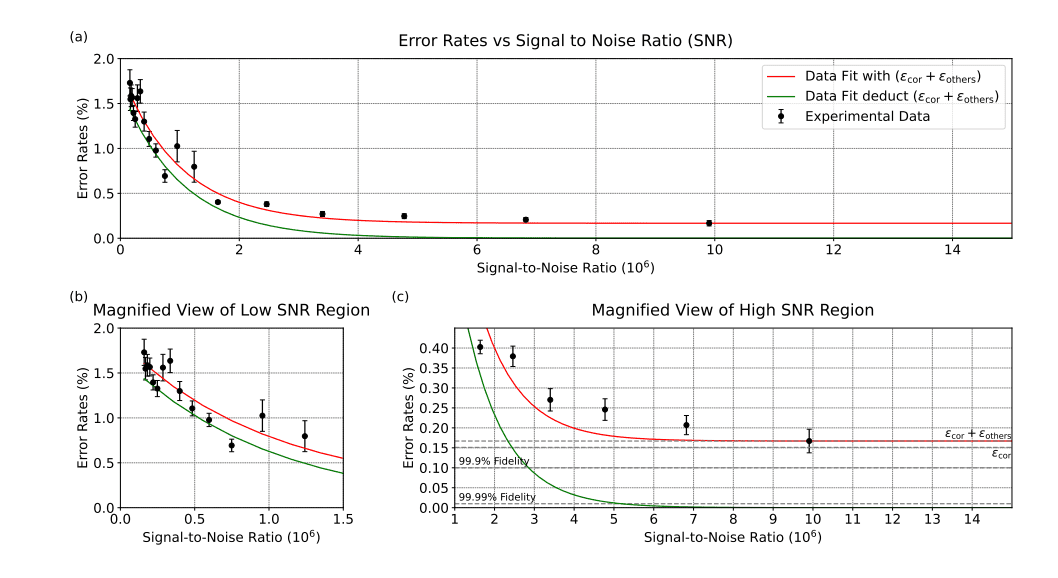
Ltd., Robinson Road, #14-04 SBF Center, Singapore 068914, Singapore. Meaningful quantum computing currently faces limitations due to the error rates of Noisy Intermediate Scale Quantum (NISQ) devices. To improve the fidelity of quantum logic gates, it is essential to identify the contributions of various error sources, including background noise. This work investigates the effects of noise applied to superconducting qubit control pulses, observing the dependency of gate fidelity with the signal-to-noise ratio (SNR).
Superconducting Qubit Control and Error Mitigation
Scientists are actively working to improve the accuracy of quantum computations by carefully examining the sources of error in superconducting qubits. This research focuses on understanding how these qubits behave and developing strategies to minimize inaccuracies. The team investigates qubit control, identifying and characterizing errors caused by noise, crosstalk, and limitations in the control hardware. They explore techniques like improved control pulses and noise filtering to enhance qubit performance and benchmark these improvements using advanced characterization methods.
Qubit Control Noise Limits Gate Fidelity
Scientists have achieved significant progress in improving the fidelity of quantum computations by meticulously characterizing noise sources within superconducting qubit systems. The research focused on understanding how control pulse noise impacts gate accuracy and identifying the contributions of various error sources. Initial simulations, accounting only for qubit decoherence, yielded a gate fidelity of 99. 849%, indicating that coherence time limitations contribute a small fraction of the overall error. Further analysis revealed that additional, non-simulated errors account for only a minimal amount of the total error, pinpointing the microwave control system as a minor contributor to overall inaccuracies.
To thoroughly investigate these error sources, the team measured qubit frequency stability over an extended period, observing drifts dominated by random fluctuations. Simultaneously, control system frequency stability was assessed, demonstrating significantly less drift than the qubit, establishing the qubit itself as the primary source of frequency-related errors. The team then directly investigated the impact of additive noise on control pulses. By introducing controlled noise and varying the signal-to-noise ratio (SNR), they demonstrated a clear relationship between SNR and error rates. Experiments revealed that decreasing the SNR directly increased error rates, as noise randomly disrupted intended operations. The research showed that achieving specific error rates requires correspondingly high SNRs, highlighting the stringent requirements for high-fidelity quantum control.
High Fidelity Gates Require Precise Control
This research investigates the impact of noise on the fidelity of quantum gates in superconducting qubits, a critical challenge for building practical quantum computers. Scientists demonstrated a clear relationship between the signal-to-noise ratio of the control pulses and the resulting gate accuracy, establishing a model to explain how control system noise interacts with the qubit itself. Through careful measurements, the team characterised the frequency stability of both the qubit and the control system, finding the control system exhibited lower drift, suggesting periodic calibration of the qubit frequency is necessary. The findings reveal that achieving high gate fidelities demands both high signal-to-noise ratios and qubits with extended coherence times, highlighting the interconnectedness of these factors.
👉 More information
🗞 Characterizing Noise in Controlling Superconducting Qubits
🧠 ArXiv: https://arxiv.org/abs/2509.18482


