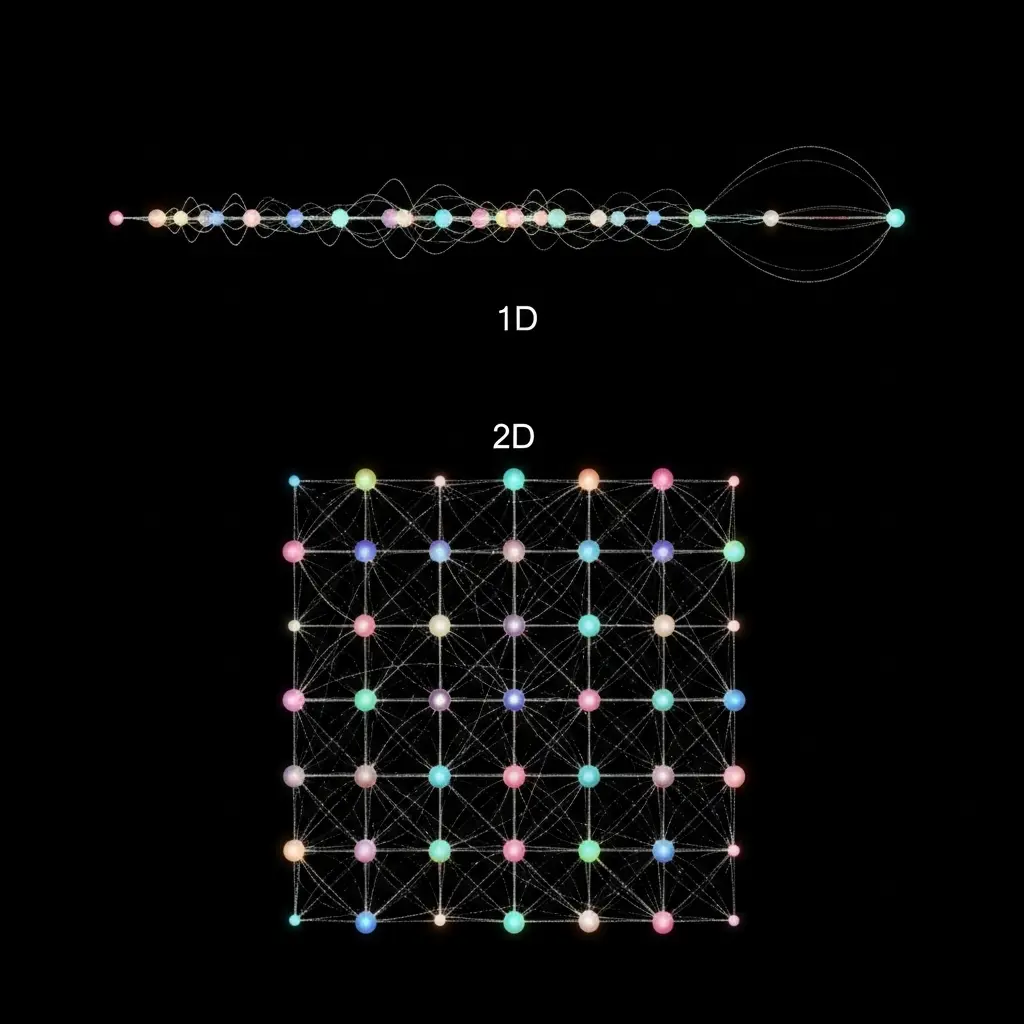
Researchers are tackling the challenge of quantum state tomography (QST), a vital process for verifying quantum devices that typically struggles with exponential increases in complexity as system size grows. Simon Tonner, Viet T. Tran, and Richard Kueng, all from the Department for Quantum Information and Computation at Kepler (QUICK), Johannes Kepler University, present a novel approach utilising hypernetworks to condition Restricted Boltzmann Machines (RBMs) on Hamiltonian control parameters. This allows a single model to represent entire families of quantum ground states, a significant improvement over existing point-wise methods requiring constant retraining. Their HyperRBM successfully reconstructs high-fidelity states from local measurements on both one and two-dimensional lattices, accurately mapping phase transitions and even identifying the critical point without prior knowledge, demonstrating a scalable and efficient route to full phase diagram tomography.
Hypernetworks and RBMs for scalable quantum tomography
Addressing Limitations of Traditional Tomography Methods
Scientists have developed a new framework for quantum state tomography (QST) that overcomes limitations in scalability and efficiency. This innovation addresses a key challenge in validating quantum devices, as traditional QST methods suffer from exponential scaling with system size and require extensive computational resources. This allows the model to learn the relationships between different quantum states across a phase diagram, rather than requiring separate training for each parameter value. Applied to the transverse-field Ising model, the HyperRBM accurately reproduces the fidelity susceptibility, a crucial indicator of phase transitions, and successfully identifies the Quantum phase transition without any prior knowledge of the critical point. Experiments demonstrate the model’s ability to reconstruct the second Rényi entropy with high accuracy, validating its performance against exact diagonalization results.
Scalable Tomographic Reconstruction Via Hypernetworks
This breakthrough establishes hypernetwork-modulated neural quantum states as a scalable route to tomographic reconstruction across full phase diagrams. The research demonstrates that the model can efficiently capture the continuous evolution of quantum states as Hamiltonian parameters are varied, enabling the extraction of critical properties like fidelity susceptibility directly from the learned representation. Unlike previous methods that focus on reconstructing individual states or estimating specific properties, this approach provides a complete tomographic description of the quantum state across the entire parameter space. The model’s performance on 4×4 lattices demonstrates its potential for scaling to larger systems, offering a significant advantage over traditional QST methods. This innovative approach enabled the creation of a single model capable of representing a family of ground states, circumventing the need for retraining at each parameter value. Experiments employed exact diagonalization to provide reference values for comparison, validating the accuracy of the HyperRBM reconstructions across both phases and through the critical region. Crucially, the model accurately reproduced the second Rényi entropy, demonstrating its ability to capture the entanglement structure of the quantum states for various subsystem sizes and transverse field strengths. Scientists calculated the fidelity susceptibility χF(g) of the 4×4 transverse-field Ising model, comparing HyperRBM estimates derived from free-energy gradient variance with exact diagonalization references. The reconstructed χF(g) accurately reproduced the expected peak in the crossover region, and importantly, identified the phase transition without any prior knowledge of the critical point. This demonstrates that hypernetwork-modulated neural states provide a scalable route to tomographic reconstruction, offering a significant advancement over existing point-wise neural QST approaches.
Conclusion and Potential Applications in Quantum Physics
🗞 Parametric Quantum State Tomography with HyperRBMs
🧠 ArXiv: https://arxiv.org/abs/2601.20950