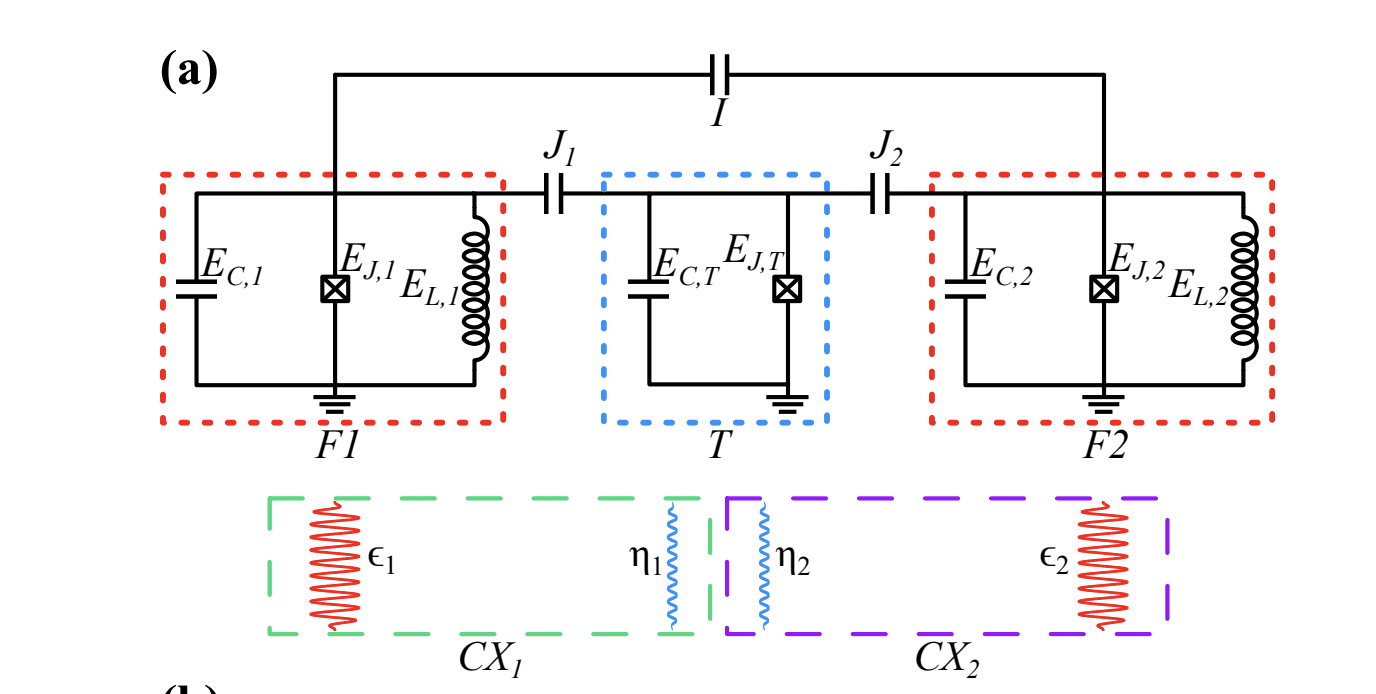
Hybrid quantum processors, combining different types of qubits, represent a promising route to scalable quantum computation, and Nikola D. Dimitrov, Chen Wang, Vladimir E. Manucharyan, and Maxim G. Vavilov investigate a novel architecture based on fluxonium and transmon qubits. Their research demonstrates how a central transmon qubit effectively mediates high-fidelity operations and parity checks between two fluxonium qubits, crucially avoiding the need for direct, long-range interactions that hinder larger systems. The team shows that cross-resonance gates between these qubit types maintain high accuracy even with additional qubits present, and sequential application of these gates enables accurate logical operations. By consolidating multiple functions, including qubit readout, into a single ancilla, this work establishes a viable dual-species architecture as a significant step towards building fault-tolerant quantum computers.
Current superconducting qubit designs struggle to simultaneously achieve strong qubit connections and long coherence times, limiting the complexity of quantum calculations. The fluxonium qubit offers extended coherence but typically lacks strong connectivity, while the transmon qubit provides strong connections but exhibits reduced coherence compared to the fluxonium. This work addresses these limitations by combining the strengths of both qubit types in a novel hybrid architecture. The proposed system uses a central transmon qubit to mediate high-fidelity gates and perform parity checks between two fluxonium qubits, enabling scalable quantum computation by connecting multiple fluxonium qubits while maintaining their long coherence times.
Fluxonium qubits offer a pathway towards quantum computation without requiring strong non-local interactions, effectively suppressing unwanted long-range interactions critical for larger quantum processors. The team analysed cross-resonance (CR) controlled-NOT (cnot) gates between a fluxonium and a transmon, demonstrating high fidelity even with a spectator qubit present, indicating robustness against common errors. They investigated how parameters like pulse shaping and frequency detuning impact gate performance, optimising control and minimising unwanted excitations, and comprehensively characterised qubit coherence and relaxation times, essential metrics for assessing the overall quality and stability of the quantum processor.
Fluxonium Qubits Demonstrate Millisecond Coherence and Fidelity
Recent advancements in superconducting qubits demonstrate significant progress towards building large-scale quantum computers. Fluxonium qubits have achieved coherence times exceeding one millisecond through careful design and fabrication, alongside high-fidelity gates, including CNOT gates exceeding 99. 9% fidelity. Researchers have also demonstrated methods for achieving arbitrary controlled-phase gates and two-photon transitions for entanglement. The pursuit of millisecond coherence is a central theme, alongside efforts to improve transmon qubit fabrication processes to achieve longer coherence times and higher fidelity.
Advancements aim to mitigate multi-excitation resonances and improve readout fidelity, with a focus on reproducible fabrication processes for high performance. Lifetimes approaching 0. 5 milliseconds have been achieved, and high-frequency readout schemes overcome limitations of traditional readout methods. A major emphasis is placed on improving materials and fabrication processes to reduce noise and increase coherence, including laser annealing of Josephson junctions and simplified fabrication processes. The work is implicitly driven by the need to reach the threshold for fault-tolerant quantum computation, with surface codes identified as a promising approach. Researchers are actively exploring new materials and techniques to further reduce noise and increase coherence.
High Fidelity Gates with Fluxonium and Transmon Qubits
This research demonstrates a scalable approach to quantum computing using a system of fluxonium and transmon qubits. The team successfully designed and analysed cross-resonance gates between these qubit types, achieving high fidelity exceeding 99. 994% for a single gate. Importantly, these gates can be combined to perform more complex operations, including parity checks and two-fluxonium CNOT gates with fidelities above 99. 98% and 99.
97% respectively. This architecture relies on a central transmon qubit to mediate interactions, avoiding the need for direct coupling between fluxonium qubits and suppressing unwanted long-range interactions, crucial for building larger processors. A key advantage of this system is its simplicity, utilising basic pulse shapes for gate operations, making it well-suited for near-term experimental implementation. The weak coupling between qubits minimises crosstalk, further enhancing scalability. While the current analysis focuses on coherent errors, the short gate times are compatible with existing qubit coherence times. Future work could address frequency shifts in the transmon qubit caused by neighbouring qubits by employing AC-Stark shift-facilitated ZZ drives to completely eliminate indirect coupling between fluxoniums, further improving the robustness and fidelity of gates in this dual-species system and paving the way for scalable quantum processors.
👉 More information
🗞 Cross-Resonant Gates in Hybrid Fluxonium-Transmon Systems
🧠 ArXiv: https://arxiv.org/abs/2509.07935