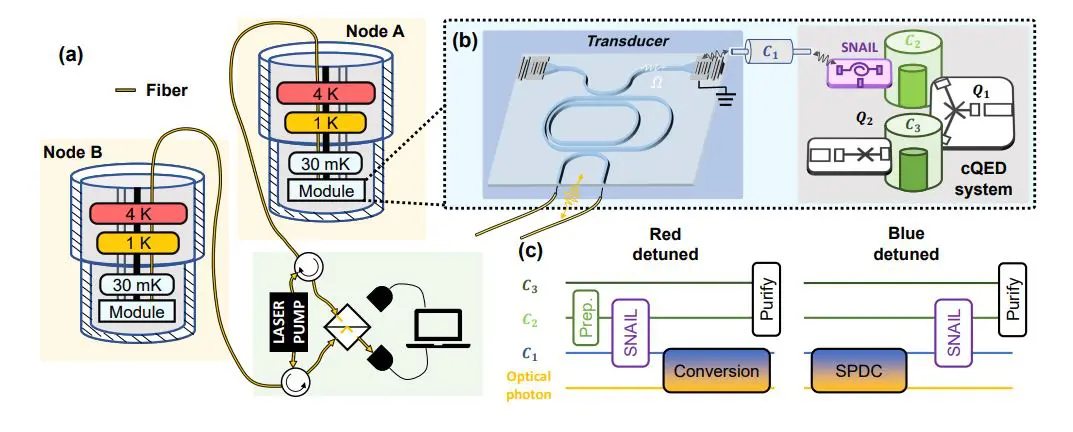
Scaling superconducting quantum processors demands efficient connections, but linking these systems presents significant hurdles due to differing frequencies and the delicate nature of quantum information. Jia-Hua Zou, Weizhou Cai, and Jia-Qi Wang, alongside colleagues including Zheng-Xu Zhu and Xin-Biao Xu, propose a new modular architecture that overcomes these challenges. Their approach utilises innovative parametric coupling to connect Brillouin microwave-to-optical transducers with long-lived three-dimensional cavities, creating a ‘plug-and-play’ compatible system for distributed quantum computing. Through detailed simulations incorporating realistic noise factors, the team demonstrates the potential to achieve raw entangled bit fidelities of 0. 8 at kilohertz-level rates over distances exceeding 30 kilometres, and further refine these to 0. 94 using a tailored entanglement strategy, paving the way for practical, scalable quantum networks.
Bosonic Codes and Quantum Error Correction
This collection of research comprehensively explores the cutting edge of quantum information science, with a strong focus on superconducting circuits and the development of quantum networks. A major theme is bosonic quantum error correction, where scientists encode quantum information in oscillating systems, offering a promising route to more robust quantum computers. Research also covers superconducting qubit design, control, and coherence, including optimizing materials and improving qubit performance. Precise control of quantum systems is also a key area, with studies focusing on techniques for implementing quantum gates and algorithms.
Extensive research focuses on extending coherence times and building quantum memories, essential for storing quantum information long enough to perform complex computations. A particularly prominent area is microwave-to-optical conversion, crucial for building quantum networks that can transmit information over long distances. Scientists are utilizing techniques like Brillouin scattering and integrated photonics to achieve this conversion efficiently. Research also addresses the challenges of long-distance quantum communication, with studies on entanglement purification and the development of quantum repeaters.
The integration of quantum devices onto chips is also a key focus, aiming for scalability and practicality. Alongside these core areas, scientists are exploring the use of quantum systems for enhanced sensing and measurement. Theoretical foundations are also being advanced, with research on quantifying entanglement, a key resource in quantum information, and developing secure quantum communication protocols. Understanding and controlling open quantum systems, which are susceptible to noise and decoherence, is also a critical area of investigation. This body of work demonstrates a strong emphasis on building practical quantum devices and systems, drawing on expertise from multiple disciplines and rapidly evolving with new discoveries.
Modular Quantum Processor Network with Brillouin Scattering
Scientists have engineered a modular architecture for scaling superconducting quantum processors, overcoming limitations imposed by single dilution refrigerators. This system utilizes stimulated Brillouin scattering within microwave-to-optical transducers to connect long-lived three-dimensional microwave cavities, maintaining compatibility between modules. Each node of the network incorporates a bosonic module housed within a cryogenic environment, comprising a microwave-to-optical transducer and a circuit quantum electrodynamics processor. The processor features two three-dimensional microwave cavities, functioning as quantum registers, coupled to ancillary qubits that enable universal quantum gate operations with high fidelity.
Researchers employed a thin-film lithium niobate on sapphire platform for the microwave-to-optical transducer, supporting high-quality acoustic and optical cavities. This design minimizes unwanted heating and isolates stray light, enhancing thermal dissipation and protecting sensitive components. A key innovation is the use of a nonlinear inductive element, which parametrically couples the transducer to the resonator cavity, allowing flexible frequency matching and efficient conversion between acoustic and microwave excitations. Comprehensive numerical simulations demonstrate the potential to achieve remote entanglement with high fidelities at kilohertz rates, paving the way for scalable quantum computing.
Long-Distance Entanglement via Bosonic Modules
Scientists have developed a new architecture for interconnecting superconducting quantum processors over optical networks, addressing key challenges in scaling quantum computing. This work centers on a “bosonic module” that efficiently converts between microwave and optical frequencies, enabling entanglement distribution over significant distances. The team achieved raw entangled bit fidelities of approximately 0. 8 at rates around 1kHz over a distance of 30 kilometers, utilizing a standard quantum protocol. Research demonstrates that cavity-based approaches outperform transmon-based systems for distances exceeding 500 meters, due to the long coherence times of the cavities.
Experiments reveal that energy relaxation fundamentally limits raw entangled bit generation. To overcome this, scientists implemented an asymmetric pumping protocol, tailored to address amplitude damping errors. This technique boosts purified fidelities to approximately 0. 94 at rates of 0. 2kHz, significantly enhancing the quality of entanglement.
Detailed analysis shows that repeating the entanglement pumping process can achieve high fidelity, with rates exceeding 10kHz for initial raw entangled bits and reaching approximately 200Hz after one pump round. Further investigation demonstrates that the conversion and generation modes exhibit similar performance with a ten-fold reduction in pump power. These results suggest that many distributed quantum protocols are now accessible by combining advanced superconducting circuits with imperfect microwave-to-optical transducer components, paving the way for scalable distributed quantum information processing.
Entanglement Purification for Scalable Quantum Networks
Scientists have developed a modular system utilizing Brillouin microwave-to-optical transducers, specialized couplers, and long-lived cavities to generate high-quality entangled bits, essential for distributed quantum computing. Through detailed numerical simulations incorporating realistic experimental imperfections, the team predicts the creation of entangled bits with fidelities reaching 0. 94 at rates of 0. 2kHz, or raw entangled bits at kilohertz-level rates over distances of 30 kilometers. The achieved performance stems from an innovative approach to entanglement purification, employing asymmetric pumping tailored to mitigate amplitude damping errors.
Importantly, this bosonic module architecture is compatible with existing bosonic quantum error correction and fault-tolerant control techniques, paving the way for further improvements in fidelity and rate. While the simulations reveal a slight degradation in performance with a second round of pumping, the results confirm the feasibility of building practical, scalable distributed quantum systems by combining advanced superconducting circuits with current microwave-to-optical transducer technology. This work establishes a clear pathway toward realizing complex distributed quantum protocols and advancing the field of quantum information processing.
🗞 Hardware-Efficient Bosonic Module for Entangling Superconducting Quantum Processors via Optical Networks
🧠 ArXiv: https://arxiv.org/abs/2511.10407