Controlling the spin of electrons within nanoscale semiconductor dots holds immense promise for building powerful quantum computers, but simultaneously achieving both fast operation and long-lasting coherence remains a significant challenge. Yuta Matsumoto, Xiao-Fei Liu, and Arne Ludwig, along with colleagues from The University of Osaka, Ruhr-Universität Bochum, and e-trees. Japan, Inc., now present a method for precisely tuning the interactions between electrons in a triple quantum dot to overcome this hurdle. The team demonstrates exceptionally high-fidelity control of electron spin by carefully adjusting the energy levels between the dots, achieving a remarkably accurate quantum gate with minimal errors, even in a material where maintaining coherence is typically difficult. This breakthrough offers a scalable path towards building robust and reliable quantum computers using semiconductor technology, relying on device-specific optimisation rather than external factors that can limit performance.
Silicon and Germanium Spin Qubit Research
Researchers are actively investigating silicon and germanium as promising materials for building quantum computers using spin qubits. This research focuses on harnessing the spin of electrons or holes confined within quantum dots, tiny semiconductor structures, to represent and manipulate quantum information. A central challenge lies in extending the coherence of these qubits and achieving precise control over their behaviour. Scientists employ techniques like dynamic decoupling and machine learning-assisted feedback control to suppress noise and enhance qubit stability, paving the way for more complex quantum algorithms. This research highlights the potential of silicon and germanium as viable platforms for building practical and scalable quantum computers, leveraging compatibility with existing semiconductor manufacturing techniques.
Triple Quantum Dot Enables Fast, Coherent Spin Control
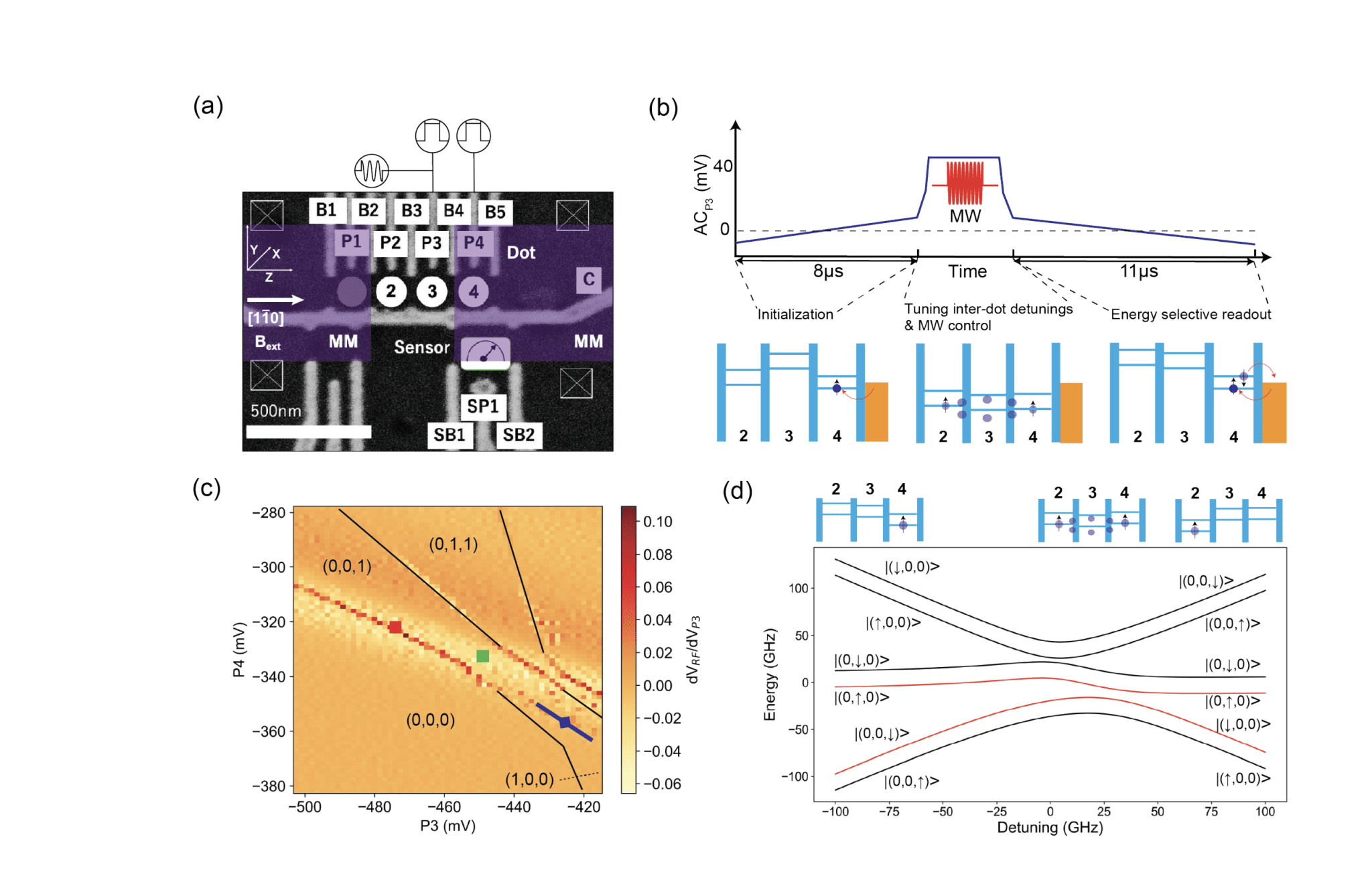
Researchers have engineered a novel approach to high-fidelity spin control by extending a technique known as the flopping-mode architecture to utilize a triple quantum dot system fabricated on gallium arsenide. This system overcomes limitations inherent in simpler designs, strategically positioning cobalt micro-magnets to induce a strong magnetic field gradient, enabling rapid manipulation of electron spin while minimizing factors that shorten coherence. This precise arrangement allows for independent optimization of qubit parameters, leading to improved control. Scientists developed a measurement scheme involving precise control of energy levels between the quantum dots using an arbitrary waveform generator, coupled with microwave pulses to perform electron dipole spin resonance.
The spin state is initialized and measured using a ramped readout technique, allowing for precise tracking of qubit behaviour. Crucially, the third dot introduces an additional tunable parameter, its energy level, allowing researchers to precisely engineer the interaction between electrons, optimizing both the speed of spin manipulation and the duration of coherence simultaneously. This combination achieved a π/2 gate fidelity of 99. 7% with a gate time of 4 nanoseconds, demonstrating high-fidelity spin control even in a gallium arsenide device where electron spin coherence is typically limited.
Fast, Coherent Spin Control in Triple Quantum Dots
Researchers have achieved a significant breakthrough in controlling electron spin in quantum dots, paving the way for more stable and reliable quantum computing. The team demonstrated high-fidelity spin control by carefully tuning the interaction between electrons in a specifically designed triple quantum dot system, where a third dot provides precise control over energy levels. This approach overcomes a key challenge in the field, simultaneously optimizing both the speed of spin manipulation and the duration of spin coherence. The team fabricated a gallium arsenide triple quantum dot and optimized the tunnel coupling between the dots to achieve Rabi frequencies exceeding 100 MHz while maintaining spin coherence.
This was accomplished by maximizing the hybridization between spin and charge states, creating a “sweet spot” where both the speed and longevity of spin control are maximized. Crucially, the researchers demonstrated a π/2 gate fidelity of 99. 7% with a gate time of only 4 nanoseconds, a remarkable achievement given the typical limitations of electron spin coherence in gallium arsenide devices. To further enhance performance, the team implemented a machine learning-based feedback control system that efficiently estimates the qubit frequency using past measurement data, allowing for the characterization and mitigation of low-frequency noise that can degrade coherence.
High-Fidelity Spin Control Via Machine Learning
This research demonstrates a pathway to high-fidelity control of electron spins in a gallium arsenide triple quantum dot device. The team successfully achieved Rabi frequencies exceeding 100 MHz while maintaining coherence, a significant step towards practical quantum computation. This was accomplished by precisely tuning the energy levels between the quantum dots and leveraging the third dot to exert control, rather than relying on material properties or external field gradients. Furthermore, the researchers implemented a machine learning-based feedback control system to characterize and mitigate low-frequency noise, improving qubit coherence with minimal measurement overhead.
This approach revealed a transition from charge noise to nuclear spin noise dominance at lower frequencies, providing valuable insight into device behaviour. Through randomized benchmarking, they demonstrated a π/2 gate fidelity of 99. 72% with a gate time of 4. 05 nanoseconds, validating their comprehensive strategy for qubit control optimisation.
👉 More information
🗞 High fidelity flopping-mode single spin operation with tuning inter-dot orbital levels
🧠 ArXiv: https://arxiv.org/abs/2508.21723