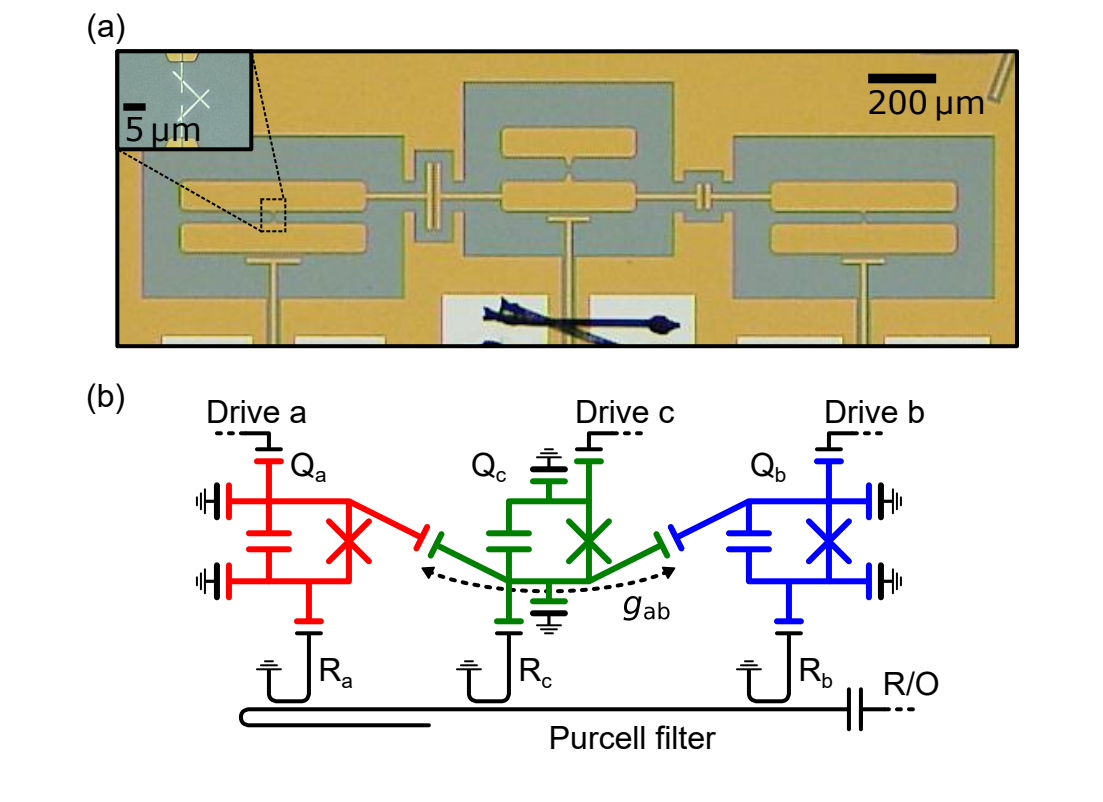
Achieving high-fidelity entanglement between qubits represents a critical challenge in the development of practical quantum computers, and researchers are increasingly focused on all-microwave control systems to simplify processor design. Shotaro Shirai, Shinichi Inoue, and Shuhei Tamate, alongside colleagues including Rui Li and Yasunobu Nakamura, demonstrate a significant advance in this area with a new all-microwave controlled-Z (CZ) gate. The team, affiliated with RIKEN and the University of Tokyo, achieves high fidelity by employing a fixed-frequency transmon coupler and a multi-path coupling approach that effectively suppresses unwanted interactions between qubits. Importantly, this method not only accelerates gate operation but also incorporates a novel error detection scheme; by measuring the coupler state after the gate, the researchers can identify specific decoherence events, paving the way for more robust quantum error correction and improved logical qubit performance.
Superconducting Qubit Control and Fabrication Advances
A comprehensive body of research focuses on advancing superconducting qubits and quantum computing, with investigations covering qubit design, materials, and fabrication techniques. Researchers refine methods like Josephson junction fabrication and laser annealing to create more reliable qubits, while also developing sophisticated circuit modeling and simulation tools to better understand and optimize superconducting circuits. Significant effort addresses controlling and manipulating qubits, including developing high-fidelity single- and two-qubit gates through precise pulse shaping and optimization, and improving qubit readout fidelity and speed with techniques like Purcell filtering and multiplexed readout. Understanding and mitigating noise sources, including charge noise, flux noise, and dielectric loss, remains central to improving qubit performance, alongside addressing the challenges of scaling up superconducting quantum systems, focusing on frequency allocation, crosstalk, and overall system optimization.
High-Fidelity CZ Gate with Three Transmons
Scientists engineered a system of three superconducting qubits to implement a high-fidelity controlled-Z (CZ) gate, modeling the interactions using a coupled Duffing oscillator and focusing on the most important energy levels of each qubit. They carefully considered the fundamental frequencies and energy differences of each qubit to optimize performance, establishing an operating regime where interactions are relatively weak for accurate calculations. To induce controlled interaction between qubits, scientists applied a microwave signal to a coupler qubit, carefully tuning its frequency and strength to match energy differences between specific qubit states. Calculations reveal the speed of this interaction depends on coupling strength, the coupler’s energy characteristics, and the applied microwave signal, leveraging a state-dependent frequency shift crucial for implementing the CZ gate by inducing state-dependent geometric phases.
High Fidelity All-Microwave Controlled-Z Gate Demonstrated
Scientists have demonstrated a novel all-microwave controlled-Z (CZ) gate for superconducting qubits, achieving high fidelity while actively suppressing unwanted interactions using a fixed-frequency transmon coupler and multi-path coupling. The team designed a system where the controlled phase of the CZ gate arises from a dispersive frequency shift, carefully manipulating the interaction between the coupler and data qubits based on the state of the other data qubit. By maintaining a small interaction between data qubits while increasing coupling with the coupler, they accelerated the gate speed and achieved precise control over qubit interactions, optimizing both speed and accuracy. They also measured the coupler state after the gate operation, identifying a subset of errors that can be pinpointed and addressed, representing errors with known locations for implementing erasure-aware codes.
High Fidelity CZ Gate with Error Detection
Researchers have successfully demonstrated a high-fidelity, all-microwave controlled-Z (CZ) gate for superconducting quantum processors, utilizing a fixed-frequency transmon coupler and a novel multi-path coupling approach to significantly suppress unwanted interactions while maintaining a fast gate operation time of 140 nanoseconds. Achieving a CZ-gate fidelity of 99. 7%, approaching the theoretical limit imposed by qubit coherence, this work introduces a partial erasure-error detection (PED) protocol, where the coupler’s state is measured after each gate operation to identify a subset of errors as ‘erasures’. Experimentally, they detected erasures in 48% of gate failures, closely matching theoretical predictions, offering a direct pathway to implementing erasure-aware quantum error correction and potentially leading to substantial reductions in logical error rates.
🗞 High-fidelity all-microwave CZ gate with partial erasure-error detection via a transmon coupler
🧠 ArXiv: https://arxiv.org/abs/2511.01260