Achieving high fidelity in quantum computations demands precise control over individual quantum bits, but traditional methods rely on painstaking calibration of every gate. Ashish Kakkar, Samuel Marsh, Yulun Wang, and colleagues at Q-CTRL present a new approach that bypasses this need, instead focusing on rapid characterisation of gate imperfections and correcting them within the circuit design itself. The team demonstrates that by treating inherent gate errors as predictable components, they can significantly improve the performance of complex quantum algorithms, achieving up to seven times higher success rates for Fourier Transform circuits and nine times lower error in simulations of complex physical systems. This hardware-agnostic methodology promises to accelerate the development of scalable quantum computers by minimising the time-consuming process of fine-tuning individual control waveforms and unlocking the potential of more expressive gate sets.
Fast Characterization Enables High-Fidelity Quantum Compilation
This research introduces a new method for designing and implementing quantum circuits that bypasses the need for extensive, individual calibration of each quantum gate. Scientists have demonstrated a technique for rapidly characterizing a small number of gate parameters and then leveraging these characteristics during circuit compilation, effectively ‘wrapping’ control pulses to mitigate errors. This approach enables the swift generation of high-fidelity entangling gates across an entire device, expanding the available gate set without extensive fine-tuning, and achieves performance comparable to, and in some cases exceeding, that of circuits built with finely calibrated gates. This represents a substantial advance towards practical, scalable quantum computation by decoupling algorithm design from the intricacies of individual hardware calibration.
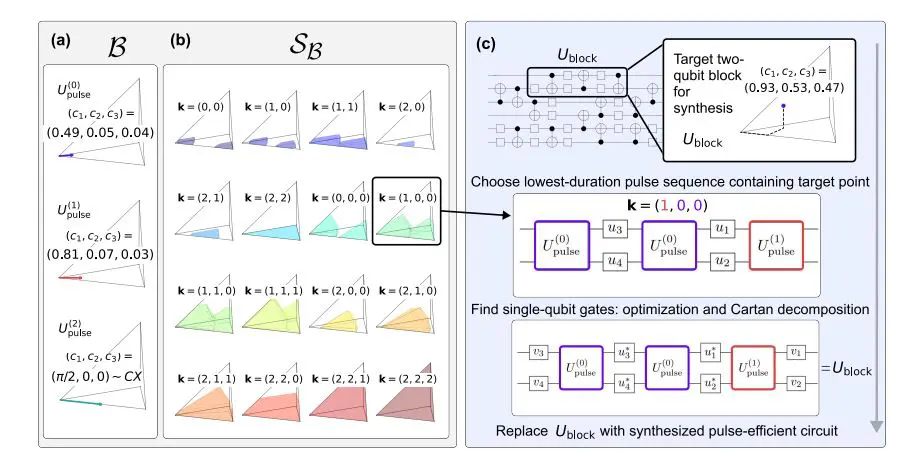
The method tracks and corrects gate parameters during circuit compilation, treating inherent imperfections as part of the gate definition and compensating for them in software via single-qubit rotations. This enables rapid, device-wide generation of high-fidelity two-qubit entangling gates, which are combined with standard calibrated gates to create an expanded gate set. The team demonstrates that these gates are directly usable within a quantum compiler, synthesizing complex two-qubit circuits into minimal-duration sequences of the characterised gates interleaved with compensating single-qubit rotations.
Two-Qubit Gate Synthesis With Pre-Characterized Pulses
This research details the mathematical foundations for synthesizing two-qubit gates using a limited set of pre-characterized pulses, providing the rigorous justifications behind the techniques described in the main research. The core idea is to express any two-qubit gate as a combination of a limited set of pre-characterized pulses, reducing the complexity of calibration and control. The research utilizes a set of parameters, known as Makhlin invariants, to uniquely characterize a two-qubit gate and optimize its representation.
These invariants are calculated from the unitary matrix representing the gate, involving a change of basis and calculating traces of matrices. The Makhlin invariants are advantageous because they are polynomial functions of the gate’s matrix elements, simplifying optimization using gradient-based methods. The research focuses on using single-axis two-qubit gates as building blocks for synthesis, simplifying the control and calibration process. A key strategy involves decomposing a general two-qubit gate into a sequence of single-axis gates and single-qubit Z rotations, requiring the calculation of parameters to achieve the desired decomposition.
The research derives conditions that must be satisfied for a given target gate to be synthesizable using the available set of pre-characterized pulses, expressed as inequalities involving the parameters of the target gate and the available pulses. A rigorous mathematical proof validates these conditions, ensuring the accuracy and reliability of the synthesis method. The document confirms that controlled pulses are indeed single-axis pulses, further solidifying their suitability as building blocks for the synthesis method.
Rapid Gate Calibration and Circuit Compilation
This research presents a new method for designing and implementing extended two-qubit gate sets on quantum computers, moving away from lengthy, iterative calibration processes. Scientists developed a technique that rapidly characterizes a small number of gate parameters and then tracks and corrects them during circuit compilation, effectively incorporating coherent contributions to the pulse as part of the gate definition. This approach enables the swift generation of high-fidelity entangling gates across an entire device, expanding the available gate set without extensive fine-tuning.
The team demonstrated the practical benefits of this method by integrating the new gates into a compiler and benchmarking its performance against standard gates on 127-qubit hardware. Results show significant improvements in algorithmic success probability, with up to a seven-fold increase for Fourier Transform circuits containing up to 26 qubits, and up to a nine-fold reduction in mean-square error for simulations of the transverse-field Ising model. This hardware-agnostic methodology offers a scalable solution for enhancing expressive gate sets on various quantum computing architectures.
The authors acknowledge that the current performance is limited by describing gate errors as unitary, meaning that incoherent energy relaxation processes are not addressed. The method also assumes the availability of a specific perfect entangler within the original gate set to ensure full control over the quantum state. Future work may focus on extending the technique to address incoherent errors and exploring its application to a wider range of quantum algorithms and hardware platforms.
🗞 No need to calibrate: characterization and compilation for high-fidelity circuit execution using imperfect gates
🧠 ArXiv: https://arxiv.org/abs/2511.21831