Achieving reliable and scalable quantum computation demands efficient methods for controlling the interactions between qubits, and researchers continually seek ways to improve these interactions. Aditya Milind Kolhatkar and Karan K. Mehta, both from Cornell University, investigate novel optical configurations for creating these crucial qubit interactions in trapped-ion systems. Their work demonstrates that carefully positioning ions within specific light patterns, known as standing waves, dramatically reduces the laser power needed to perform quantum gates, potentially by a factor of ten or more. This advance addresses a significant challenge in building larger quantum computers, as lower power requirements simplify system design and reduce potential errors, paving the way for faster and more stable quantum operations.
Optimizing Optics for Scalable Trapped-Ion Control
Achieving high-fidelity and parallel operation of two-qubit entangling gates remains a significant challenge in building practical, fault-tolerant quantum computers. Integrated optical addressing of trapped-ion qubits offers a promising route to scalability, but requires careful optimisation of optical configurations to ensure both high gate accuracy and efficient control of multiple qubits. This research investigates novel optical configurations designed to overcome these limitations and enable high-performance, scalable entangling gates for trapped-ion quantum computers, focusing on techniques for shaping, steering, and focusing laser beams to achieve precise and individual control over multiple qubits.
Trapped Ions Demonstrate Reduced Laser Scattering Errors
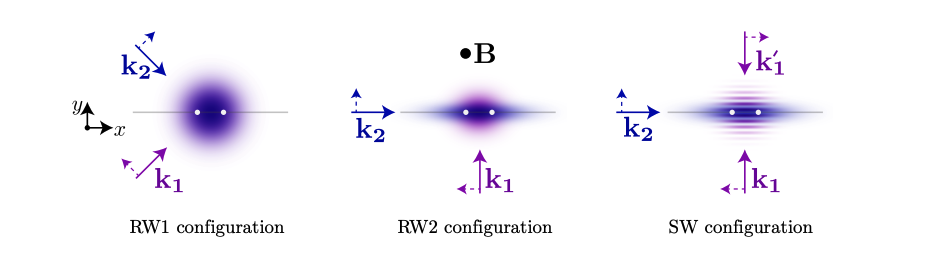
This research focuses on reducing errors in quantum gates implemented using trapped ions by minimising errors caused by light scattering. Trapped ions, individual charged atoms held in place by electromagnetic fields, represent a leading platform for building quantum computers. Lasers are used to cool the ions and drive transitions between qubit energy levels, implementing quantum gates, but laser light interaction can cause scattering errors. The research compares two laser configurations to reduce scattering, considering Rayleigh and Raman scattering, and how coherent displacements are used to implement quantum gates. A detailed mathematical model calculates error rates, predicting the new configuration reduces scattering and improves gate fidelity compared to the standard approach, even with pessimistic estimates of Rayleigh scattering. The research also shows how the required laser power to achieve a target gate error scales with the laser configuration.
Standing Waves Reduce Quantum Gate Power
This research demonstrates a substantial reduction in the optical power required for high-fidelity two-qubit gates in trapped-ion quantum computers. By employing standing-wave light configurations alongside conventional running-wave approaches, the team shows that power requirements can be lowered by approximately one order of magnitude for gates achieving errors between 10 -3 and 10 -2 , with even greater enhancements at higher fidelities. These improvements are predicted across various ion species commonly used in quantum computing, including barium and calcium, and apply to both light-shift and Mølmer-Sørensen gate types. The key to this advancement lies in utilizing standing-wave light fields, which suppress unwanted spontaneous scattering and coherent couplings that typically limit gate speed and fidelity, eliminating the “carrier” term in the interaction Hamiltonian and allowing for faster gate operation and simplified pulse shaping. For example, calculations indicate that a Mølmer-Sørensen gate operating with barium-137, aiming for an error rate of 10 -4 , would require approximately 3 milliwatts of optical power using the standing-wave scheme, compared to 50-70 milliwatts with conventional running-wave methods.
🗞 Efficient optical configurations for trapped-ion entangling gates
🧠 ArXiv: https://arxiv.org/abs/2509.05271