Quantum simulation promises to revolutionise fields from materials science to drug discovery, but accurately modelling complex systems remains a significant challenge, particularly with limited quantum resources. Seung Park, Dongkeun Lee, and Jeongho Bang, along with their colleagues, address this issue by developing a new approach to quantum simulation that focuses on optimising performance within a defined computational space. Their work introduces a method that compresses complex calculations into more manageable circuits and simultaneously trains these circuits across multiple initial states, using fidelity as a key measure of success. Importantly, the team provides a way to guarantee performance even in the most challenging scenarios, and demonstrates the effectiveness of their method through simulations of both small and larger quantum systems, paving the way for more efficient and reliable quantum simulations.
Variational Algorithms and Barren Plateaus Avoidance
This collection comprehensively surveys the field of variational quantum algorithms (VQAs), quantum machine learning, and related optimization techniques. It highlights ongoing research into overcoming significant challenges, particularly the problem of barren plateaus, situations where optimization becomes impossible due to vanishing gradients. The collection demonstrates a strong focus on theoretical foundations, practical implementation, and the development of new tools for advancing the field. Researchers are actively exploring methods to improve the trainability of VQAs, including novel optimization strategies, improved quantum circuit designs, and efficient data encoding techniques. Symmetry exploitation and landscape analysis are also prominent areas of investigation, aiming to better understand and navigate the complex optimization landscapes encountered in VQA training.
Compressed Trotter Circuits for Efficient Quantum Simulation
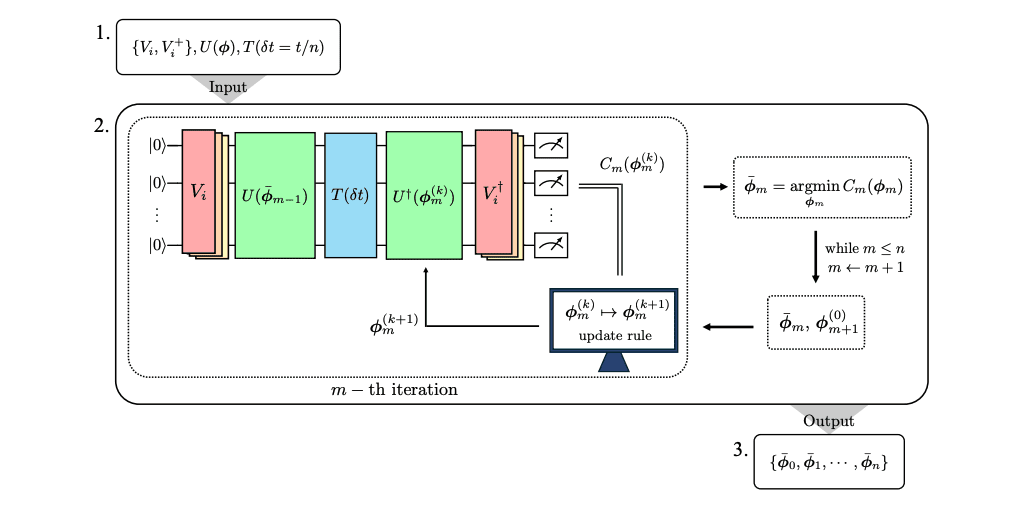
Scientists have developed a new approach to quantum simulation that efficiently models the time evolution of multiple quantum states within a defined space. The method compresses the computationally intensive Trotter circuit, a standard technique for simulating quantum systems, into a shorter, parameterized quantum circuit. This compression allows for simultaneous optimization across multiple initial states, reducing the demands on quantum hardware. The team iteratively trains the parameterized circuit to accurately reproduce the Trotter evolution at each time step. By optimizing the circuit for a set of basis states and their combinations, the trained circuit accurately reproduces the time evolution of any state within that space. Experiments using a 2-qubit Ising model on an IBMQ processor and simulations of a larger 10-qubit system demonstrate the practical implementation and scalability of this promising new pathway for efficient and reliable quantum simulation.
Efficient Quantum Simulation with Parameterized Circuits
Scientists have developed a new method for simulating the evolution of quantum systems using parameterized quantum circuits, offering a way to overcome limitations imposed by current quantum hardware. The method compresses complex quantum simulations into shorter, more manageable circuits that can be optimized using a novel training procedure. This optimization process simultaneously refines the circuit parameters for multiple initial states, significantly improving efficiency and performance. The core of the method involves iteratively refining a parameterized quantum circuit to accurately reproduce the behavior of a target quantum system evolving over time.
A key innovation lies in the cost function used during training, which maximizes the fidelity of the simulated states while carefully regulating the relative phases between them, crucial for accurate simulation. Researchers validated the method through simulations of a 2-qubit Ising model on an IBMQ processor and extended it to a larger 10-qubit system. This advancement paves the way for more complex and accurate modeling of quantum phenomena with near-term quantum devices.
Efficient Quantum State Evolution with Fidelity Guarantees
This research presents a new method for simulating the time evolution of quantum states within a defined space using parameterized quantum circuits. The method compresses the computationally expensive Trotter circuit, commonly used for this purpose, into a shorter, more efficient circuit that is trained to accurately reproduce the dynamics of multiple initial states simultaneously. A key achievement is the development of a computable lower bound on the fidelity of these approximated states, providing a performance guarantee even in challenging training scenarios. The team demonstrated the effectiveness of this method through simulations of both 2-qubit and 10-qubit Ising models, and experimentally validated it on the IBMQ Yonsei processor, achieving high fidelities for states within the chosen space. Importantly, the algorithm avoids the barren plateau problem that often hinders the training of quantum circuits, maintaining trainability for larger systems. The authors acknowledge that noise on the quantum processing unit does impact performance, particularly with larger qubit numbers, but the trained circuits still capture the essential trends in the simulated dynamics.
👉 More information
🗞 Subspace Variational Quantum Simulation: Fidelity Lower Bounds as Measures of Training Success
🧠 ArXiv: https://arxiv.org/abs/2509.06360