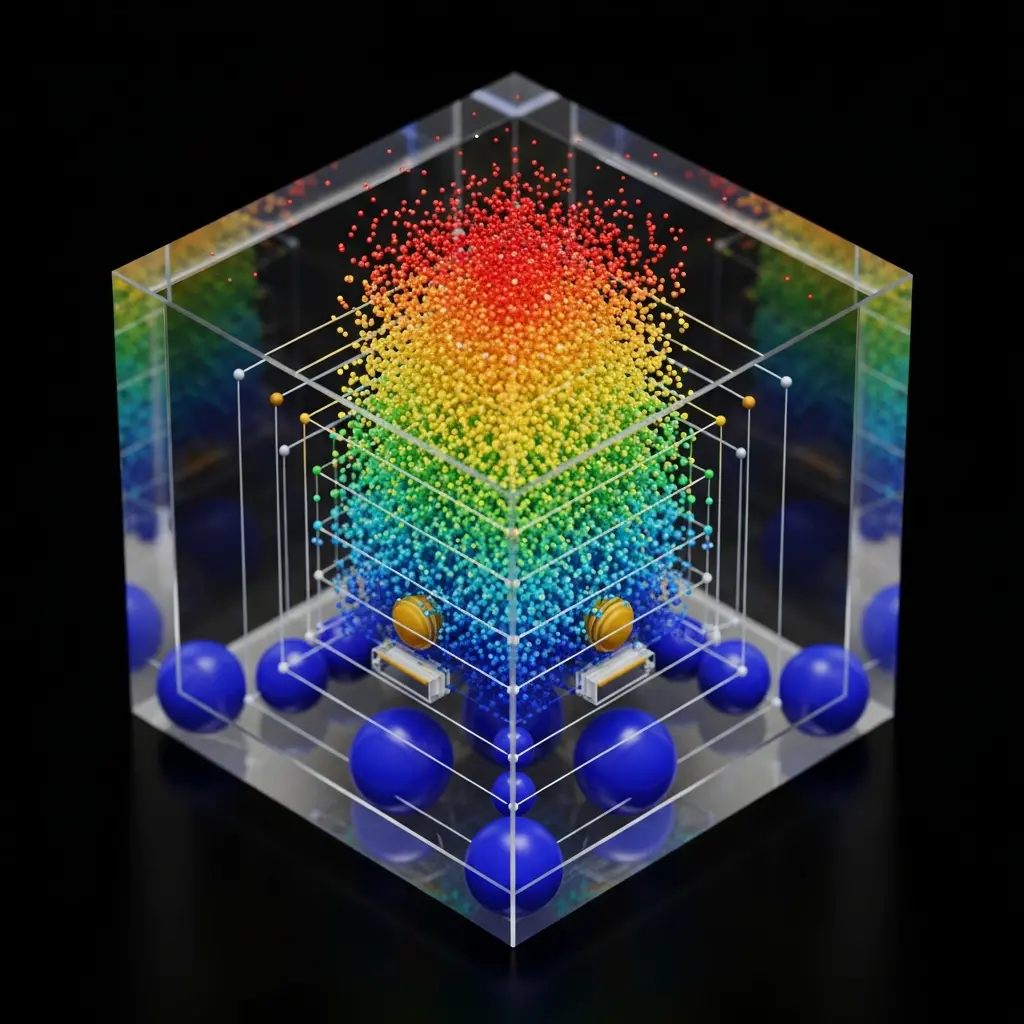
Understanding air quality and climate change requires accurate measurement of Aerosol Optical Depth, a key indicator of airborne particles, but current satellite data often lacks the necessary detail for effective policy making. Fernando Rodriguez Avellaneda and Paula Moraga, from King Abdullah University of Science and Technology, alongside their colleagues, address this challenge with a new modelling approach that generates high-resolution estimates of Aerosol Optical Depth in both space and time. Their work introduces a method which links coarse satellite observations to a continuous, underlying process, effectively ‘disaggregating’ the data to reveal finer details. This innovative technique, based on advanced statistical modelling and computational methods, improves spatial resolution from 0. 75° to 0. 25° and temporal resolution from three to one hour, offering a significantly enhanced tool for monitoring air quality and nowcasting conditions across India.
Fine-Scale Processes From Coarse Data
This research focuses on spatial-temporal disaggregation, a technique for estimating high-resolution processes from coarse, aggregated data. This is crucial in fields like environmental monitoring, remote sensing, and epidemiology, where data is often averaged, obscuring finer details. Scientists aim to reconstruct a continuous, underlying process from these limited observations. The study explores two approaches to modelling change across space and time: separable models, assuming independent spatial and temporal processes, and non-separable models, allowing for interaction between them. Researchers investigate spatial and temporal autocorrelation, measuring how strongly values correlate with their neighbors, with strong autocorrelation indicating similar values nearby. The study pioneers a method for linking coarse satellite observations to a continuous, underlying process, enabling predictions at significantly finer scales. Researchers assume a latent Gaussian process governs Aerosol Depth distribution in both space and time, observed through aggregated measurements, and implemented a framework to translate these coarse observations into detailed representations. The team engineered a model based on a diffusion-based stochastic partial differential equation, allowing for flexible covariance structures that capture realistic spatial and temporal dependencies.
This approach enables the creation of a Gaussian process with either separable or non-separable covariance, accommodating complex relationships in Aerosol Depth variability. To achieve computational efficiency, scientists harnessed the INLA-SPDE framework, a powerful tool for Bayesian inference with Gaussian random fields. Experiments employed the INLA and INLAspacetime packages to perform Bayesian inference, directly linking aggregated observations to the underlying continuous latent process. The study achieved a substantial improvement in spatial resolution, refining estimates from 0. 75° to 0. 25°, and increased temporal resolution from 3 hours to 1 hour. The research addresses the challenge of obtaining detailed Aerosol Depth data, typically limited by the coarse resolution of satellite imagery, by linking aggregated observations to a continuous underlying process. Scientists developed a method that improves both spatial and temporal resolution, moving from a 0. 75° spatial grid with 3-hour temporal steps to a finer 0. 25° grid with 1-hour intervals.
The core of the model is a diffusion-based stochastic partial differential equation that defines a Gaussian process representing the continuous Aerosol Depth field. This approach allows researchers to estimate Aerosol Depth values at locations and times where direct measurements are unavailable. Experiments demonstrate the model’s ability to accurately reconstruct the continuous Aerosol Depth field from sparse, aggregated data. The team successfully implemented the model using the INLA-SPDE framework, a computationally efficient Bayesian inference technique. Researchers explored both separable and non-separable covariance structures within the model, controlling the degree of spatial and temporal correlation.
In simulation studies, the team utilized specific parameter settings to characterize the models. The model’s performance was further enhanced through reparameterization of scale parameters, relating them to physically meaningful quantities like marginal variance and correlation ranges. The model operates on the principle of a latent, continuous field underlying observed, aggregated data, allowing for more flexible and accurate representation of real-world phenomena. 25° spatially and one hour temporally, enhancing the ability to monitor and respond to air quality conditions. Furthermore, the model incorporates covariates, such as elevation, to improve predictive accuracy and interpretability. Building on existing research into pollutant interdependence, future work could extend this approach to a multivariate framework, modelling multiple pollutants simultaneously and accommodating data measured at differing resolutions.
🗞 Bayesian spatio–temporal disaggregation modeling using a diffusion-SPDE approach: a case study of Aerosol Optical Depth in India
🧠 ArXiv: https://arxiv.org/abs/2511.06276