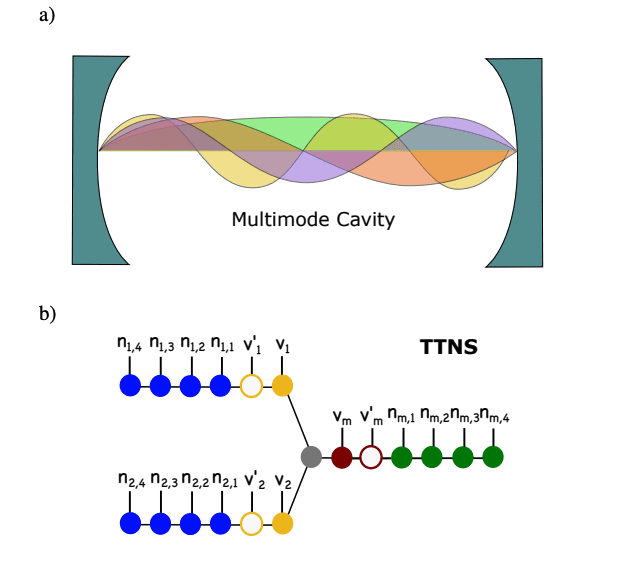
Controlling chemical reactions with light represents a significant frontier in chemistry, and researchers are now exploring how to achieve this using microscopic optical structures, a field known as polaritonic chemistry. Yaling Ke and Jakob Assan, both from ETH Zürich, along with colleagues, investigate how the complex structure of these optical cavities influences chemical reactivity. Their work demonstrates that cavities supporting multiple light frequencies, rather than just one, can dramatically enhance reaction rates through two distinct mechanisms. By precisely tuning the cavity structure, the team reveals how molecules can access new reaction pathways and climb vibrational energy levels more efficiently, offering valuable insights for designing more effective light-driven catalysts and fundamentally altering our approach to chemical control.
Most theoretical efforts to date have focused on single-mode cavities, but practical implementations in polaritonic chemistry typically involve planar optical cavities that support a series of equally spaced photon modes, determined by the cavity geometry. This work presents a numerically exact, fully quantum-mechanical study of chemical reactions in few-mode cavities, revealing two key scenarios by which multi-mode effects can enhance cavity-modified reactivity. The first scenario emerges when the free spectral range is comparable to the single-mode Rabi splitting, leading to hybridization between a rate-decisive
Effective Spectral Density and Simulations
This document provides detailed supplementary information accompanying research on cavity quantum electrodynamics (QED) and its influence on chemical reaction rates. It explains the mathematical and computational techniques used in the study, offering a comprehensive understanding of how the researchers reached their conclusions. The core of this work lies in the theoretical framework and computational methods used to model the interaction between molecules and the cavity environment. Researchers derive an effective spectral density function and employ a sophisticated simulation technique called Hierarchical Equations of Motion with a Tensor Train Network Solver (HEOM+TTNS) to accurately represent quantum dynamics. Cavity QED exploits the strong coupling between light and matter, altering the electronic structure and reaction pathways of molecules placed within the cavity. Understanding these alterations requires accurate modelling of the complex interplay between the molecular system and the quantized electromagnetic field of the cavity.
The results are then carefully compared with predictions from Fermi’s Golden Rule (FGR), a simpler analytical approach, to validate the accuracy and identify the limitations of each method. The derivation of the effective spectral density involves modeling the cavity modes as a complex environment, treating them as a collection of oscillators, and applying the fluctuation-dissipation theorem to connect fluctuations in the cavity field with the energy lost from the molecule. The fluctuation-dissipation theorem, a cornerstone of statistical mechanics, establishes a relationship between the response of a system to a perturbation and the fluctuations it exhibits in equilibrium. HEOM+TTNS is a powerful technique for simulating open quantum systems, those interacting with their surroundings. The method involves deriving a set of hierarchical equations that describe how the system’s quantum state evolves over time, and solving these equations efficiently using a tensor train network solver. Tensor train networks represent high-dimensional tensors in a compressed format, significantly reducing the computational cost of simulating complex quantum systems. This allows researchers to accurately model the complex interactions between the molecule and the cavity modes, even for systems with many degrees of freedom.
A crucial aspect of this work is the comparison between the HEOM+TTNS results and those obtained using Fermi’s Golden Rule. FGR is a widely used analytical method for calculating reaction rates, but it relies on approximations, such as assuming a short environmental memory and a weak interaction between the molecule and its surroundings. The environmental memory refers to the timescale over which the cavity environment retains information about the molecular system. By comparing the results from both methods, researchers assess the validity of these approximations and identify the limitations of FGR. Key findings reveal that FGR provides qualitatively correct results only in the weak coupling regime, where the interaction between the molecule and the cavity is weak. In this regime, the molecule’s dynamics are only slightly perturbed by the cavity, and the approximations inherent in FGR are valid. However, FGR significantly overestimates reaction rate enhancements in the strong coupling regime, failing to capture essential features like red-shifting and peak broadening observed in the HEOM+TTNS simulations. Red-shifting refers to the lowering of the energy of the reaction products due to the interaction with the cavity modes, while peak broadening indicates an increased uncertainty in the energy of the reaction products.
Furthermore, FGR breaks down completely when applied to multi-mode cavities, demonstrating its inadequacy for modeling complex cavity environments. Multi-mode cavities, unlike single-mode cavities, support multiple resonant frequencies, leading to a more intricate interplay between the molecule and the cavity field. Supplementary figures demonstrate the discrepancies between HEOM+TTNS and FGR for both single-mode and two-mode cavities. In single-mode cavities, FGR deviates significantly from the accurate HEOM+TTNS results in the strong coupling regime, overestimating the reaction rate enhancement by up to an order of magnitude. In two-mode cavities, FGR completely fails to predict the rate splitting observed in the HEOM+TTNS simulations, highlighting its limitations in modeling complex systems. Rate splitting occurs when a single reaction pathway splits into multiple pathways due to the interaction with multiple cavity modes. This phenomenon is a clear indication that the approximations used in FGR are no longer valid.
This work validates the reliability and accuracy of the HEOM+TTNS method for simulating cavity QED effects on chemical reaction rates, and demonstrates the limitations of the FGR method, particularly in strong coupling regimes and multi-mode cavities. This is crucial because experiments increasingly utilize these conditions, aiming to harness the unique properties of cavity QED to control and manipulate chemical reactions. Accurate modeling is essential for understanding and predicting cavity QED effects, designing experiments, and developing new technologies, such as more efficient catalysts and novel materials. Ultimately, this research contributes to a deeper understanding of how cavity QED can be harnessed to control and manipulate chemical reactions. In summary, this supplementary information document provides a detailed and rigorous analysis of the methods used in the research, confirming the accuracy of HEOM+TTNS and the limitations of FGR, and advancing our understanding of cavity QED effects on chemical reactions.
👉 More information
🗞 Harnessing multi-mode optical structure for chemical reactivity
🧠 DOI: https://doi.org/10.48550/arXiv.2507.13897