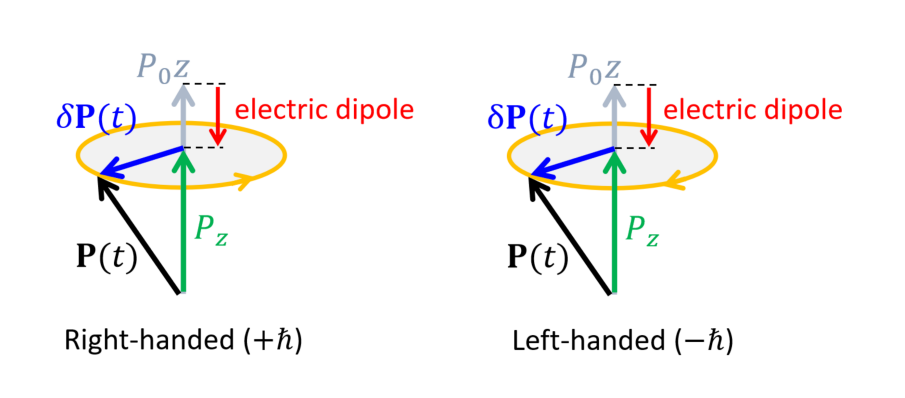
The search for materials exhibiting both electric and magnetic properties simultaneously remains a central challenge in materials science, with potential applications ranging from advanced sensors to novel data storage. Ping Tang and Gerrit E. W. Bauer, from Tohoku University, now demonstrate that certain ferroelectric materials can host quasiparticles exhibiting behaviour remarkably similar to that of multiferroics, even without inherent magnetism. This research reveals that these materials generate ‘multiferrons’, particles possessing both static electric and magnetic dipoles arising from the unique dynamics of the ferroelectric polarization, a phenomenon distinct from conventional multiferroicity which relies on oscillating electric fields. The discovery of multiferrons promises a new pathway toward creating materials with multiferroic functionalities in simple ferroelectrics and opens exciting possibilities for developing nonlinear optical technologies operating in the terahertz range.
Electric Field Excitation of Magnetic Moments
Certain ferroelectric materials exhibit multiferroic-like behaviour, even without static magnetic order. This research investigates how electric fields can excite magnetic moments within these materials, mimicking the coupling seen in traditional multiferroics. Theoretical modelling reveals that specific symmetry conditions and material properties significantly enhance this effect, offering a pathway towards novel device functionalities and improved magnetoelectric coupling. This achievement opens possibilities for developing low-power spintronic devices based on ferroelectric materials.
This work predicts that pure ferroelectric materials can exhibit multiferroic-like quasiparticles, simultaneously carrying static magnetic and electric dipole moments. The electric dipole moment arises from the unique dynamics of the ferroelectric material, while the magnetic moment originates from both paramagnetic and diamagnetic effects generated by the circular polarization of the ferroelectric polarization. This contrasts with established concepts of dynamical multiferroicity.
Multiferroics, Ferroelectrics and Magnetoelectric Coupling
These materials exhibit both electric and magnetic properties, offering potential for advanced technologies. Ferroelectrics possess a spontaneous electric polarization, while multiferroics combine ferroelectricity with magnetism. Understanding the coupling between these properties is crucial, and research emphasizes understanding the dynamics of polarization and magnetization, not just their static properties, including the motion of domain walls and collective excitations.
A novel concept, multiferons, describes lattice vibrations that carry both polarization and magnetization, suggesting a direct coupling between lattice vibrations and the ferroelectric/magnetic order. Researchers utilize techniques like second harmonic generation to probe the symmetry and polarization of these materials, and mechanisms such as charge ordering and spin-spiral order can induce multiferroicity. Domain walls, boundaries between regions of different polarization or magnetization, play a crucial role in the dynamic properties of these materials.
Key research directions focus on understanding multiferons as fundamental excitations and developing dynamic control over multiferroicity. Exploring nonlinear optics and understanding the coupling of lattice vibrations to order parameters are also important, and topological effects, arising from spin-spiral order and domain walls, may contribute to the behaviour of these materials. The concept of ferronics, a new type of excitation related to the transport of ferroelectric polarization, is also introduced.
The overarching themes are symmetry breaking, collective excitations, and the coupling between different order parameters. Understanding these interactions is crucial for designing new multiferroic materials, and the discovery of new excitations like multiferons and ferrons, coupled with a deeper understanding of the dynamic properties of multiferroics, promises to unlock new functionalities and applications in areas such as data storage, sensors, and energy harvesting.
Multiferrons Enable Tunable Terahertz Magnetoelectric Coupling
This research predicts the existence of “multiferrons”, a novel class of quasiparticles within ferroelectric materials. These quasiparticles uniquely possess both static electric and magnetic dipole moments, arising from the circular polarization of ferroelectric order. Unlike previously understood phenomena such as electromagnons, multiferrons generate a strong, tunable second-harmonic optical response, particularly within the terahertz frequency range, and exhibit significant magnetoelectric coupling.
This intrinsic coupling allows for the potential control of thermal transport properties using both electric and magnetic fields, opening avenues for advanced thermal management strategies. The team demonstrates that the strength of this magnetoelectric coupling is comparable to that observed in established multiferroic materials. While the study focuses on barium titanate as an example, the researchers note that the magnitude of the effect varies depending on the origin of the ferroelectricity. They also suggest that incorporating piezoelectric coupling could lead to the creation of hybrid quasiparticles with enhanced electro- and magneto-active properties, and acknowledge that their model represents a theoretical prediction requiring experimental validation.
🗞 Multiferroic-like Excitation in Ferroelectrics
🧠 ArXiv: https://arxiv.org/abs/2510.18588