

Van der Waals heterostructures represent a promising pathway towards next-generation electronic devices, but achieving both efficient operation and tunable functionality remains a significant challenge. Baoyu Wang, Lingrui Zou, and Tao Wang, alongside colleagues at their institutions, now demonstrate a novel device based on a carefully constructed p-n heterojunction using layered materials. The team creates near-ideal junctions from tin selenide and indium diselenide, exhibiting exceptionally low leakage currents and a substantial ability to modulate the barrier between materials. This breakthrough enables the realisation of a ferroelectric junction field-effect transistor memory, offering a large memory window, ultrafast switching speeds, and reliable performance at elevated temperatures, paving the way for advanced brain-inspired computing and low-power electronics.
Van der Waals FeFET for Memory and Logic
This research details the development of a new ferroelectric field-effect transistor (FeFET) utilizing a unique van der Waals heterostructure composed of α-In2Se3 and SnSe. The resulting device exhibits a large memory window, a steep subthreshold slope for energy-efficient operation, and non-volatile retention, maintaining stored data even without power. Importantly, the device functions reliably across a range of temperatures and demonstrates linearity and symmetry, characteristics crucial for simulating brain-like behavior in neuromorphic computing. The device operates by modulating the charge carrier concentration within the SnSe channel using the ferroelectric polarization of the α-In2Se3 material, effectively controlling its conductivity and enabling memory effects.
This linearity and symmetry make the device well-suited for implementing artificial synapses and neural networks, accurately mimicking Long-Term Potentiation (LTP) and Long-Term Depression (LTD), essential processes for synaptic plasticity. The device proves compatible with Convolutional Neural Networks (CNNs), a powerful tool for pattern recognition, presenting a promising pathway towards advanced electronic devices that combine memory and computing in a single, energy-efficient platform, offering potential advantages in scalability, performance, and integration with existing technologies. The neuromorphic computing capabilities open possibilities for building more intelligent and energy-efficient artificial intelligence systems.
Near-Ideal Heterojunctions Enable Ultrafast Memory Devices
Researchers have achieved a significant breakthrough in creating near-ideal van der Waals p-n heterojunctions by combining band-aligned SnSe and α-In2Se3. The fabricated heterojunctions exhibit remarkably small reverse leakage currents and a diode ideality factor of 1. 95, indicating near-ideal rectification behavior. Electrical characterization revealed excellent rectifying behavior with a threshold voltage of 0. 6V, ensuring low leakage current and a high on/off ratio.
Based on these heterojunctions, the team developed a novel ferroelectric junction field-effect transistor memory, demonstrating large memory windows of 1. 8V and ultrafast switching speeds of 100ns. The devices maintain high operational temperatures up to 393 K and exhibit low cycle-to-cycle variation of only 2%, signifying robust and reliable performance. Further analysis revealed ultra-low leakage currents and a subthreshold swing (SS) of as low as 138mV/dec, significantly better than previously reported Fe-FET devices. The unique memory characteristics stem from the α-In2Se3 ferro-channel, exhibiting a distinctive clockwise hysteresis. Comparative experiments using MoS2 confirmed that the observed hysteresis originates from ferroelectric polarization reversal within the α-In2Se3 channel, not from trapping effects.
Ferroelectric Control of van der Waals Heterojunctions
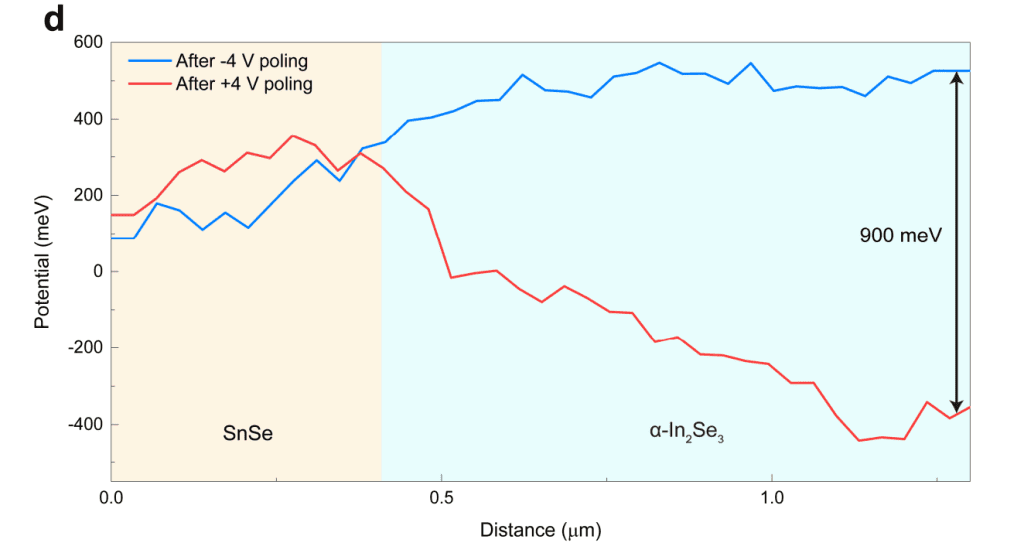
This work demonstrates the creation of near-ideal van der Waals p-n heterojunctions using band-aligned tin selenide and indium diselenide, resulting in a novel device called a ferroelectric junction field-effect transistor, or Fe-JFET. The team achieved remarkably low leakage currents and successfully modulated the barrier height of the junction by a substantial 900 meV using the ferroelectric properties of the material. This control over the band alignment enables the creation of switchable memory devices with large memory windows, ultrafast operation speeds, and high operational temperatures. Furthermore, the Fe-JFET exhibits reliable synaptic characteristics, demonstrating excellent potential for low-power neuromorphic computing applications.
The researchers constructed a convolutional neural network, utilizing the Fe-JFET as synaptic connections, and achieved a high image recognition accuracy of 95. 8% on a standard handwritten digit dataset. While the devices demonstrate promising performance, further optimization of the Fe-JFET’s synaptic properties and exploration of more complex datasets are needed to fully realize their potential in advanced artificial intelligence hardware. This research establishes a new platform for switchable memory heterojunctions, paving the way for future developments in brain-inspired electronics and optoelectronics.
👉 More information
🗞 A ferroelectric junction transistor memory made from switchable van der Waals p-n heterojunctions
🧠 ArXiv: https://arxiv.org/abs/2510.10521