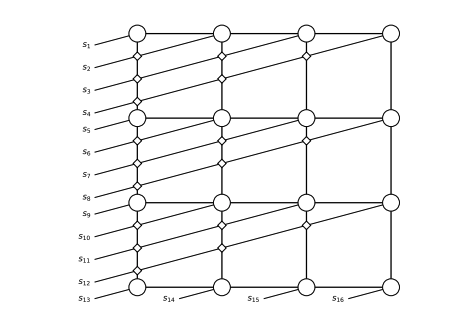
The simulation of complex quantum systems presents a significant computational challenge, particularly when dealing with interacting fermions, where traditional methods often falter due to the notorious ‘sign problem’. Researchers are increasingly turning to tensor network states, specifically projected entangled pair states (PEPS), combined with Monte Carlo techniques, to circumvent these limitations. These methods approximate the quantum state of a system using a network of interconnected tensors, reducing the computational demands while maintaining accuracy. Yantao Wu of the Institute of Physics, Chinese Academy of Sciences, and Zhehao Dai from the Department of Physics and Astronomy, University of Pittsburgh, detail advancements in this area in their article, “Algorithms for variational Monte Carlo calculations of fermion PEPS in the swap gates formulation”. Their work focuses on optimising the variational Monte Carlo (VMC) approach, a method used to estimate the ground state energy of a system, within the framework of fermion PEPS, employing a ‘swap gates’ formulation to enhance efficiency and demonstrating detailed balance in sequential sampling of tensor networks.
Recent advances establish functional projected entangled pair states (fPEPS) and associated tensor network methods as a powerful technique for investigating many-body quantum systems. These methods represent a quantum state as a network of interconnected tensors, allowing researchers to efficiently simulate the behaviour of interacting particles. Significant effort concentrates on refining the accuracy and efficiency of fPEPS simulations, particularly for fermionic systems, where computational challenges, such as the ‘sign problem’ in quantum Monte Carlo methods, present considerable hurdles. The sign problem arises from the oscillatory nature of fermionic wavefunctions, leading to cancellations that exponentially increase computational cost.
A clear trend emerges from current research, demonstrating a concentrated effort to improve computational tools and apply them to understand complex quantum phases of matter, notably spin liquids and quantum critical points. Spin liquids are exotic states of matter exhibiting long-range entanglement without conventional magnetic order, while quantum critical points represent transitions between different quantum phases. Investigations into specific models, including the J1-J2-J3 Heisenberg model and the Shastry-Sutherland model, reveal a commitment to exploring the behaviour of interacting quantum systems in reduced dimensions and characterizing emergent phenomena. These models serve as testbeds for understanding complex quantum behaviour and validating computational methods.
Researchers actively develop and refine fPEPS, focusing on
Researchers actively develop and refine fPEPS, focusing on improving accuracy and efficiency in ground state calculations and addressing the inherent challenges in simulating many-body fermion systems. This detailed work often presents a concise explanation of the Variational Monte Carlo (VMC) implementation of fPEPS, utilizing a ‘swap gate’ formulation and employing diagrammatic tensor notation for clarity. Swap gates manipulate the entanglement structure of the tensor network, allowing for efficient calculation of ground state energies. Several publications detail the Tenpy and TeNPy libraries, Python packages designed to facilitate tensor network calculations, providing crucial tools for implementing and executing complex fPEPS simulations.
The inclusion of Sorella’s work on Green Function Monte Carlo (GFMC) demonstrates a commitment to benchmarking tensor network results against established computational methods, ensuring the validity and reliability of the findings. GFMC is a highly accurate, albeit computationally expensive, method for solving the many-body Schrödinger equation. Researchers actively compare fPEPS results with GFMC, validating the approach and identifying areas for further improvement.
W.-Y. Liu, in collaboration with Z.-C. Gu and others, has made significant contributions to both methodological development and application to diverse physical systems, establishing a strong foundation for future research. P. Corboz and collaborators developed the TeNPy library, a shared platform for researchers to perform complex simulations and validate their findings, fostering collaboration and accelerating progress.
Researchers actively explore the limitations of fPEPS and develop strategies to mitigate computational bottlenecks, pushing the boundaries of what is possible with tensor network methods. They investigate techniques to improve the efficiency of simulations and extend the reach of fPEPS to larger system sizes and more complex models, addressing the challenges inherent in simulating strongly correlated quantum systems.
Comparison with alternative computational methods, such as Green Function Monte Carlo, serves as an important validation step, ensuring the reliability and accuracy of the simulations. This comparative analysis fosters confidence in the accuracy of the developed methods and promotes a rigorous approach to scientific inquiry.
The inclusion of theoretical work on Riemannian geometry
The inclusion of theoretical work on Riemannian geometry suggests an interest in the underlying mathematical foundations of quantum state representation and simulation, potentially leading to further methodological improvements. Researchers explore the connections between tensor network states and the geometry of quantum state space, seeking to develop more efficient and accurate methods for simulating quantum systems.
Future research will likely focus on developing more efficient algorithms and computational strategies to overcome the limitations of existing methods, pushing the boundaries of what is possible with tensor network simulations. Researchers will also explore new applications of fPEPS to a wider range of physical systems, expanding the scope of this powerful technique and unlocking new insights into the behaviour of quantum materials.
The ongoing development of fPEPS and related tensor network methods promises to revolutionise our ability to simulate and understand complex quantum systems, paving the way for new discoveries in materials science, condensed matter physics, and beyond.
🗞 Algorithms for variational Monte Carlo calculations of fermion PEPS in the swap gates formulation
🧠 DOI: https://doi.org/10.48550/arXiv.2506.20106