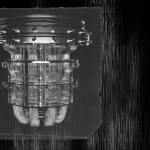
A massive 95-ton coldbox is en route to Fermi National Accelerator Laboratory in Batavia, Illinois, where it will play a crucial role in the lab’s upgraded accelerator complex. The coldbox, assembled by Air Liquide Advanced Technologies in Sassenage, France, is part of the Proton Improvement Plan-II project, which aims to enhance the particle accelerator complex using cutting-edge superconducting radio-frequency technologies.
The Department of Atomic Energy in India has provided the cryogenic plant as an in-kind contribution, with Fermilab and Indian teams collaborating on the project’s technical specifications, design, construction, and delivery. The coldbox will be used to cool the superconducting components in the accelerator to extremely low temperatures, near those found in outer space. Upon arrival, crews will install the coldbox at the PIP-II site, marking a significant milestone in the project’s development.
Introduction to the Coldbox Delivery
The U.S. Department of Energy’s Fermi National Accelerator Laboratory is expecting a significant delivery from France – a 95-ton coldbox that will be at the heart of the cryogenic system for the lab’s upgraded accelerator complex, known as the Proton Improvement Plan-II (PIP-II). This state-of-the-art linear accelerator will utilize the latest advances in superconducting radio-frequency technologies to accelerate particles. However, for these technologies to function effectively, they must be kept extremely cold, near the temperature of outer space. The coldbox, a vital piece of equipment, is designed to facilitate this cooling process.
The journey of the coldbox from Sassenage, France, to Batavia, Illinois, has been a complex and carefully planned process. After being assembled at the Air Liquide Advanced Technologies workshop in France, the coldbox departed on October 14 for its two-month voyage across the Atlantic Ocean, up the Mississippi River, and finally, via interstate to Fermilab. The transportation of such a massive piece of equipment requires meticulous planning and execution to ensure its safe arrival. The coldbox was loaded onto a transport ship at the Port of Marseille-Fos in France and began its 25-day cross-Atlantic trip to the Port of New Orleans in the United States.
Upon arrival at the Port of New Orleans, the coldbox was transferred to a river barge for transport up the Mississippi River to Romeoville, Illinois. From there, it will be offloaded onto a heavy-haul truck and driven at a slow pace to Fermilab, where it will be carefully moved to its final destination within the PIP-II Cryogenic Plant Building. The public is invited to witness the final stages of this journey from a designated viewing area at Wilson Hall on January 7, although the event is subject to change based on weather conditions.
The coldbox’s arrival marks a significant milestone in the development of the PIP-II project, which aims to upgrade Fermilab’s particle accelerator complex. The cryogenic plant, of which the coldbox is a critical component, has been provided as an in-kind contribution from the Department of Atomic Energy (DAE) in India, highlighting the international collaboration and cooperation that underpins scientific research at this level.
Cryogenics and Superconducting Technologies
Cryogenics plays a crucial role in cooling the superconducting components of the PIP-II accelerator to extremely low temperatures. The coldbox is designed to be part of the cryogenic plant, which will utilize advanced technologies to achieve these low temperatures. Superconducting radio-frequency (SRF) cavities are key components of modern particle accelerators, enabling the efficient acceleration of particles. However, for SRF cavities to operate effectively, they must be cooled to near-absolute zero, a temperature that is achievable through cryogenic systems.
The principle behind superconductivity is that certain materials can conduct electricity with zero resistance when cooled below their critical temperature. This property makes them ideal for use in particle accelerators, where energy efficiency and stability are paramount. The coldbox, as part of the PIP-II’s cryogenic system, will be instrumental in maintaining these low temperatures, thereby ensuring the optimal performance of the SRF cavities.
The development and implementation of such advanced cryogenic systems require significant scientific and engineering expertise. The collaboration between Fermilab, the DAE in India, and other international partners underscores the global nature of scientific research and the shared goals of advancing our understanding of the universe through particle physics.
Logistics and Public Engagement
The transportation of the 95-ton coldbox from France to Fermilab is a testament to the complexity and scale of modern scientific endeavors. The journey involves multiple modes of transport – sea, river, and road – each requiring precise planning and execution to ensure the safe arrival of the equipment. The use of heavy-haul trucks and specialized trailers for the final leg of the journey highlights the logistical challenges involved in moving such massive pieces of equipment.
Fermilab’s decision to invite the public to witness the delivery of the coldbox reflects the laboratory’s commitment to outreach and education. By providing a viewing area at Wilson Hall, Fermilab offers an opportunity for the community to engage with scientific research and understand the scale and complexity of projects like the PIP-II. This event not only promotes public awareness of particle physics but also inspires interest in science, technology, engineering, and mathematics (STEM) fields among younger generations.
The chronicling of the coldbox’s journey on social media platforms and the PIP-II website demonstrates how scientific institutions can leverage digital communication tools to share their work with a broader audience. By doing so, Fermilab fosters a sense of community and shared curiosity about the advancements in particle physics and the technologies that make them possible.
International Collaboration and Scientific Advancement
The PIP-II project and the delivery of the coldbox from France to Fermilab exemplify the international collaboration that underpins modern scientific research. The involvement of the DAE in India as a key partner, providing the cryogenic plant as an in-kind contribution, highlights the global nature of particle physics research. Such collaborations not only facilitate the sharing of resources and expertise but also promote a culture of cooperation and mutual advancement among nations.
The development of advanced technologies like superconducting radio-frequency cavities and sophisticated cryogenic systems is crucial for pushing the boundaries of particle physics research. These advancements have the potential to reveal new insights into the fundamental nature of matter and the universe, contributing significantly to our understanding of physics at its most basic level.
As scientific research continues to evolve, the importance of international collaboration, public engagement, and the development of cutting-edge technologies will only continue to grow. The successful delivery and integration of the coldbox into the PIP-II project at Fermilab represent a significant step forward in this journey, marking another milestone in humanity’s quest for knowledge about the universe and its underlying principles.
External Link: Click Here For More