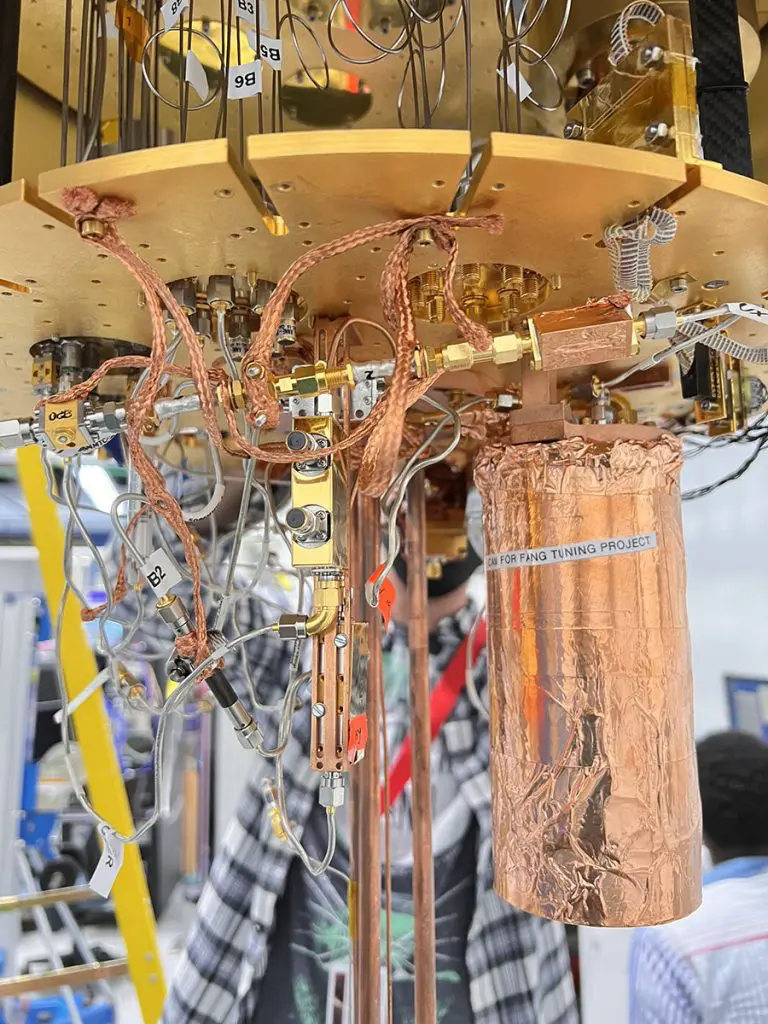
Fermilab scientists have developed a quantum sensor that accelerates the search for dark matter, potentially unlocking secrets about the universe’s composition. Researchers from Fermi National Accelerator Laboratory, University of Chicago, Stanford University and New York University designed a detector capable of electronically tuning itself to scan broader frequency ranges for evidence of dark photons, a theorized type of dark matter particle, with improved precision. This advancement bypasses the need for building numerous detectors by utilizing a superconducting quantum interference device, or SQUID, within a three-dimensional microwave cavity, allowing for rapid frequency adjustments. “Without the ability to electrically tune its frequency, you would have to build billions of detectors to capture the signal,” said Ziqian Li, a former University of Chicago graduate student who worked on the study. The research, enabled by the U.S. Department of Energy, represents a significant step toward understanding the invisible substance believed to constitute most of the universe’s mass.
Dark Photon Search Motivates Ultrasensitive Detector Design
For decades, scientists have acknowledged that most of the universe’s mass remains invisible, prompting an ongoing investigation into its composition. Identifying the nature of dark matter presents significant challenges, primarily due to the vast range of possible particle masses and their faint interactions with ordinary matter. To overcome these hurdles, researchers are increasingly reliant on detectors of exceptional sensitivity, capable of capturing the weakest signals. This research, facilitated by the U.S. Department of Energy’s Quantum Information Science Enabled Discovery program, leverages advances in quantum sensor technology for future high-energy physics experiments. “Fermilab’s longstanding expertise in designing and building ultrasensitive, low-noise electronics makes it the ideal place to further this technology for dark matter searches,” said Aaron Chou, a scientist at Fermilab involved in the study.
The detector’s innovation lies in its ability to rapidly scan a broad spectrum of frequencies, a capability achieved through “flux tuning,” which utilizes electricity to adjust the device rather than relying on manual adjustments. Fang Zhao, a former Fermilab postdoctoral researcher who led the study, explained that “Rather than physically turning a dial to a specific frequency like with a radio, we apply electromagnetic flux to the SQUID, precisely controlling its ability to oppose changes in electricity flowing through it.” The team successfully scanned a 22-megahertz range over three days, achieving a scanning rate at least 20 times faster than conventional mechanical methods. Although no dark photons were detected, the research significantly narrowed the potential search space.
Flux Tuning Enables Rapid Frequency Scanning of SQUIDs
The search for dark matter, the unseen substance theorized to comprise most of the universe’s mass, has long been hampered by the sheer breadth of potential signals and the extreme sensitivity required to detect them. For nearly a century, scientists have sought evidence of this elusive material. Conventional detectors, designed to capture the faint interactions between dark matter and ordinary matter, often require painstaking manual adjustments to scan for signals across a wide range of frequencies, a process that is time-consuming and prone to error. Researchers are now demonstrating an advancement in detector technology with the development of a system capable of rapid, electronically controlled frequency scanning, which promises to accelerate the hunt for dark matter particles like the theorized dark photon. This approach bypasses the limitations of mechanical tuning, which can introduce heat and noise that obscure the delicate signals from potential dark matter interactions. This electronic tuning offers benefits beyond speed; conventional tunable detectors rely on physically altering cavity shapes, a process problematic at the ultracold temperatures required for qubit-based detectors.
Fermilab’s longstanding expertise in designing and building ultrasensitive, low-noise electronics makes it the ideal place to further this technology for next-generation quantum science research like dark matter searches
Aaron Chou, a scientist at Fermilab
20x Faster Scanning Narrows Dark Matter Frequency Range
Aaron Chou, a scientist at Fermilab, and his colleagues are pursuing a new approach to the decades-long search for dark matter, focusing on accelerating the detection of potential signals through advanced quantum sensors. This advancement addresses a fundamental challenge in dark matter research: the vastness of the potential signal space, stemming from uncertainty about the particle’s mass and interaction properties. The innovation lies in a technique called flux tuning, which employs electricity to adjust the detector’s frequency, bypassing the limitations of traditional mechanical tuning methods. This electrical control is crucial, as mechanical adjustments at ultracold temperatures, necessary for qubit-based detectors, can be prone to failure and introduce noise.
While this particular search did not yield a dark photon detection, the results are valuable because they refine the parameters for future investigations. Chou said, “What we’re really trying to do is to build a detector that is more sensitive than anybody else has ever made before; we did that.” The researchers envision scaling up the technology by combining multiple cavities, each tuned to a different frequency, to broaden the search even further.
Rather than physically turning a dial to a specific frequency like with a radio, we apply electromagnetic flux to the SQUID, precisely controlling its ability to oppose changes in electricity flowing through it
Fang Zhao, a former Fermilab postdoctoral researcher
Quantum Coherence Preserved for Next-Generation Detectors
The development of highly sensitive detectors capable of electronically tuning themselves is accelerating the search for dark photons, theorized particles that could constitute dark matter, and dramatically improving the precision with which scientists can scan for these elusive signals. Preserving quantum coherence is paramount to the detector’s performance; Zhao stated that it “is a fundamental requirement for quantum devices to be protected from anything like heat or noise that might obscure such fragile signals and preserve them long enough for us to detect them.” Unlike mechanical systems prone to heat generation and potential failure at cryogenic temperatures, flux tuning minimizes interference, maintaining the delicate quantum state necessary for precise measurements.
It’s a fundamental requirement for quantum devices to be protected from anything like heat or noise that might obscure such fragile signals and preserve them long enough for us to detect them.
Zhao