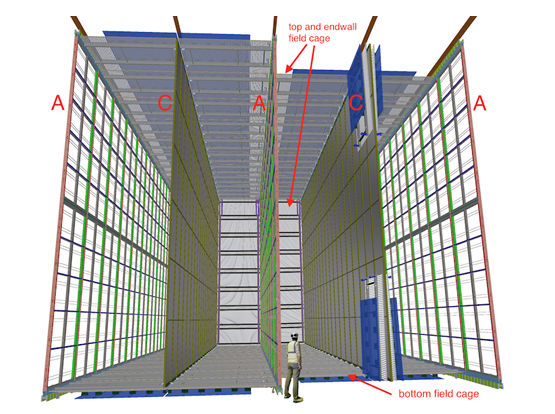
The U.S. Department of Energy’s Fermi National Accelerator Laboratory is hosting an international collaboration to construct the Deep Underground Neutrino Experiment (DUNE) in the United States and South Dakota. DUNE will utilise detectors—some measuring approximately 58 feet tall, 62 feet wide, and 215 feet long—located a mile underground and 800 miles away at Fermilab, Illinois, to study neutrino oscillations. Researchers intend to investigate the asymmetry between matter and antimatter by quantifying changes in neutrino types as they travel between the two detector sites.
Particle physics experiments investigate the origins and composition of the universe, and the Deep Underground Neutrino Experiment (DUNE) is designed to address the prevalence of matter over antimatter through the study of neutrinos. An international collaboration hosted by the U.S. Department of Energy’s Fermi National Accelerator Laboratory is constructing DUNE in the United States, requiring skilled technicians and meticulously engineered machinery to produce crucial detector components, such as Anode Plane Assemblies (APAs). This endeavour represents a significant investment in neutrino experiments aimed at furthering our understanding of fundamental asymmetries in the universe.
The DUNE collaboration intends to build enormous detectors a mile underground at the Sanford Underground Research Facility in Lead, South Dakota, and a smaller detector 800 miles away at Fermilab in Batavia, Illinois. The Illinois detector will be downstream from an upgraded particle accelerator complex, generating the world’s most intense neutrino beam, allowing researchers to study neutrino oscillations – a quantum phenomenon where neutrinos spontaneously change from one type to another as they travel. Detectors at both locations are required to quantify the number of each neutrino type at the beginning and end of their journey.
The DUNE far detectors in South Dakota will be housed within cryostats – large, insulated containers – standing approximately 58 feet tall, 62 feet wide, and 215 feet long, providing the necessary infrastructure for these complex measurements. Neutrinos, electrically neutral and weakly interacting subatomic particles, are chosen for study because their ability to pass through matter with minimal disturbance allows for long-distance observation and analysis.
More information
External Link: Click Here For More