Perovskite materials currently drive innovation across numerous scientific fields due to their remarkable electronic and optical characteristics, and researchers are continually seeking improved methods for their controlled fabrication. Volodymyr Vasylkovskyi, Andrey B. Evlyukhin, and Elena Schlein, alongside colleagues from Leibniz University Hannover, Julius-Maximilian University of Würzburg, the Institute for Scintillation Materials, and the National Technical University ”Kharkiv Polytechnic Institute”, now demonstrate a novel technique for creating perovskite nanocrystals using ultrashort pulses from a femtosecond laser. This method achieves high-purity nanocrystals, up to 100 nanometres in size, directly in air without the need for complex chemical processes or stabilizing agents, a significant improvement over existing synthesis techniques. The team successfully applied this approach to both conventional organic-inorganic perovskites and entirely inorganic, lead-free double perovskites, revealing how laser parameters and material composition influence nanocrystal properties and opening new avenues for developing advanced optoelectronic devices.
Laser Synthesis of Lead-Free Perovskite Nanocrystals
This research details the laser synthesis of cesium lead halide perovskite nanocrystals, specifically Cs2AgBiBr6, a lead-free double perovskite. Scientists demonstrate a new approach to produce these nanocrystals, potentially offering a more sustainable and environmentally friendly alternative to traditional lead-based perovskites. The laser synthesis method offers a promising alternative to traditional chemical synthesis, potentially providing better control over the size and shape of the resulting particles. This method addresses concerns about the toxicity of lead-based materials and their long-term stability, paving the way for safer and more reliable devices.
The study investigates the optical properties of the synthesized nanocrystals, exploring their potential for light-emitting applications. Researchers suggest these lead-free perovskite nanocrystals could be used in various optoelectronic devices, including light-emitting diodes and solar cells. The research emphasizes the importance of exploring lead-free alternatives to address the limitations of traditional perovskite materials.
Laser Ablation Synthesizes High Purity Perovskite Nanocrystals
Scientists pioneered a novel ligand-free approach to synthesize perovskite nanocrystals, achieving high-purity materials without the stabilizing agents typically required in conventional chemical methods. The study employed femtosecond pulsed laser ablation in ambient air, directly ablating solid perovskite targets to generate nanocrystals up to 100nm in size. This technique simplifies the synthesis process and eliminates potential solvent-induced transformations, offering a cleaner and more efficient route to nanomaterial fabrication. Researchers systematically investigated both organic-inorganic hybrid perovskites and fully inorganic lead-free double perovskites, expanding the versatility of the method.
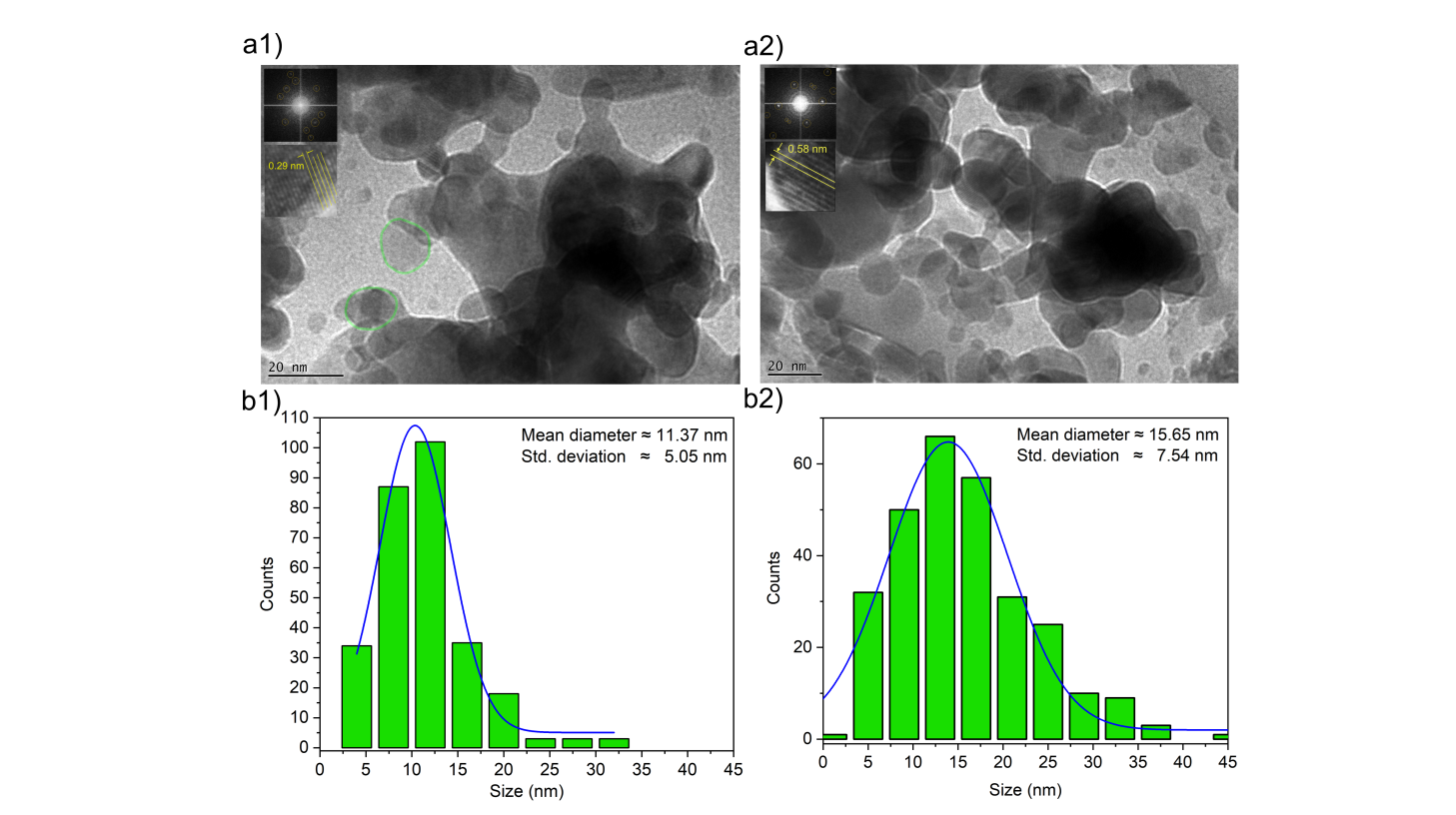
Scientists elucidated the influence of halide type, organic versus inorganic cation, and single versus double perovskite structure on the resulting nanocrystal properties. Transmission electron microscopy and x-ray diffraction confirmed the preservation of crystallinity throughout the process, revealing that organic-inorganic perovskites formed larger cubic nanocrystals, while lead-free double perovskites yielded smaller rounded nanocrystals. Photoluminescence spectroscopy demonstrated pronounced size-dependent blue shifts, attributable to quantum confinement effects, particularly within bromine and iodine-containing perovskites. This clean, scalable, and versatile laser ablation approach provides direct access to high-purity, ligand-free perovskite nanocrystals with tunable optical properties, representing a significant advance in nanostructure fabrication and enabling exploration of new perovskite-based optoelectronic devices.
Air-Synthesized Perovskite Nanocrystals Demonstrate High Purity
Scientists have achieved a breakthrough in fabricating perovskite nanocrystals using femtosecond pulsed laser ablation in ambient air, a method that eliminates the need for liquid media and stabilizing ligands. This novel approach successfully produced high-purity nanocrystals of both organic-inorganic and fully inorganic perovskites, demonstrating a versatile pathway for nanomaterial synthesis. The team meticulously optimized laser parameters to control the ablation process and tailor the resulting nanocrystal properties. Detailed transmission electron microscopy and x-ray diffraction measurements confirm the preservation of crystallinity throughout the fabrication process.
Organic-inorganic perovskites formed predominantly cubic nanocrystals with average sizes of approximately 90nm, while lead-free double perovskites yielded smaller, rounded nanocrystals averaging 10nm. Photoluminescence spectroscopy revealed pronounced size-dependent blue shifts, particularly for perovskites containing bromine and iodine, directly linking nanocrystal size to optical properties. These shifts, attributed to quantum confinement effects, demonstrate a clear correlation between nanoscale dimensions and the resulting bandgap energy. Further analysis revealed sharp emission peaks with varying widths, and blue shifts of up to 40nm were observed in the photoluminescence spectra of certain perovskites compared to their bulk counterparts, confirming the quantum confinement effect. This scalable and versatile method for producing high-purity perovskite nanocrystals with tunable optical properties, paves the way for advancements in optoelectronic devices and nanotechnology.
Air Synthesis of Crystalline Perovskite Nanocrystals
This research demonstrates a novel method for synthesizing perovskite nanocrystals using femtosecond pulsed laser ablation in ambient air, achieving high-purity, ligand-free nanocrystals without the need for additional synthesis media. The team successfully produced both organic-inorganic and fully inorganic, lead-free double perovskite nanocrystals, controlling size up to approximately 100 nanometers. Transmission electron microscopy and x-ray diffraction confirmed the preservation of crystallinity during the process, with cubic structures observed for one perovskite type and rounded structures for another. Importantly, the resulting nanocrystals exhibit size-dependent optical properties, demonstrated by shifts in photoluminescence spectra, offering a pathway to tune their characteristics through size manipulation. The absence of stabilizing ligands on the nanocrystal surfaces is a significant advancement, potentially improving surface tunability and charge transport efficiency compared to conventionally synthesized materials. This scalable and eco-friendly technique positions laser ablation as a promising route for producing high-purity perovskite nanocrystals, broadening their potential applications in optoelectronics, biomedical fields, and photocatalysis.
🗞 Synthesis of organic-inorganic perovskite and all-inorganic lead-free double perovskite nanocrystals by femtosecond laser pulses
🧠 ArXiv: https://arxiv.org/abs/2510.27563