The quest to combine magnetism and two-dimensional materials has yielded a significant advance with the creation of high-quality, fully-grown heterostructures of iron germanium telluride and tungsten diselenide. Hua Lv, Tauqir Shinwari, and Kacho Imtiyaz Ali Khan, alongside colleagues including Jens Herfort from the Paul-Drude-Institut and Chen Chen and Joan M. Redwing from the Pennsylvania State University, demonstrate a scalable method for building these structures with exceptional interfacial quality. Their work reveals unusual magnetic and electrical behaviour, including reversals in magnetic bias and unexpected changes in electrical signals with varying material thickness. These anomalies stem from strong interactions between the layers, offering fundamental insights into two-dimensional physics and paving the way for innovative spintronic devices that exploit these proximity effects.
Iron-Based 2D Ferromagnets and Properties
Research into two-dimensional (2D) materials has revealed exciting possibilities for spintronics, with iron-based compounds like Fe3GeTe2 and Fe5GeTe2 at the forefront. These materials, possessing inherent 2D structures, demonstrate potential for high-temperature ferromagnetism and are compatible with the fabrication of layered van der Waals (vdW) heterostructures. Scientists are actively investigating their magnetic properties, including ferromagnetism, Curie temperature, coercivity, and magnetic anisotropy, alongside detailed structural characterization. A key focus involves creating heterostructures by combining these 2D ferromagnets with other 2D materials such as graphene, tungsten diselenide, and tungsten ditelluride.
This approach allows researchers to tune the magnetic properties of the ferromagnet through proximity coupling, induce new phenomena like the topological Hall effect and skyrmions, and enhance functionality by combining magnetic properties with the electronic characteristics of other 2D materials. Understanding and controlling magnetic anisotropy, encompassing shape, magnetocrystalline, and interfacial effects, is crucial for manipulating spin textures like skyrmions and domain walls. The emergence of topological spin textures is driving research into the topological Hall effect, which arises from non-coplanar spin arrangements. Scientists are exploring methods to induce and control this effect within vdW heterostructures.
The formation, manipulation, and detection of skyrmions, alongside other chiral spin textures, are central themes, with efforts focused on stabilizing skyrmions at higher temperatures and controlling their motion for potential spintronic applications. Demonstrations of room-temperature spin-valve devices based on Fe5GeTe2/Graphene heterostructures represent a significant step towards practical spintronic devices. Exploration of spin-orbit torque (SOT) switching in vdW magnets offers a pathway for low-power, high-speed memory and logic devices. Researchers are also investigating the use of magnetic skyrmions as artificial synapses for neuromorphic computing applications and incorporating vdW materials into magnetic tunnel junctions to improve performance and reduce power consumption. The ultimate goal is to develop novel memory and logic devices based on these 2D magnets, achieving spintronic functionality at room temperature and above.
Epitaxial Growth of Magnetic Van der Waals Heterostructures
Scientists have successfully engineered all-epitaxial van der Waals heterostructures composed of Fe5-xGeTe2 (FGT) and WSe2, achieving high-quality interfaces and demonstrating perpendicular magnetic anisotropy and room-temperature ferromagnetism. This approach overcomes limitations of traditional flake-stacking methods, offering a scalable process for precise control over layer thickness and interface quality. The team fabricated large-area Hall-bar devices to investigate magnetic and transport properties. Experiments employed SQUID magnetometry and anomalous Hall effect (AHE) measurements to characterize the magnetic behavior of the heterostructures.
AHE measurements, particularly sensitive to magnetization in ultrathin films, revealed sharp, square-shaped loops at low temperatures originating from the FGT layer, confirming strong perpendicular magnetic anisotropy. Careful analysis distinguished the AHE signal from surface oxides, utilizing AHE to selectively probe the conductive FGT layer while SQUID measurements captured the overall magnetic response. Temperature-dependent AHE measurements demonstrated a transition from hard to soft ferromagnetism, with the AHE signal vanishing near 340 K. Further analysis of AHE data revealed a peak in the AHE resistivity at 110 K, attributed to the magnetic unordering of Fe(1), and a subsequent decline at higher temperatures reflecting reduced magnetization. Combining SQUID and AHE results, scientists estimate the Curie temperature (TC) of the FGT/WSe2 heterostructures to be slightly above room temperature, with minimal dependence on FGT thickness, comparable to values reported for exfoliated FGT flakes. Notably, the team discovered an unusual sign reversal of the exchange bias effect, observed in AHE loops at low temperatures, which depended on both temperature and FGT thickness.
Epitaxial Heterostructures Demonstrate Room-Temperature Ferromagnetism
Researchers have successfully fabricated high-quality, all-epitaxial Fe₅₋ₓGeTe₂ (FGT)/WSe₂ heterostructures that exhibit room-temperature ferromagnetism and perpendicular magnetic anisotropy, both essential properties for next-generation spintronic devices. This work overcomes the scalability and interface-quality limitations of conventional manual stacking techniques by using molecular beam epitaxy (MBE) to directly grow FGT films on single-crystalline WSe₂ substrates.
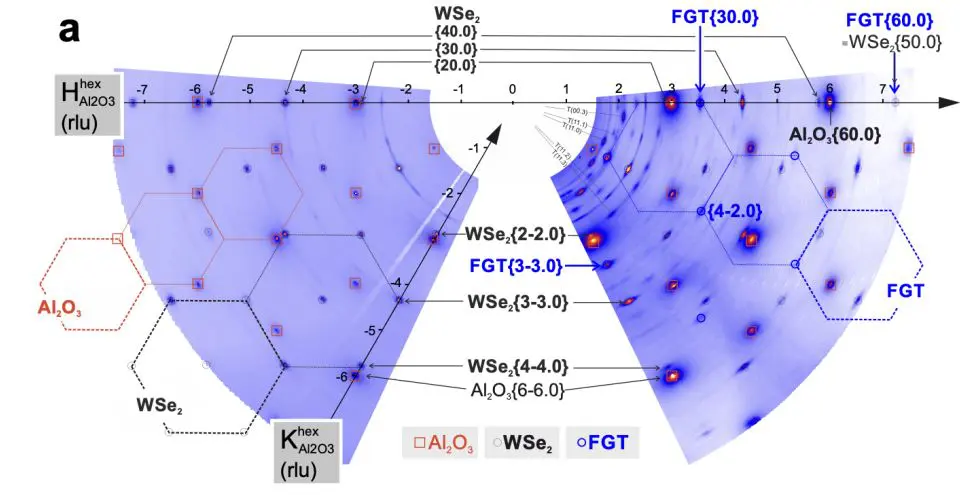
FGT layers with thicknesses of 6, 12, and 17 nm were grown under carefully controlled conditions, with the process monitored in real time using reflection high-energy electron diffraction (RHEED). This approach produced atomically smooth, two-dimensional FGT films with well-defined crystalline order. Synchrotron-based grazing-incidence diffraction measurements confirmed a strong in-plane epitaxial relationship between FGT and WSe₂, despite the weak van der Waals coupling at the interface.
Crystallographic analysis showed precise alignment of the ([10.0]) direction across both materials, highlighting the high structural coherence of the heterostructure. The measured in-plane lattice constants—4.032 Å for FGT and 3.299 Å and 3.273 Å for WSe₂—closely match reported bulk and thin-film values. A slight contraction of the WSe₂ lattice following FGT growth was observed, likely caused by defect formation or vacancy generation during the high-temperature epitaxial process.
🗞 Proximity-tuned Magnetic and Transport Anomalies in All-epitaxial Fe5-xGeTe2/WSe2 Van der Waals Heterostructures
🧠 ArXiv: https://arxiv.org/abs/2512.13888