A study by Ryohei Kobayashi from the University of Maryland and Guanyu Zhu from IBM Quantum IBM TJ Watson Research Center has provided new insights into the Z2 toric code surface code and Floquet code, which are crucial for fault-tolerant quantum computation. The researchers discovered that nonorientable geometry offers a new way for emergent symmetry to act on the code space. They also found a new realization of the fault-tolerant Hadamard gate, which they named a nonorientable surface code. The findings could potentially lead to the development of more efficient and fault-tolerant quantum computing systems.
What is the Study About?
The study, conducted by Ryohei Kobayashi from the Department of Physics Condensed Matter Theory Center and Joint Quantum Institute University of Maryland, and Guanyu Zhu from IBM Quantum IBM TJ Watson Research Center, focuses on the Z2 toric code surface code and Floquet code. These are defined on a nonorientable surface and can be considered as families of codes extending Shor’s nine-qubit code. The researchers investigate the fault-tolerant logical gates of the Z2 toric code in this setup, which corresponds to the exchanging symmetry of the underlying Z2 gauge theory.
What are the Key Findings?
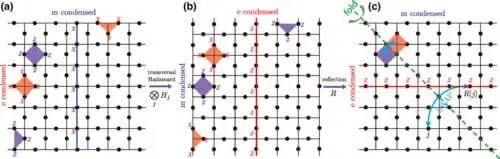
The researchers discovered that nonorientable geometry provides a new way for the emergent symmetry to act on the code space. They also found a new realization of the fault-tolerant Hadamard gate of the two-dimensional surface code with a single cross cap connecting the vertices nonlocally along a slit, which they dubbed a nonorientable surface code. This Hadamard gate can be realized by a constant-depth local unitary circuit modulo nonlocality caused by a cross cap.
By folding the nonorientable surface code, it can be turned into a bilayer local quantum code. The folded cross cap is equivalent to a bilayer twist terminated on a gapped boundary, and the logical Hadamard only contains local gates with intralayer couplings when being away from the cross cap, as opposed to the interlayer couplings on each site needed in the case of the folded surface code.
What is the Significance of the Study?
The study is significant as it provides a new understanding of the Z2 toric code surface code and Floquet code. The researchers were able to obtain the complete logical Clifford gate set for a stack of nonorientable surface codes and similarly for codes defined on Klein bottle geometries. They also constructed the honeycomb Floquet code in the presence of a single cross cap and found that the period of the sequential Pauli measurements acts as a HZ logical gate on the single logical qubit.
The researchers discovered that the dynamics of the honeycomb Floquet code is precisely described by a condensation operator of the Z2 gauge theory and illustrated the exotic dynamics of their code in terms of a condensation operator supported at a nonorientable surface.
What is the Context of the Study?
Quantum error-correcting codes are a cornerstone of fault-tolerant quantum computation. Over the past few decades, there has been an active effort to find new error-correcting codes and associated logical gates due to their importance from both theoretical and practical perspectives. In many cases, a quantum error-correcting code realizes a topologically ordered state at its code space, where the robust nature of topological order against local perturbations makes it possible to achieve fault tolerance.
What are the Implications of the Study?
The implications of the study are vast, especially in the field of quantum computation. The researchers’ findings could potentially lead to the development of more efficient and fault-tolerant quantum computing systems. The study also opens up new avenues for further research into the Z2 toric code surface code and Floquet code, as well as other related areas in quantum computation.
Publication Date: 2024-06-13
Authors: Ryohei Kobayashi and Guanyu Zhu
Source: PRX Quantum 5, 020360
DOI: https://doi.org/10.1103/PRXQuantum.5.020360