

On April 24, 2025, researchers including M. C. Goffage and S. N. Coppersmith published Leakage at zero temperature from changes in chemical potential in Majorana qubits, revealing that errors in Majorana-based tetron qubits grow linearly with length at zero temperature due to leakage into excited quasiparticle states.
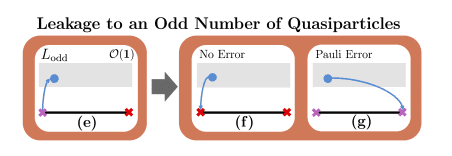
The study reveals that Majorana-based tetron qubits, despite predictions of exponentially decreasing error rates with temperature and length, exhibit errors growing linearly with tetron length at zero temperature due to leakage into excited quasiparticle states. This leakage poisons Majorana modes at opposite ends, causing errors. The dynamics are explained by the half Landau-Zener effect, dependent on parameters like superconducting gap, chemical potential variations, and spatial profile changes of Majorana modes. These findings highlight the need for further investigation into leakage’s impact on qubit performance and mitigation strategies.
In the pursuit of more reliable quantum computing, researchers have turned their attention to Majorana fermions, particles that are their own antiparticles. This unique property makes them highly resistant to decoherence, a major challenge in traditional qubit systems.
Majorana fermions are being studied within solid-state devices such as quantum dots and Josephson junctions. Quantum dots, tiny semiconductor structures, confine electrons in all three dimensions, acting like artificial atoms. Josephson junctions involve superconducting materials separated by a thin insulating barrier, allowing Cooper pairs to tunnel through. The Kitaev chain model is a theoretical framework arranging Majorana fermions in a one-dimensional chain, potentially enabling fault-tolerant quantum computing. This setup leverages topological properties to protect qubits from local disturbances.
Parity qubits use the even or odd number of particles to encode information robustly. Majorana fermions’ non-Abelian statistics allow operations resilient to errors, as swapping them doesn’t simply change the system, enabling quantum gates.
Noise modeling and error correction are critical challenges. While Majorana qubits offer stability, environmental factors and manufacturing imperfections must be addressed. Scaling up from minimal chains to practical systems is complex. Experimental progress includes realizing minimal Kitaev chains using coupled quantum dots, testing theoretical predictions. Materials like aluminum and indium arsenide in Josephson junctions are chosen for their superconducting properties.
Majorana fermions present a promising direction for quantum computing, offering solutions to decoherence issues. However, further research is needed on noise modeling, error correction, and scaling up systems. While challenges remain, the potential for practical, scalable quantum computers is significant.
👉 More information
🗞 Leakage at zero temperature from changes in chemical potential in Majorana qubits
🧠 DOI: https://doi.org/10.48550/arXiv.2504.17485


