

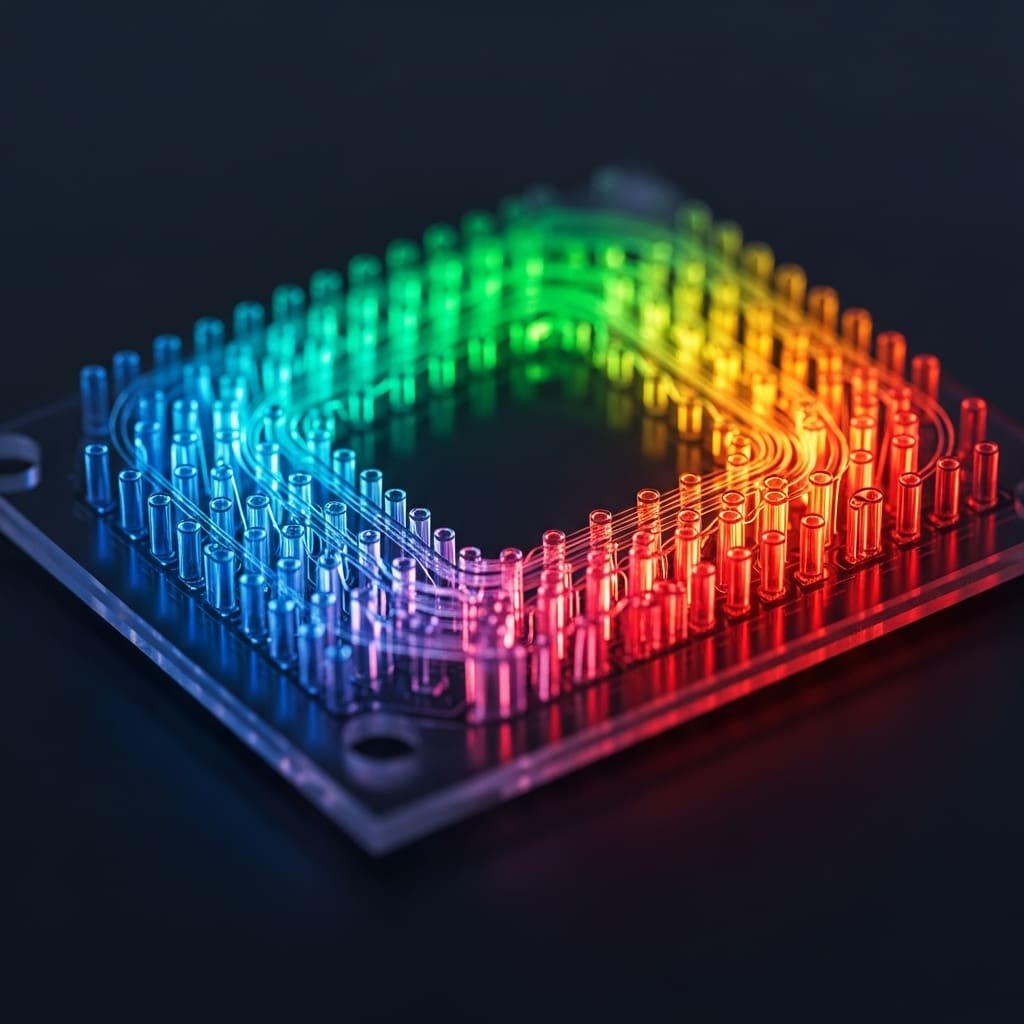
Researchers are developing integrated optical amplifiers capable of boosting signals across an exceptionally broad spectrum, spanning from visible light to near-infrared wavelengths, to facilitate advances in sensing and communications. Guanyu Han, Wenjun Deng, and Yu Wang, alongside Ziyao Feng, Wei Wang, Meng Tian, and colleagues at the Photonics Initiative, Advanced Science Research Center, City University of New York, have demonstrated a novel, electrically reconfigurable optical parametric amplifier on a lithium niobate chip that overcomes the bandwidth limitations of existing technologies. Their device achieves record gain across an optical octave, from 770 to 1650nm, and crucially operates with a low-power, on-chip pump, representing a significant step towards compact, multifunctional photonic systems that seamlessly integrate visible and infrared functionalities.
This breakthrough addresses a critical limitation in current optical amplification technologies, which struggle to provide broadband gain across the visible and near-infrared (NIR) spectrum.
Conventional semiconductor and ion-doped amplifiers are restricted by fixed energy levels, while existing optical parametric amplifiers have been hampered by limited bandwidth and the need for high-power visible or ultraviolet pumps. The research overcomes these challenges through a novel architecture that synergistically combines ultra-high effective nonlinearity, reaching 7,000%/W-cm², with high-order dispersion engineering and precise local electro-thermal tuning of quasi-phase matching.
This innovative approach enables amplification across a range encompassing key transitions for numerous photonic systems and all standard telecommunication bands. The device delivers a peak on-chip gain of 23.67 dB using only a 1060nm pump operating at 90mW average on-chip power, eliminating the need for complex and costly high-power pumping schemes.
This electrically reconfigurable optical parametric amplifier (OPA) represents a significant advancement in integrated photonics. By achieving octave-bandwidth amplification, the work paves the way for multifunctional, reconfigurable photonic devices capable of unifying the visible and infrared regimes.
The implications extend to diverse applications, including enhanced quantum sensing, improved metrology, and more efficient classical communication systems. Specifically, the amplifier can boost weak quantum emitter fluorescence, enabling higher-fidelity readout and increased sensitivity for quantum sensors.
Furthermore, this technology facilitates the direct interfacing of fragile quantum signals with fiber-compatible telecommunication bands, a crucial step towards realizing low-loss, long-distance quantum networking and distributed quantum sensing and computing. The optimized waveguide geometry, exhibiting near-zero second-order dispersion (-3.6 fs²/mm) and low fourth-order dispersion (543 fs⁴/mm) at 1064nm, is central to the device’s performance and broad bandwidth capabilities. This work establishes a new paradigm for on-chip optical amplification, promising significant advancements in both quantum and classical photonics.
Fabrication and characterisation of a periodically poled lithium niobate optical parametric amplifier are reported
A 7-mm-long periodically poled lithium niobate (PPLN) nanophotonic waveguide forms the core of this study’s optical parametric amplifier (OPA) design. The device fabrication began with establishing a uniform poling period and optimized waveguide cross-section, crucial for efficient nonlinear interaction.
Two-photon microscopy confirmed the quality of the periodic poling structure prior to waveguide fabrication, revealing ferroelectric domains with a nearly ideal 50% duty cycle and a poling period of 2.55μm. A 5-mm-long nickel chromium (NiCr) micro-heater was then fabricated alongside the OPA section, positioned 10μm from the waveguide, enabling local electro-thermal tuning of quasi-phase matching.
Characterization of the χ(2) nonlinear property commenced with measuring the second harmonic generation (SHG) spectral response using a low-power input fundamental frequency (FH) around 1064nm. The measured on-chip SH power exhibited a quadratic scaling with the fundamental pump power, yielding an ultra-high η0 of 6898 %/W-cm2.
A near sinc-shaped SHG transfer function was observed, with slight distortions and elevated side-lobes attributed to thin-film thickness inhomogeneities along the 7-mm waveguide length. To address photorefractive effects that induce a blue-shift of the phase-matching wavelength at higher input powers, the entire OPA chip was stabilized at 70°C using a thermoelectric cooler (TEC).
This temperature elevation suppressed photorefractive instability by increasing photo-conductivity, resulting in a power-independent phase-matching wavelength. OPA measurements utilized a 7GHz, ∼3ps pulse train centered around 1064nm, generated from a 1050nm continuous-wave tunable laser coupled with an electro-optic frequency comb system. Broadband parametric gain was quantified using both a spectrally filtered supercontinuum source and a wavelength-tunable continuous wave laser around 1550nm as signal sources, with the device maintained at 70°C via the TEC and fine-tuned with a programmable DC voltage applied to the micro-heater.
Broadband optical amplification exceeding an octave with low-noise performance on lithium niobate is demonstrated
Gain spectral spanning exceeding an optical octave, from 770 to 1650nm, was achieved through an electrically reconfigurable optical parametric amplifier (OPA) fabricated on a lithium niobate integrated photonic platform. This range encompasses key transitions for numerous photonic systems and all telecommunication bands.
The device delivers a peak on-chip gain of 23.67 dB with a single 1060nm pump operating at 90mW average on-chip power. Ultra-high effective nonlinearity of 7,000\%/W-cm, combined with high-order dispersion engineering and local electro-thermal tuning of quasi-phase matching, enabled this broadband amplification.
Measurements of on-chip signal output power at a wavelength of 1550nm, as a function of input power, demonstrated an unsaturated on/off gain of 18.1 dB at the 90mW pump power. The noise figure (NF) approached the 3-dB quantum limit for phase-insensitive amplification across three spectral windows, specifically spanning 840, 876nm, 920, 1239nm and 1381, 1421nm.
Increasing the on-chip fundamental harmonic (FH) pump power resulted in a monotonic increase in on/off gain, reaching the peak value of 23.67 dB at 920nm. The wavelength-dependent noise figure was evaluated under 90mW on-chip FH average power, revealing performance consistent with the measured parametric fluorescence spectrum.
Electrical reconfigurability was demonstrated by applying various voltages, shifting the OPA gain window across a wide spectral range. A 3.43 dB signal enhancement was measured at 1550nm with a 2mW off-chip input signal and 90mW pump, accompanied by an idler peak at 796nm. Instantaneous peak gain was calculated to be 18.1 dB, determined by scaling the output power linearly with the input signal.
Electrically tuned lithium niobate amplifier delivers octave-spanning gain with low noise
Scientists have demonstrated a new electrically reconfigurable optical parametric amplifier on a lithium niobate integrated photonic chip, achieving record gain spectral bandwidth exceeding an optical octave, spanning from 770 to 1650nm. This broad amplification range covers key wavelengths for many photonic systems and all telecommunication bands, representing a significant advance over existing technologies.
The device utilizes ultra-high nonlinearity, high-order dispersion engineering, and local electro-thermal tuning to achieve a peak on-chip gain of 23.67 dB with only 90mW of average on-chip power from a 1060nm pump. This work overcomes limitations of conventional semiconductor and ion-doped amplifiers, which are restricted by fixed energy levels and narrow bandwidths, and previous optical parametric amplifiers that required high-power visible or ultraviolet pumps.
The amplifier’s reconfigurability and broad bandwidth open possibilities for multifunctional photonics, unifying visible and infrared regimes for applications in sensing and communications. Negligible gain saturation and a noise figure close to the quantum limit were also observed during testing. The authors acknowledge that gain spectral ripples, caused by lithium niobate thin-film thickness variations, currently limit performance.
Future research will focus on mitigating these ripples through adaptive poling techniques and extending the nonlinear interaction length via long meandering waveguides. Further improvements in fiber-to-chip coupling and the incorporation of intra-cavity resonances are also anticipated to enhance gain and versatility. These developments promise to enable wavelength-agile light sources for high-resolution spectroscopy, visible-to-telecom quantum transduction, and enhanced quantum sensing and information processing.
👉 More information
🗞 On-chip electrically reconfigurable octave-bandwidth optical amplification from visible to near-infrared
🧠 ArXiv: https://arxiv.org/abs/2602.00246

