The increasing demand for secure communication drives the development of ever more complex public-key algorithms, and a new approach promises a significant leap forward in cryptographic protection. Keum-Bae Cho from KAIST and Seoul National University, along with colleagues, presents a novel public-key algorithm that generates ciphertexts by counting elements within randomly selected subsets, offering a fundamentally different method of encoding information. This research establishes a cryptographic system rooted in mathematical principles of satisfiability, resulting in an algorithm that not only surpasses the speed of existing methods but also operates efficiently on any computing device, eliminating the need for exceptionally large numbers. Crucially, the system’s design allows for easy expansion into a robust public-key cryptosystem, maintaining strong resistance against attacks while utilising a single public key alongside multiple private keys.
SAT Problem Secures Quantum-Resistant Encryption
This research details a new approach to public-key cryptography designed to withstand attacks from both conventional computers and future quantum computers. The core idea centers on the difficulty of solving a specific type of Satisfiability (SAT) problem, enhanced with particular constraints. The algorithm exploits the inherent computational challenge of SAT, where finding solutions becomes increasingly difficult as the problem grows in complexity. The team imposes a strict condition, requiring that any valid solution must have exactly K elements set to TRUE, significantly increasing the difficulty for standard SAT solvers.
The private key acts as a ‘trapdoor’, providing the knowledge needed to construct a solvable SAT instance, while without this knowledge, finding a solution becomes computationally expensive. The team developed several variations of the algorithm, each aiming to improve performance or reduce the size of the encrypted data. Method 4, which divides the public key into two groups of clauses, appears particularly promising, offering a reduction in both ciphertext size and the time required to generate it. The algorithm offers potential advantages, including resistance to quantum attacks, as it doesn’t rely on mathematical problems vulnerable to Shor’s algorithm, and a zero probability of decryption failure, unlike some lattice-based schemes.
However, the algorithm currently produces larger public keys and ciphertexts compared to established post-quantum cryptography candidates, a significant practical concern. Thorough analysis and optimization are needed to assess the actual computational cost of encryption and decryption, and rigorous scrutiny by the cryptographic community is essential to validate the security claims. Selecting appropriate parameters is crucial for both security and performance, and further investigation is needed to determine optimal settings. In summary, this research presents a promising, albeit currently inefficient, approach to post-quantum cryptography. The core idea of leveraging the difficulty of solving constrained SAT problems is novel and potentially secure. However, significant work is needed to reduce data size, optimize performance, and thoroughly validate the security of the algorithm before it can be considered a viable alternative to established post-quantum cryptography candidates.
Multiset Subset Counting for Public-Key Cryptography
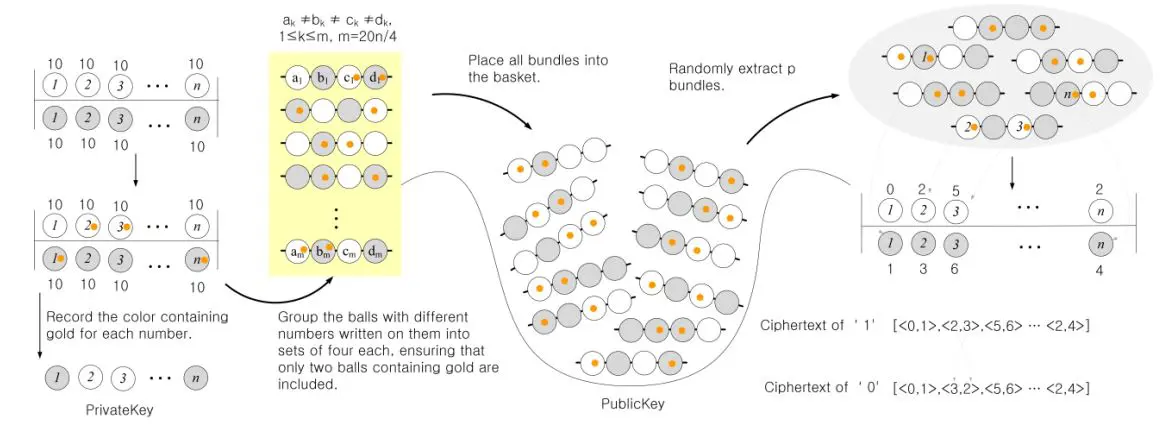
This research team engineered a new public-key cryptographic algorithm centered around counting elements within randomly selected subsets of a multiset, offering a departure from traditional methods. The core of the method involves preparing a collection of white and gray balls, each inscribed with numbers from 1 to n, with multiple balls bearing each unique number. By randomly assigning gold markings to selected colors, the team established the foundation for generating ciphertexts based on the composition of randomly extracted bundles of balls. Scientists then randomly extract bundles of 2k balls, adhering to two specific criteria: each bundle must contain exactly k gold-marked balls, and each bundle must consist of balls bearing distinct numbers.
A total of ‘e’ such bundles are randomly selected, forming the basis of the public key, while a record of the gold markings constitutes the private key. The team meticulously counts the number of white and gray balls within each bundle, recording these counts as pairs to create an array representing the ciphertext. To enhance security, a ‘contaminated array’ is also generated by randomly swapping the white and gray counts in selected pairs, further obscuring the relationship between the ciphertext and the private key. This innovative approach establishes the basket of ball bundles as the public key and the ‘notepad’ as the private key, offering a potentially more efficient and secure cryptographic system.
Multiset Subset Counting Enables Fast Cryptography
This work introduces a new public-key cryptographic algorithm based on counting elements within randomly extracted subsets from a multiset, achieving significant speed improvements over existing methods. The core concept involves preparing a collection of white and gray balls, each marked with a number from 1 to n, with multiple balls bearing each number. By randomly assigning gold to selected balls and then forming bundles of 2k balls, ensuring each bundle contains exactly k gold balls and distinct numbers, a complex system is created where discerning between normal and contaminated arrays becomes computationally challenging. Crucially, the number of possible normal arrays grows exponentially with the input variable count ‘n’, exceeding polynomial time complexity when ‘e’ is set to n/a (where a is an integer greater than 1).
This makes it computationally infeasible to distinguish contaminated arrays from normal ones within a reasonable timeframe. To concretize this concept, the team leverages the satisfiability problem (SAT), representing gold-bearing balls as literals with a value of TRUE and non-gold balls as FALSE. The bundles of balls are thus expressed as clauses in a conjunctive normal form (CNF), with each bundle containing exactly k TRUE literals. This innovative approach delivers a public-key cryptosystem that does not require large numbers, enabling execution on any device, and maintains resistance against attacks due to its inherent computational complexity.
Subset Counting Enables Novel Cryptography
This research presents a new public-key cryptographic algorithm founded on the principles of satisfiability problems, offering a distinct approach to data encryption. The team demonstrates a method of generating ciphertexts by counting elements within randomly selected subsets of a multiset, a technique that diverges from conventional methods.
🗞 Equilibrium SAT based PQC: New aegis against quantum computing
🧠 ArXiv: https://arxiv.org/abs/2512.02598