

The time it takes for fluids to reach a stable flow state within extremely narrow spaces presents a significant challenge in microfluidic device design, and Carmelo Riccardo Civello, Luca Maffioli, and colleagues from Swinburne University of Technology, alongside researchers from the University of Melbourne, Brunel University London, Imperial College London, and RMIT University, now demonstrate a surprising link between boundary conditions and equilibration time. Their research investigates how the way a fluid interacts with the walls of a confined channel affects the speed at which it settles into a steady flow, revealing that seemingly identical flow rates can arise from dramatically different transient behaviours. The team finds that systems with sliding walls reach stability four times faster than those with a fixed and moving wall under no-slip conditions, a purely hydrodynamic effect independent of the fluid’s properties. Furthermore, the study shows that allowing for slip at the walls actually increases equilibration times, with highly slippery water confined to narrow channels exhibiting enhancements of over two orders of magnitude, offering crucial insights for optimising microfluidic systems and predicting their performance.
Nanoscale Slip and Molecular Dynamics Simulations
Scientists investigate fluid behavior at the nanoscale, focusing on slip length, the distance over which fluid velocity deviates from expected behavior at a solid surface. This understanding is crucial for developing microfluidic devices and understanding transport in confined spaces. Researchers employ Molecular Dynamics (MD) simulations, which model the movement of atoms and molecules, to calculate macroscopic properties like viscosity and shear stress. Accurately representing complex fluid behavior, especially when density varies or non-local effects are present, remains a key challenge. Many studies utilize Non-Equilibrium Molecular Dynamics (NEMD) techniques to drive fluid flow and measure its response.
Accurate modeling of interatomic forces is critical, leading researchers to explore and optimize various interatomic potentials. Modern simulation packages, like LAMMPS, and visualization tools, like VMD, are essential for conducting and analyzing these complex simulations. Research demonstrates the importance of accounting for non-local effects and density variations when modeling nanoscale fluids. Studies reveal that these factors significantly impact fluid properties and require more sophisticated approaches than traditional continuum models. The team has also developed improved methodologies for computing friction at interfaces.
Shear Rate Effects on Liquid Stabilisation
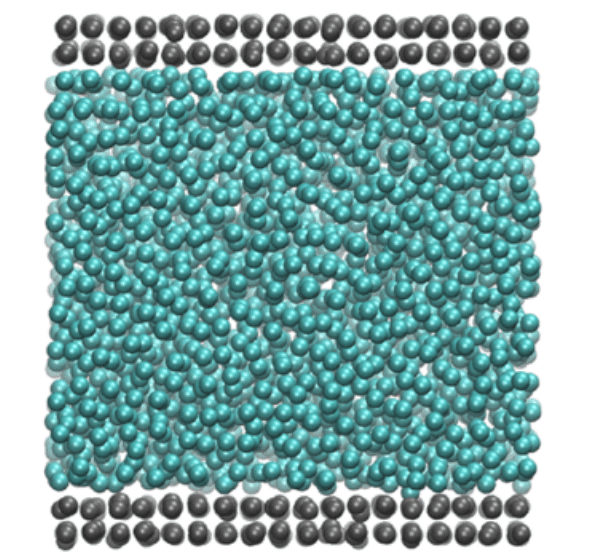
Scientists investigated how quickly a liquid reaches a stable state under shear using nonequilibrium molecular dynamics simulations. The study focused on planar Couette flow, where a fluid is confined between two parallel walls and one or both walls move, creating shear. Researchers examined two boundary conditions: one where both walls slide with equal and opposite velocity, and another where one wall remains fixed while the other moves at twice the velocity. Despite yielding identical steady-state flow properties, these conditions produced markedly different transient behaviors, revealing significant differences in how quickly the system stabilized.
To quantify equilibration times, the team decomposed the complex planar Couette flow into simpler, symmetric and antisymmetric components, allowing for detailed analysis of the system’s response. They discovered that, under no-slip conditions, the counter-sliding wall setup reached equilibrium exactly four times faster than the single sliding wall system, a result independent of the fluid’s molecular properties. Further investigation revealed that systems exhibiting slip generally required longer equilibration times, and the difference between the two boundary conditions became even more pronounced. The no-slip equilibration time is governed by the slowest decaying component of the solution to the Navier-Stokes equations, which describe fluid motion.
When slip is present, the longest relaxation time is instead dominated by the transient response of the slip velocity itself, extending the time needed to reach a stable state. To address the computational demands of NEMD, particularly at low shear rates, the researchers leveraged the Transient Time Correlation Function (TTCF) method, which links equilibrium and nonequilibrium states. Results demonstrated that selecting appropriate boundary conditions is crucial for minimizing the transient response time and reducing computational cost. This work establishes a clear preference for specific boundary conditions in boundary-driven simulations, offering significant benefits for diffusive transport processes and tribology-related technologies.
Faster Equilibration with Counter-Sliding Walls
Scientists investigated the time required for a liquid to reach a stable state under specific flow conditions using nonequilibrium molecular dynamics simulations. The research focused on two boundary conditions: one where walls slide with equal and opposite velocity, and another where one wall remains fixed while the other moves at twice the velocity. Importantly, both setups achieve the same steady-state flow rate, but exhibit markedly different transient behaviors. Results demonstrate that, under no-slip conditions, systems with counter-sliding walls reach equilibrium exactly four times faster than those with a single moving wall, irrespective of the fluid’s atomic characteristics.
This acceleration represents a purely hydrodynamic effect, independent of the specific liquid being studied. Further analysis revealed that systems exhibiting slip require longer equilibration times overall. However, the difference in equilibration speed between the two boundary condition types is even more pronounced in these slipping systems. Researchers decomposed the flow into symmetric and antisymmetric components, discovering that the no-slip equilibration time is governed by the slowest decaying solution to the Navier-Stokes equation. In contrast, the longest relaxation time for slipping systems is dominated by the transient response of the slip velocity, which is slower than the no-slip response.
Experiments with water confined within graphene channels, a high-slip system, showed an enhancement in equilibration speed exceeding two orders of magnitude. The team developed a universal relationship that accurately predicts this enhanced equilibration time, confirming its validity for both simple Lennard-Jones fluids and the water-graphene system. This breakthrough delivers a significant speed-up in attaining steady-state, particularly in the presence of slip, and has implications for computational efficiency in simulations of nanofluidics, slippery surfaces, and tribology.
Confined Shear Flows Equilibrate Faster With Slip
Researchers have achieved a significant advance in understanding how fluids reach a stable state under shear, specifically within confined spaces. Through detailed molecular simulations of liquids subjected to planar Couette flow, where a fluid is sheared between moving walls, the team discovered that equilibration times, or the time it takes to reach a steady flow, are strongly influenced by the nature of the boundaries. They demonstrated that systems with counter-sliding walls reach equilibrium four times faster than those with a single moving wall, a result independent of the fluid properties and therefore fundamentally hydrodynamic in origin. Furthermore, the research reveals that the presence of slip at the boundaries dramatically alters equilibration times.
Systems exhibiting slip generally take longer to reach stability, and the difference in equilibration time between the counter-sliding and single-sliding wall configurations is even more pronounced with increased slip. By mathematically decomposing the flow into symmetric and antisymmetric components, the scientists determined that the no-slip equilibration time is governed by the slowest decaying mode predicted by the Navier-Stokes equations, while slip-dominated systems are controlled by the transient response of the slip velocity itself. In high-slip systems, such as water confined between graphene walls, this enhancement in equilibration time can exceed two orders of magnitude. The authors acknowledge that the simulations were performed with specific interatomic potentials and channel dimensions, which may limit the generalizability of the findings. However, they propose a universal relationship to predict the speed up in equilibration as a function of the degree of slip, offering a valuable tool for optimizing simulations of similar systems. This work has implications for a range of applications, including the design of microfluidic devices and the development of advanced tribological technologies, by offering a means to substantially reduce computational costs and improve the efficiency of simulations.
👉 More information
🗞 The influence of boundary conditions and interfacial slip on the time taken to achieve a nonequilibrium steady-state for highly confined flows
🧠 ArXiv: https://arxiv.org/abs/2509.20944


