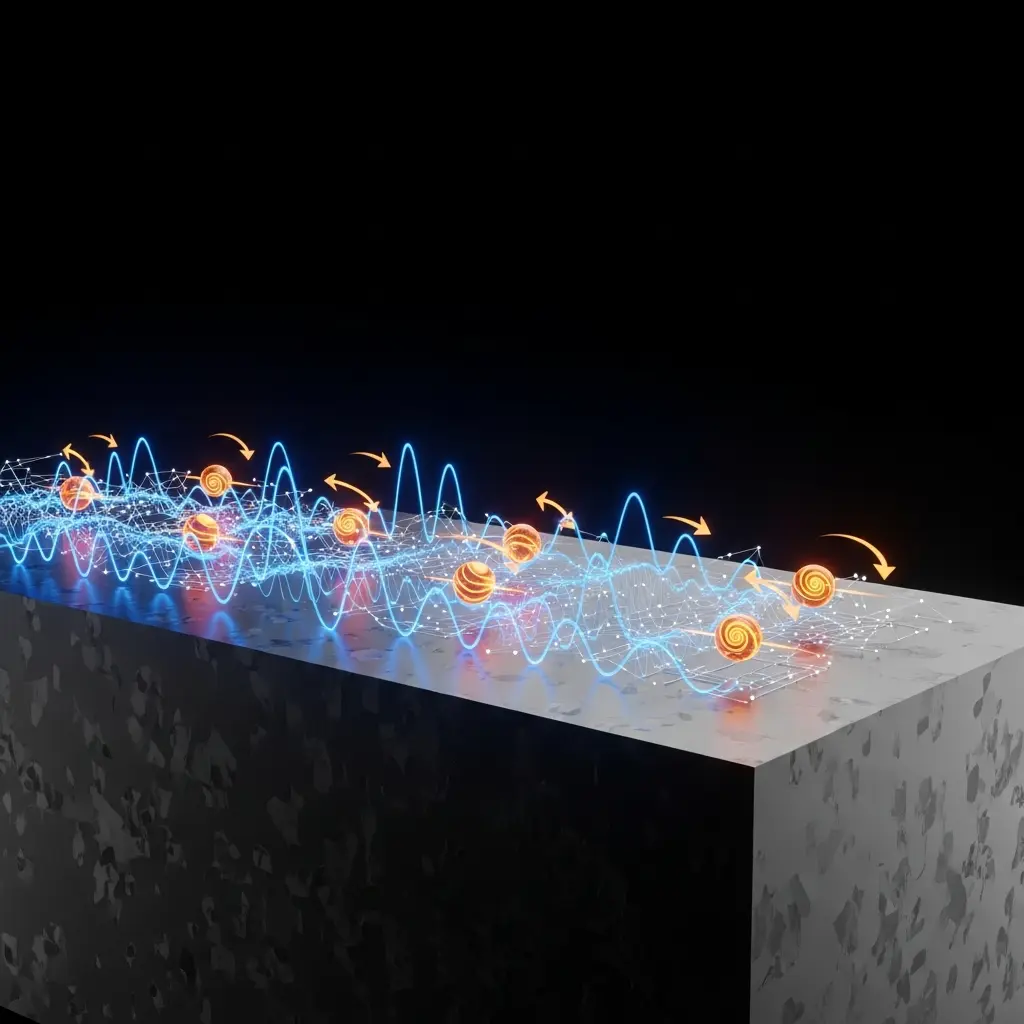
Harnessing the spin of electrons within semiconductors represents a promising pathway towards advanced quantum technologies, and germanium-based qubits are gaining prominence due to their strong interaction with external forces. Chun-Yang Yuan and Tzu-Kan Hsiao, both from the Department of Physics at National Tsing Hua University in Taiwan, investigate a novel method for controlling these germanium hole spins using surface acoustic waves. Their work demonstrates that carefully shaped sound waves can dynamically alter the spin’s environment, enabling rapid and precise rotations with minimal energy input. This achievement establishes a fundamental basis for manipulating quantum information using sound and opens exciting possibilities for integrating spin-based qubits with acoustic devices, potentially leading to more robust and scalable quantum systems.
The periodic strain dynamically modulates the g-tensor, enabling fast spin rotation even with small acoustic amplitudes, and demonstrates a strong dependence of the Rabi frequency on confinement within the quantum dot.
Germanium Hole Spin Control via Acoustic Waves
Scientists have demonstrated coherent control of germanium hole spins using surface acoustic waves, achieving a significant breakthrough in manipulating quantum information carriers. The research numerically investigates how periodic strain, induced by acoustic waves, dynamically alters the g-tensor, enabling fast and precise spin rotation even with small acoustic amplitudes. Experiments reveal a strong dependence of the Rabi frequency on both the anisotropy and confinement within the germanium quantum dot. The team measured the Rabi frequency as a function of the in-plane magnetic field angle, discovering a lack of mirror symmetry in the driving behavior.
The frequency drops to zero when the magnetic field is perpendicular to the acoustic wave propagation direction, due to modulation of the Zeeman energy, and reaches a maximum at an angle of 330 degrees. This asymmetry originates from the phase difference between the longitudinal and shear strain components of the Rayleigh wave, causing the effective driving vector to trace an elliptical trajectory. Detailed analysis confirms a linear relationship between the Rabi frequency and the amplitude of the surface acoustic wave displacement, with values up to 9.61MHz per picometer of displacement for a 50 by 45 nanometer quantum dot. Measurements across different dot geometries reveal that this configuration yields the highest driving efficiency, reducing the magnitude of gxx and necessitating a larger magnetic field for resonance. The study establishes that the SAW-driven control is governed by an elliptically polarized driving vector, theoretically predicting Rabi frequencies exceeding 100MHz with achievable acoustic amplitudes, paving the way for advanced acoustic-driven germanium hole spin qubit control.
Germanium Spin Control via Acoustic Waves
Researchers have demonstrated coherent control of electron spin in germanium using surface acoustic waves, a significant step towards advanced quantum technologies. The team numerically modeled how periodic strain, generated by these waves, dynamically alters the electronic structure of germanium, enabling rapid and precise manipulation of spin. This method relies on the inherent properties of germanium, specifically its strong spin-orbit coupling and the way strain modifies its anisotropy, to achieve fast spin rotation even with relatively small acoustic signals. The findings reveal a strong relationship between the speed of spin control and both the shape of the germanium structures and the direction of the acoustic waves, with certain geometries and alignments leading to significantly enhanced driving efficiency. Calculations suggest that the resulting spin manipulation speeds could exceed 100MHz with currently achievable technology, paving the way for practical applications in quantum information processing. Further improvements through strain engineering, optimized device design, and careful control of acoustic wave properties could lead to even stronger interactions between electron spin and acoustic phonons, promising new avenues for interconnecting and controlling quantum bits.
🗞 Ge hole spin control using acoustic waves
🧠 ArXiv: https://arxiv.org/abs/2512.23520