

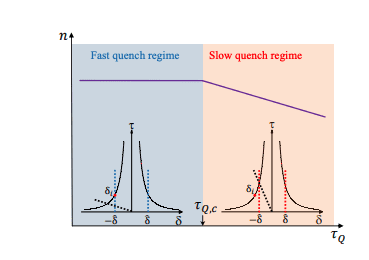
Experiments utilising a trapped-ion qubit demonstrate a breakdown of the Kibble-Zurek mechanism’s predicted universality during rapid phase transitions. Defect density and freezing time become independent of quench rate above a critical value, instead scaling with the quench range, confirming recent theoretical predictions for fast quenches.
The behaviour of physical systems undergoing rapid change is a fundamental question in condensed matter physics. Conventional theory, embodied in the Kibble-Zurek mechanism (KZM), posits a predictable relationship between the speed of change – the ‘quench rate’ – and the resulting density of imperfections, known as topological defects. However, recent theoretical work suggests this relationship breaks down under extremely rapid transitions, with defect density becoming governed by the extent of the change rather than its speed. Researchers from Sun Yat-sen University, Hainan University, and the Quantum Science Center of Guangdong-Hong Kong-Macao Greater Bay Area have now experimentally verified this prediction, demonstrating a critical quench rate beyond which KZM universality fails. Their findings, detailed in the article ‘Verified Universal Breakdown of Kibble-Zurek Scaling in Fast Quenches’, are presented by Xinxin Rao, Yang Liu, Mingshen Li, Teng Liu, Huabi Zeng, and Le Luo, and utilise a single trapped-ion qubit to model these rapid transitions in established physical systems – the Landau-Zener and 1D Rice-Mele models.
Experimental Verification of Modified Kibble-Zurek Mechanism During Rapid Quenches
Recent research challenges established predictions concerning defect formation in quantum systems undergoing rapid parameter changes – termed ‘quenches’. The Kibble-Zurek Mechanism (KZM) traditionally predicts a universal relationship between quench rate and the density of topological defects created during a continuous phase transition. However, theoretical work now suggests this universality breaks down under sufficiently fast quenches, with defect density becoming independent of quench rate and instead scaling with the range of the quench – the total change in the parameter. Researchers have directly tested this prediction using a single trapped-ion qubit, implementing fast quenches within both the Landau-Zener and one-dimensional Rice-Mele models, providing crucial experimental data. They identified a critical quench rate, proportional to the quench range, which demarcates two distinct dynamical regimes, offering a clear pathway to understanding the transition in scaling behaviour.
The experiments utilised a single trapped-ion qubit, a system favoured for its precise control and isolation from environmental noise, to investigate the behaviour of quantum systems during rapid parameter changes. Fast quenches were implemented within both the Landau-Zener and one-dimensional Rice-Mele models. These models were selected for their theoretical tractability and relevance to understanding continuous phase transitions – points where a system’s properties change qualitatively. By carefully controlling the duration and amplitude of the quenches, scientists systematically explored the relationship between quench parameters and the resulting defect density, gathering data essential for validating or refuting existing theoretical predictions.
The study meticulously identified a critical quench rate, directly proportional to the quench range, which serves as a clear demarcation between two distinct dynamical regimes, revealing a fundamental shift in the scaling behaviour of defect density. Below this critical rate, the defect density adheres to the predictions of the traditional Kibble-Zurek Mechanism, increasing monotonically with the quench rate. Above this threshold, however, the defect density plateaus, becoming independent of the quench rate itself. This observation represents a significant departure from established theory, suggesting that the traditional KZM breaks down under sufficiently fast quenches, and that a new scaling law governs the behaviour of defect density in this regime. The identification of this critical quench rate provides a crucial benchmark for future investigations, allowing researchers to systematically explore the transition between these two dynamical regimes.
This research demonstrates a breakdown in the conventional understanding of defect formation during rapid quantum quenches, challenging the Kibble-Zurek mechanism (KZM). The results suggest that beyond a certain speed, the system’s evolution is governed not by how quickly the change occurs, but by the magnitude of the change itself. This highlights the importance of considering quench range as a key parameter in understanding defect formation in rapidly driven quantum systems, challenging the traditional focus on quench rate. The traditional KZM, while accurate for slow quenches, fails to capture the essential physics governing defect formation in the fast-quench regime, necessitating a revised theoretical framework.
This research opens new avenues for exploring the dynamics of quantum phase transitions and the formation of topological defects in rapidly driven systems, challenging existing theoretical frameworks and paving the way for a more complete understanding of these phenomena. Future research will focus on extending these findings to more complex systems and exploring the potential applications of these insights in areas such as quantum computing and materials science. The development of new theoretical models that accurately capture the behaviour of defect density in the fast-quench regime will be crucial for advancing our understanding of these phenomena and unlocking their full potential.
👉 More information
🗞 Verified Universal Breakdown of Kibble-Zurek Scaling in Fast Quenches
🧠 DOI: https://doi.org/10.48550/arXiv.2506.06841


