

Controlling and reading information from arrays of quantum dots represents a promising pathway to scalable quantum computing, but tuning these complex systems demands navigating an enormous range of control voltages. To accelerate development in this field, Tara Murphy, Katarina Brlec, and Giovanni Oakes, all from Quantum Motion, alongside colleagues including Lorenzo Peri and Henning Sirringhaus at the University of Cambridge, and Henry Moss at Lancaster University, have created RF-Squad, a new physics-based simulator. This tool realistically models radiofrequency reflectometry measurements of quantum dot arrays, going beyond existing simplified models to incorporate crucial physical effects like tunnel coupling and confinement. By achieving rapid simulation speeds, generating a detailed charge stability diagram in just over fifty milliseconds, RF-Squad empowers researchers to efficiently test and train automated tuning algorithms, ultimately paving the way for more stable and scalable quantum devices.
Radiofrequency Simulation for Quantum Dot Control
RF-Squad is a radiofrequency simulator designed for quantum dot arrays, addressing the need for accurate and efficient modelling of the radiofrequency signals used to control and read out qubits within these arrays. The simulator employs a finite-element method to solve Maxwell’s equations, calculating electric and magnetic field distributions across the array geometry. This detailed approach allows for thorough analysis of qubit drive and readout performance, considering the complex interaction between radiofrequency fields and the quantum dot structure. RF-Squad incorporates user-defined geometry, enabling researchers to model arrays with varying quantum dot positions, sizes, and materials.
The simulator calculates the spatial distribution of radiofrequency fields, including electric and magnetic field components, and provides metrics relevant to qubit control, such as field amplitude and uniformity. RF-Squad also accounts for the effects of dielectric materials and metallic gates, which significantly influence the radiofrequency field distribution within the quantum dot array. The simulator’s capabilities extend to the analysis of different antenna designs and their impact on qubit coupling and coherence, ultimately enhancing qubit performance and scalability by mitigating unwanted crosstalk and improving the fidelity of quantum operations.
Spins in semiconductor quantum dots offer a scalable approach to quantum computing, however, precise control and efficient readout of large quantum dot arrays remain challenging, primarily stemming from the hyperdimensional voltage space required for tuning multiple gates per dot.
Quantum Dot Simulations Validate Computational Framework
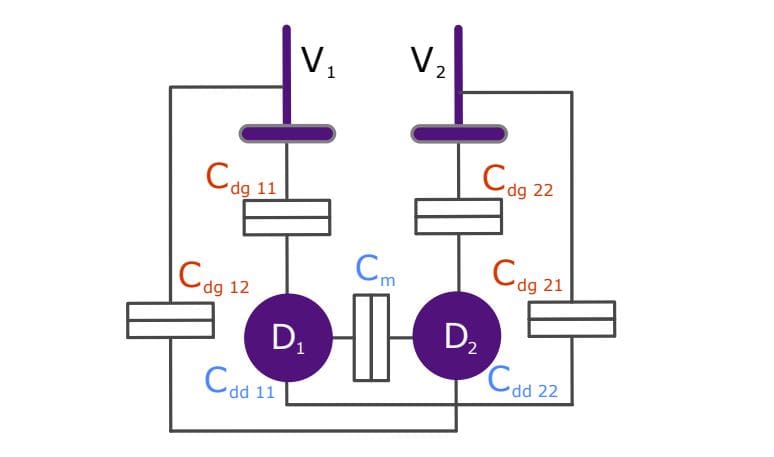
Researchers have developed and benchmarked a computational framework for modelling quantum dot devices, building layers of increasing physical realism to understand the trade-offs between accuracy and speed. The framework begins with a basic model and adds complexity through successive layers, including interdot tunneling, quantum confinement, and voltage-dependent tunnel coupling, alongside voltage-dependent capacitances to model electrostatic control. Simulations utilise capacitance matrices, tunnel coupling strengths, and confinement frequencies, operating at low temperatures around 1. 5 Kelvin.
Realistic noise, including 1/f and Gaussian noise, is included to mimic experimental conditions, and the reduced Fock-state approach controls computational cost by limiting the number of states considered. Performance benchmarks measure the runtime of the simulation with different levels of complexity, demonstrating the impact of simulation parameters and layers on runtime. This work represents a comprehensive effort to develop and benchmark a computational framework for modelling quantum dot devices, carefully balancing accuracy and speed for device design, optimisation, and understanding.
Fast Quantum Dot Simulation with RF-Squad
RF-Squad is a new physics-based simulator representing a significant advance in the ability to model and understand quantum dot arrays, promising building blocks for future quantum computers. The team successfully developed a computational framework capable of generating charge stability diagrams in milliseconds, achieved through a layered architecture that allows users to balance computational efficiency with the inclusion of increasingly complex physical effects. The simulator’s performance has been rigorously validated against experimental data, demonstrating its ability to accurately reproduce key features of radiofrequency reflectometry measurements, including both interdot and dot-to-reservoir transitions. Beyond replicating existing data, RF-Squad provides a practical means of generating the large datasets needed to train and test machine learning algorithms for automated device tuning, addressing a critical challenge in scaling quantum dot technology. The authors acknowledge that the simulator’s complexity involves approximations, and future work will focus on expanding its capabilities to support the design and characterization of larger, more complex quantum devices and their integration into complete quantum computing architectures.
👉 More information
🗞 RF-Squad: A radiofrequency simulator for quantum dot arrays
🧠 ArXiv: https://arxiv.org/abs/2511.11504


