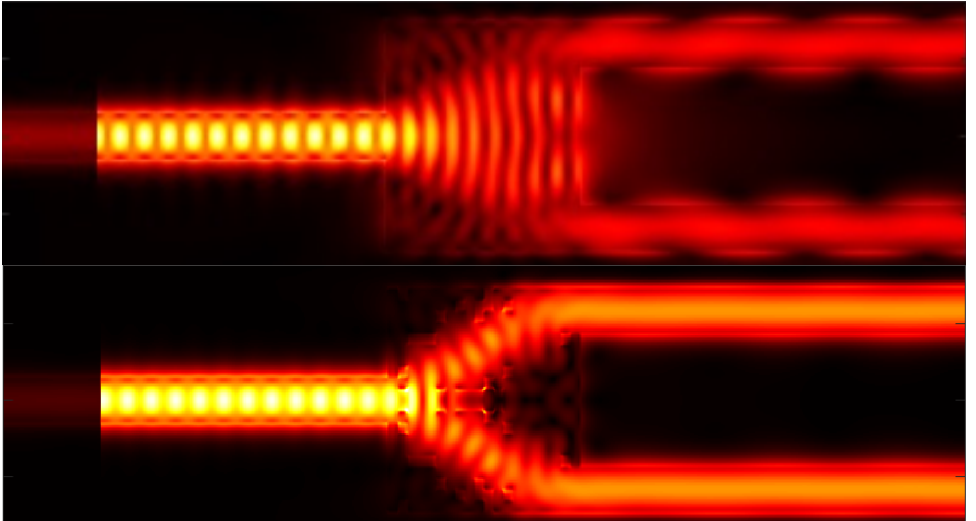
Designing nanophotonic devices demands increasingly complex and precise structures, yet current design methods often struggle with the computational demands of these tiny systems. Amirhossein Fallah and Constantine Sideris, both from the University of Southern California, and their colleagues have developed a significantly faster approach to nanophotonic design, based on a mathematical technique called the volume integral equation. This new method bypasses the limitations of traditional computer simulations by offering multiple orders of magnitude improvement in efficiency, dramatically speeding up the design process. The team validates their approach by successfully designing both a selective mode reflector and a 3 dB power splitter, demonstrating the potential of this framework to accelerate the development of next-generation nanophotonic devices.
This work focuses on the Volume Integral Equation (VIE) method, a numerical technique for modeling how light interacts with complex materials. Instead of directly solving complex equations governing light, the VIE transforms the problem into a more manageable form, relating the electric and magnetic fields within a structure to those on its surface. This approach, combined with gradient-based optimization, allows researchers to efficiently tailor the design of photonic structures to achieve specific optical properties.
A key innovation is the adjoint method, a technique for rapidly calculating how changes to a structure’s design affect its performance. Calculating these changes, known as the gradient, is computationally demanding, but the adjoint method dramatically reduces the required calculations. This allows for the design of structures with tailored optical properties, such as selective reflection or transmission of specific wavelengths. The team successfully applied this methodology to design selective mode reflectors, structures that reflect certain light modes while transmitting others. The optimization process involves defining a cost function that quantifies the desired performance and then iteratively adjusting the design parameters to minimize this cost. This work has significant implications for fields including photonic integrated circuits, optical sensors, metamaterials, nanophotonics, and optical communication.
Adjoint VIE Method for Nanophotonic Inverse Design
Scientists have pioneered a new computational approach to accelerate the design of nanophotonic devices, addressing the limitations of conventional simulation methods. This work centers on a forward modeling technique based on the Volume Integral Equation (VIE) formulation, offering a significant efficiency gain over traditional finite-difference (FD)-based methods. The team engineered a specialized adjoint method tailored specifically for the VIE framework, enabling efficient computation of optimization gradients crucial for inverse design processes. A novel unidirectional mode excitation strategy was also implemented, ensuring compatibility with VIE solvers and enhancing the accuracy of simulations.
Comparative benchmarks demonstrate that this VIE-based approach achieves multiple orders of magnitude improvement in computational efficiency compared to conventional FD methods, both in the time and frequency domains. This substantial speedup directly addresses a critical bottleneck in nanophotonic device design, enabling faster prototyping and optimization. To validate the practical utility of their method, researchers successfully designed two representative nanophotonic components: a selective mode reflector and a 3 dB power splitter. This work positions the VIE-based framework as a promising tool for accelerating inverse design workflows and enabling the development of next-generation nanophotonic devices.
Efficient Nanophotonic Design via Volume Integrals
Scientists have developed a novel computational approach to designing nanophotonic devices, achieving substantial improvements in efficiency over conventional methods. This work centers on the Volume Integral Equation (VIE) formulation, employed as an alternative to traditional finite-difference (FD)-based simulations, which often struggle with the electrical size and subwavelength features of nanophotonic structures. The team successfully integrated mode sources, mode monitors, and gradient calculation using the adjoint method within the VIE environment, enabling efficient inverse design workflows. Comparative benchmarks demonstrate that the VIE-based approach delivers multiple orders of magnitude improvement in computational efficiency compared to conventional FD methods in both time and frequency domains.
Specifically, the researchers leveraged the mathematical structure of the VIE system to accelerate calculations using Fast Fourier Transforms, a significant advantage for large systems. Appropriately constructed mathematical tools further enabled rapid convergence of the VIE solvers, even for structures that are electrically large in one or two dimensions. To validate the practical utility of this approach, the team successfully designed two representative nanophotonic components: a selective mode reflector and a 3 dB power splitter. These demonstrations underscore the significant runtime advantages offered by the VIE-based framework, highlighting its potential to accelerate the design of next-generation nanophotonic devices and overcome limitations inherent in conventional simulation techniques.
Rapid Nanophotonic Design via Adjoint Methods
Researchers have developed a new computational method for designing nanophotonic devices, offering substantial improvements in efficiency over existing techniques. The team implemented a forward modeling approach based on the Volume Integral Equation, coupled with a specialized adjoint method and a novel strategy for exciting light within the structure. Benchmarking studies demonstrate that this method achieves multiple orders of magnitude faster simulation times compared to conventional finite-difference methods, both in time and frequency domains. This advancement enables more rapid and efficient inverse design of complex nanophotonic components.
To demonstrate its practical utility, the researchers successfully designed both a selective mode reflector and a 3 dB power splitter using their new method. The optimization process involved defining a cost function to evaluate device performance and employing a gradient-based optimizer to refine the design parameters. The researchers acknowledge that the initial optimized designs require a processing step to translate continuous material properties into fabricable silicon and silica structures. Future work may focus on refining this processing step and exploring the method’s application to even more complex nanophotonic systems. This new computational framework represents a significant step towards accelerating the development of next-generation nanophotonic technologies.
🗞 Fast 3D Nanophotonic Inverse Design using Volume Integral Equations
🧠 ArXiv: https://arxiv.org/abs/2509.20809