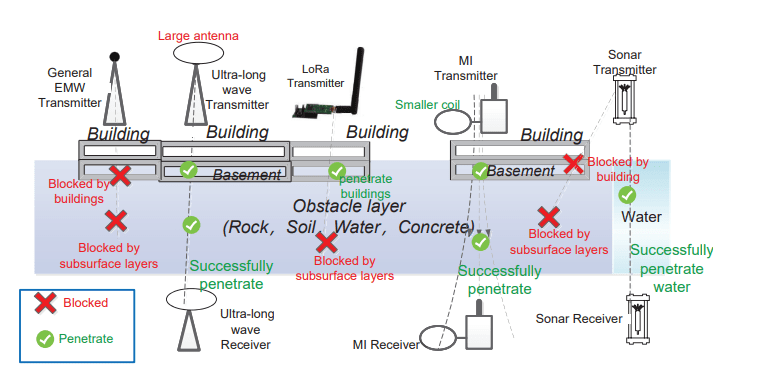
Magnetic induction communication (MIC) presents a compelling solution for establishing reliable networks underground, and researchers are now exploring its potential within integrated Space-Air-Ground-Underground (SAGUI) systems. Honglei Ma, Erwu Liu from Tongji University, Wei Ni, Zhijun Fang from Shanghai University of Engineering Science, Rui Wang from Tongji University and Shanghai Institute of Intelligent Science and Technology, and Yongbin Gao from Shanghai University of Engineering Science comprehensively survey the field of through-the-earth (TTE) MIC, addressing critical challenges and outlining future directions. This work distinguishes itself by detailing the unique characteristics of underground magnetic channels, including the recently discovered phenomenon of MI fast fading, and proposes a new geometric model to analyse it. By examining existing techniques and proposing a practical framework supporting TCP/IP and Linux, the team empowers researchers to accelerate the development and implementation of MIC within complex SAGUI networks, ultimately paving the way for seamless communication in previously inaccessible environments.
Ekram Hossain’s IEEE Editorial Leadership
Researchers actively contribute to numerous prominent journals and conferences within the field of wireless communications. Ekram Hossain serves as an Editor for several key publications, including IEEE Transactions on Wireless Communications , IEEE Transactions on Vehicular Technology , and IEEE Transactions on Information Forensics and Security . Published research encompasses a wide range of topics and authors, including studies by Chen, Zhao, and Zhang, Huang et al., Ortiz-Gomez et al., Shi et al., Tan and Akyildiz, Xie et al., and Zhang et al. This collaborative effort drives innovation and expands the boundaries of wireless communication technologies.
Underground Magnetic Communication and Soil Sensing
Magnetic induction (MI) communication is proving to be a viable technology for underground networks and integration into comprehensive Space-Air-Ground-Underground (SAGUI) systems. Recent investigations have revealed the phenomenon of MI fast fading, prompting the development of a new geometric model for its analysis and a detailed breakdown of MI channel power gain into key physical parameters. This research addresses the unique challenges of through-the-earth (TTE) communication, paving the way for robust and reliable underground networks. Practical demonstrations of MI-based wireless sensor networks have achieved real-time soil moisture sensing with communication distances of 15 to 30 meters and sensor spacing of 5 to 10 meters.
Experiments yield a root mean square error of only 6% in volumetric water content (VWC) measurements, demonstrating the accuracy and reliability of the system. Furthermore, MI technology is being applied to industrial settings, including pipeline leakage detection and infrastructure monitoring, with communication ranges extending up to 36 meters. Investigations into underwater applications have shown promising results, utilizing rotating permanent magnets to generate modulated magnetic fields and achieve energy savings in underwater communication systems, with communication distances ranging from 1 to 100 meters. Key findings from these studies include a root mean square error of 6% in volumetric water content (VWC) achievable through COMSOL simulations, sensor spacing of 5 to 10 meters in agricultural applications, and communication distances of 15 to 30 meters in mid-range MI-based underground wireless sensor networks.
Pipeline monitoring systems have been tested with pipeline lengths of 27 and 36 meters, utilizing MI waveguide models to enhance signal propagation. Researchers are utilizing frequencies ranging from 30Hz to 1kHz in rotating permanent magnet arrays (RPMAs) for energy saving in underwater magnetic induction communication. The potential for environmental and disaster monitoring applications extends to 1,000 meters, while localization applications could reach 1,700 meters.
Magnetic Induction Fast Fading and Networks
This research provides a comprehensive survey of magnetic induction communication (MIC), with a particular focus on through-the-earth (TTE) applications and the emerging challenges posed by MI fast fading. The work establishes that traditional understandings of MIC channels as quasi-static may no longer hold, as recent studies demonstrate the presence of significant fast fading effects, a topic previously unaddressed in existing surveys. To better understand this phenomenon, the team introduces an antenna vibration model and supporting simulations, contributing to the development of a universal statistical model for MI fast fading. This research advances the understanding of MIC channel behavior and lays the groundwork for improved system design.
Furthermore, this study delivers a complete review of MIC network architecture, organized according to the layers of the OSI framework. This approach reveals a critical gap in current research, the lack of standardized MI protocol stacks, which hinders the integration of MIC into larger Space-Air-Ground-Underground multi-network systems. The researchers address this need by proposing an advanced MIC framework supporting TCP/IP and Linux, providing a platform for accelerated research and implementation. While acknowledging that research on MI fast fading is still in its early stages, this work identifies key challenges and promising techniques to advance the field and enable seamless integration of underground communication networks into future mobile systems.
👉 More information
🗞 Through-the-Earth Magnetic Induction Communication and Networking: A Comprehensive Survey
🧠 ArXiv: https://arxiv.org/abs/2510.14854