

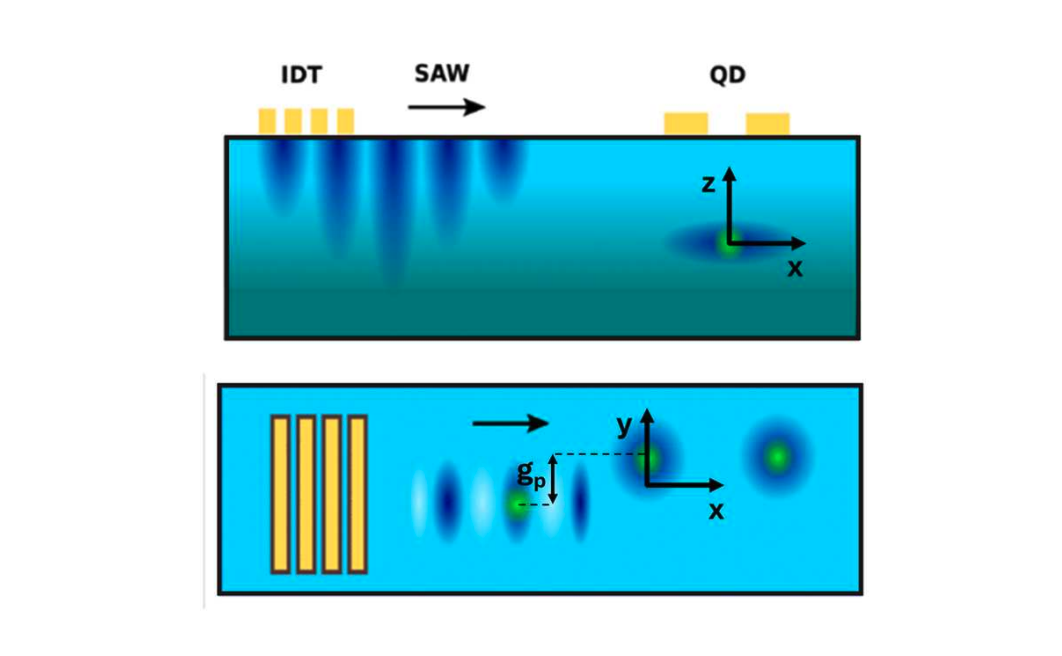
The challenge of achieving rapid, long-range interactions between quantum dots represents a significant hurdle in the development of scalable quantum technologies, particularly as computational demands increase. Mikel Olano and Geza Giedke, from the Donostia International Physics Center and the University of the Basque Country, now address a crucial aspect of this problem by investigating electron transfer between quantum dots, specifically those made to move using surface acoustic waves. Their work presents a new model for understanding this process, detailing how electrons jump between stationary and moving dots, and crucially, how the electron’s spin influences the efficiency of this transfer. By incorporating the effects of Rashba-Dresselhaus interactions, common in semiconductor materials, the researchers provide a detailed picture of electron transport that could pave the way for more efficient quantum devices.
Mobile Electron Spins for Quantum Information
This research focuses on harnessing electrons as mobile quantum bits, or qubits, within semiconductor nanostructures like quantum dots and nanowires, and manipulating their spin for quantum information processing. A central challenge lies in maintaining the coherence of these qubits while they are moved and operated on. The team explores methods to create, control, and entangle electron spins, transport these qubits coherently over significant distances, and ultimately scale up to larger quantum systems. Surface acoustic waves (SAW) are employed to dynamically control quantum dots by creating potential wells that trap and move electrons, effectively forming dynamic quantum dots and enabling coherent electron transport over long distances.
Maintaining the quantum state of the electron spin is a major hurdle, with factors like spin-orbit interaction and material imperfections causing decoherence. Long-distance qubit transport is crucial for scalable quantum computers, and SAW-driven transport offers a promising approach. Developing fast and accurate quantum gates is also essential, with SAW potentially enabling very fast operations. Scalability requires overcoming challenges in controlling and entangling many qubits, and generating entangled pairs of qubits is fundamental for many quantum algorithms. Precisely controlling the spin-orbit interaction can manipulate qubit states and implement quantum gates. This work aims to build scalable quantum computers, enable secure quantum communication, develop highly sensitive quantum sensors, and create new spintronic devices. This research describes cutting-edge work aimed at building a quantum computer based on mobile electron spins in semiconductor nanostructures, with the use of surface acoustic waves to dynamically control and transport qubits offering a potential pathway to overcome the challenges of coherence and scalability.
Moving Quantum Dots and Electron Transfer
Researchers have developed a sophisticated method to investigate electron transfer between static and moving quantum dots, a process crucial for scalable quantum computation and surface acoustic wave experiments. The team engineered a system comprising a static quantum dot and a dynamically controlled “moving” quantum dot created using a surface acoustic wave (SAW) pulse propagating within a one-dimensional waveguide. This setup allows precise manipulation and study of electron interactions over micrometer distances. Scientists model the electron’s behavior using a two-dimensional Hamiltonian that accounts for the electron’s effective mass and the combined potential created by both the static and time-dependent SAW-induced quantum dots.
To quantify the transfer process, the team calculates the time-dependent evolution of the electron’s state using a time-ordered exponential, effectively tracing the electron’s trajectory through the combined potential landscape. The primary focus lies on determining the transfer probability, calculated as the squared magnitude of the overlap between the initial state localized in the static dot and the final state localized in the moving dot. This calculation reveals the efficiency of the transfer process and provides insights into the conditions required for high-fidelity electron shuttling.
Electron Transfer Between Static and Moving Quantum Dots
Researchers have developed a detailed model to understand the transfer of single electrons between static and moving quantum dots, a process crucial for advancing scalable quantum computation and simulation. The team focused on overcoming a key challenge: efficiently moving electrons over longer distances within these arrays, particularly when one of the dots is propelled by a surface acoustic wave (SAW). Their work addresses the dynamics of electron transfer between a stationary dot and one carried by a moving SAW pulse. Through careful analysis, scientists derived equations describing the non-adiabatic transfer process, accounting for the electron’s spin state and the influence of Rashba-Dresselhaus spin-orbit interactions within gallium arsenide heterostructures.
The model considers the electron’s behavior as the SAW pulse moves, effectively creating a “moving quantum dot” that can transport the electron. Results demonstrate that successful electron transfer relies on carefully matching the parameters of the static and moving potentials, specifically ensuring near-degeneracy of their ground states. This work identifies conditions for achieving electron transfer driven solely by the SAW pulse, eliminating the need for additional pulsed gates, and paving the way for more streamlined and efficient quantum information processing.
Efficient Quantum Particle Transfer Between Moving Dots
This research presents a model demonstrating efficient transfer of a particle between a static and a moving quantum dot, achieving near-complete transfer under experimentally realistic conditions. The study reveals that this transfer can occur primarily through the interaction of the two lowest energy states of the system, simplifying the dynamics of the process. Analysis of spin-orbit interactions indicates a limited impact on transfer probability, with the derivation of an expression suggesting protection against these interactions under optimal transfer conditions. The authors acknowledge a limitation in the current model, stemming from the reduction of the Hilbert space to only the two lowest energy states, which neglects some dynamic effects related to transitions to excited states. Future work should address this by incorporating the first excited state into the system’s description and by investigating the effects of two.
🗞 Electron transfer between surface-acoustic-wave-induced moving and static quantum dots
🧠 ArXiv: https://arxiv.org/abs/2509.01525


