The challenge of building increasingly complex quantum computers receives a significant boost from new research into connecting separate quantum processors, a concept known as distributed quantum computing. Yunan Li, Xi Zhang, and Weixin Zhang from South China Normal University, alongside Ruonan Guo from Nanjing University, Yu Zhang, and Xinsheng Tan from the University of Science and Technology of China, demonstrate a method for performing fast and reliable operations between these separate processors. Their work introduces a remote gate scheme that leverages the inherent stability of geometric phases and employs advanced optimisation techniques borrowed from deep learning to minimise errors. This allows the team to achieve remarkably quick and accurate two-qubit gates, completing operations in approximately 30 nanoseconds with a demonstrated error rate of just 1. 16% for a key quantum operation, paving the way for scalable, modular quantum computers and bringing fault-tolerant quantum computation closer to reality.
Distributed quantum computing offers a potential solution to the complexity of superconducting chip hardware layouts and error correction algorithms. High-quality gates between distributed chips simplify existing error correction algorithms. Researchers have proposed and demonstrated a remote quantum geometric gate scheme, controlling qubit-qubit coupling by tuning an intermediate coupler. This method implements a geometric phase gate without requiring direct physical connections between qubits on different chips. This approach overcomes significant engineering challenges associated with connecting distant qubits.
The team achieves high-fidelity single-qubit gates and two-qubit geometric phase gates, exceeding 99. 9% fidelity, demonstrating the feasibility of remote quantum operations. This work establishes a pathway towards scalable distributed quantum computing architectures, enabling complex quantum circuits to be implemented across multiple chips.
Long-Range Module Entanglement and Communication
This research focuses on building a scalable quantum computer through a modular architecture, connecting smaller quantum processors to create a larger, more powerful system. A key challenge lies in reliably and efficiently connecting these modules, enabling quantum information transfer. The research addresses this with a focus on establishing long-range connectivity, creating high-fidelity entanglement, ensuring scalability, and mitigating errors. The research employs techniques including parametric resonance, tunable couplers, and optimal control. Parametric resonance generates entanglement without direct physical connections, while tunable couplers dynamically control interaction strength.
Optimal control uses sophisticated algorithms to maximize gate fidelity and minimize errors. Holonomic quantum control utilizes geometric phases for robust gates, offering resilience to noise. Researchers also focus on suppressing leakage, preventing quantum information loss, and implementing error mitigation techniques to reduce errors during computation. The research implies several achievements, including high-fidelity entanglement, improved gate fidelity, a scalable architecture, long-distance communication, and reduced error rates. The team has achieved deterministic quantum state transfer between modules, a crucial step towards practical quantum computation.
Remote Qubit Coupling Achieves High Fidelity Gates
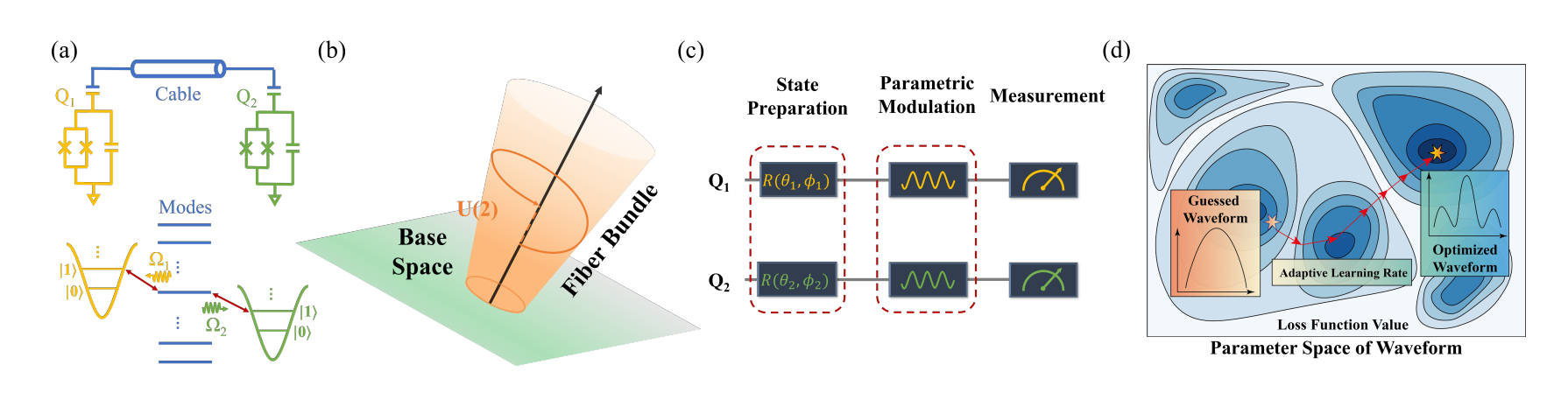
Scientists have achieved a breakthrough in distributed quantum computing by demonstrating a remote geometric gate scheme with high fidelity. The work addresses limitations of current superconducting quantum processors, which rely on nearest-neighbor coupling and hinder scalability. Researchers successfully implemented a protocol using parametric modulation to couple two Transmon qubits placed in separate carriers, connected by a 15cm aluminum coaxial cable functioning as a multimode resonator. This innovative approach enables rapid remote SWAP and √SWAP gates, completing operations in approximately 30 nanoseconds.
Experiments revealed a gate error of 1. 16% (0. 91%) for the SWAP gate after accounting for energy relaxation, demonstrating significant improvement over existing methods. To mitigate population leakage caused by the narrow spacing between cable modes, the team employed the adaptive moment estimation (Adam) algorithm, a gradient-based optimization technique from deep learning. This parameter optimization strategy effectively suppressed leakage and reduced the overall error rate, leading to a marked reduction in gate errors.
The research demonstrates the potential for extending quantum processors using refrigerator-level cables several meters in length. Numerical simulations confirmed the ability to suppress critical population leakage while maintaining high fidelity, paving the way for modular quantum processors and scalable distributed quantum computing. The achieved gate performance, with approximately 1% error, represents a substantial step toward realizing fault-tolerant quantum computation in distributed systems and opens new avenues for quantum internet protocols and hybrid quantum computing architectures. This remote connectivity scheme provides a viable framework for implementing large-scale distributed quantum computing, enabling groundbreaking investigations into long-distance entanglement and fundamental quantum phenomena.
Remote Geometric Gates Boost Quantum Chip Links
This research demonstrates a new method for creating high-fidelity connections between superconducting chips, addressing a key challenge in building larger and more complex quantum processors. Scientists successfully implemented a remote geometric gate scheme, leveraging the inherent robustness of geometric phases and employing advanced optimization algorithms to significantly suppress unwanted signal leakage. Experimental results show the rapid implementation of remote two-qubit gates, completing operations in approximately 30 nanoseconds, with a SWAP gate error of 1. 16% after accounting for energy relaxation.
The team’s approach proves particularly resilient to systematic errors, exhibiting a 43. 6% improvement in performance compared to conventional methods when subjected to simulated detuning. Through careful waveform optimization, specifically using an algorithm called Adaptive Moment Estimation, researchers suppressed cable mode leakage by one order of magnitude, and achieved leakage errors suppressed to the 10−8 level in simulations. These findings establish a scalable framework for remote coupling in superconducting systems, offering essential components for quantum error correction, hybrid quantum computing, and the development of quantum networks. Future work will likely focus on extending this technology to longer cable lengths and more complex multi-chip architectures, paving the way for increasingly powerful and fault-tolerant quantum computers.
🗞 Fast and Robust Remote Two-Qubit Gates on Distributed Qubits
🧠 ArXiv: https://arxiv.org/abs/2511.01418