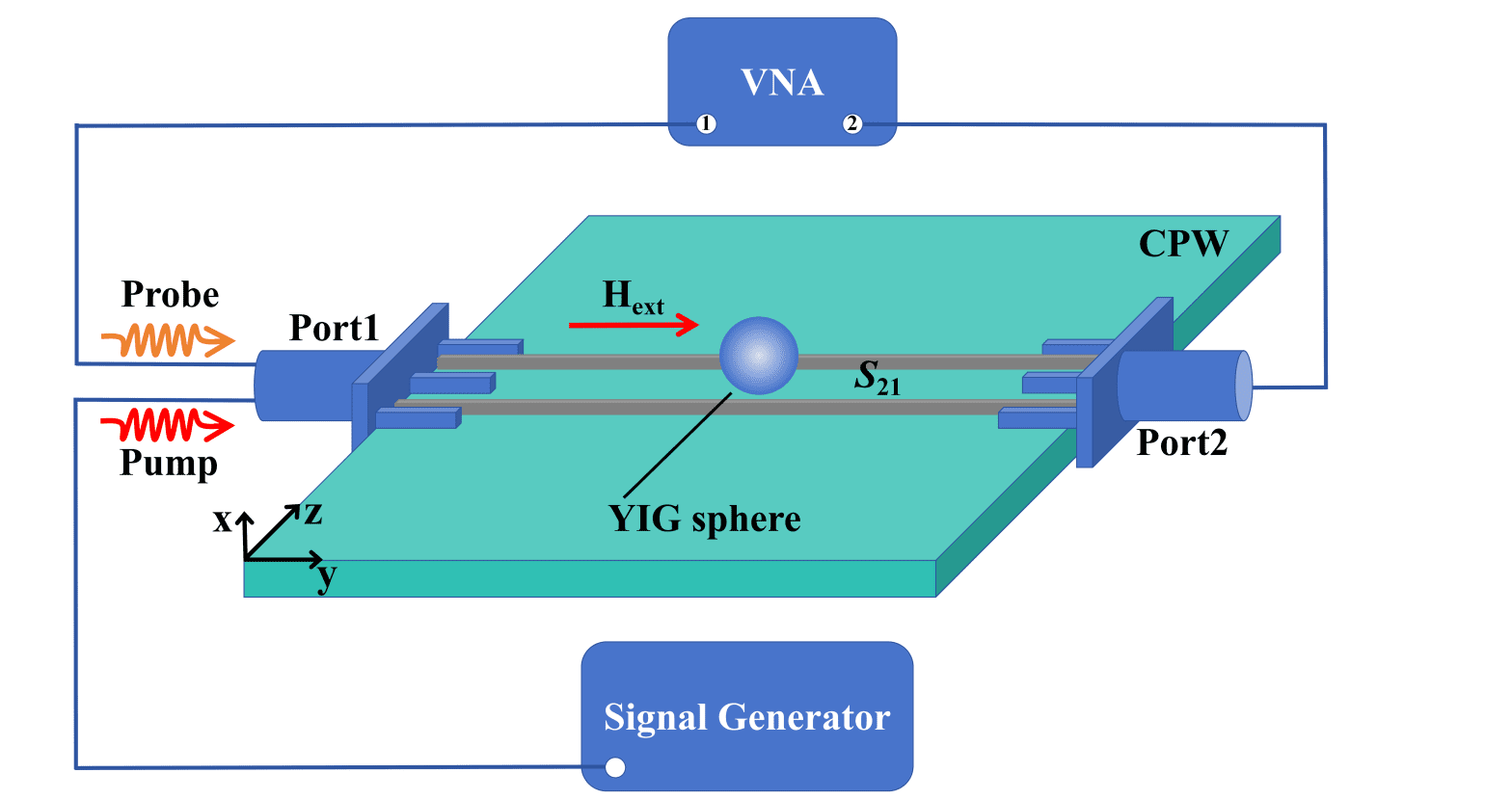
The behaviour of magnetic materials under intense microwave radiation reveals surprising insights into fundamental interactions, as Qian-Nan Huang, Zhiping Xue, and Tao Yu from Huazhong University of Science and Technology demonstrate in their recent work. The team investigates how microwaves interact with a high-quality magnetic sphere, uncovering a phenomenon called a Fano resonance, which appears when the microwave frequency nears the material’s natural resonance. This resonance arises not from single magnetic excitations, but from the complex scattering of microwaves by interacting pairs of these excitations, known as magnons, and provides a new way to detect these low-damping magnon pairs. The discovery is significant because these subtle fluctuations, particularly those with minimal energy loss, hold promise for developing more efficient and versatile magnonic devices, potentially enabling advanced logic operations in future technologies.
They observe a distinctive Fano resonance in the microwave transmission when the material is strongly driven by microwaves at a frequency near its ferromagnetic resonance. This resonance arises from the interference between discrete and continuous energy states, revealing crucial information about the system’s energy levels and how quickly energy dissipates.
The investigation demonstrates that this Fano resonance serves as a sensitive tool for detecting low-damping magnon pairs, which maintain their energy for extended periods. The team’s theoretical model, based on the principles of photon scattering and three-magnon interactions, explains how the microwave signal measures the dynamic fluctuations of both individual magnons and these long-lived pairs. The close agreement between theoretical predictions and experimental results confirms that the observed resonance originates from the exceptionally low energy dissipation within the magnon pairs.
Magnon-Photon-Phonon Coupling Creates Fano Resonances
This research explores the interaction of magnons, phonons, and photons, focusing on the emergence of Fano resonances in these coupled systems. Fano resonances are a consequence of destructive interference, creating an asymmetric spectral lineshape when a discrete energy state interferes with a continuum of states. The team investigates how to strongly couple these excitations, a crucial step for observing and controlling these resonances.
Researchers are particularly interested in cavity magnomechanics, an approach where magnons are confined within cavities to enhance their interaction with photons or phonons. This coupling opens possibilities for achieving non-reciprocity, where signals travel differently in opposite directions, which is valuable for applications like optical isolators. The potential applications extend to controlling the speed of light, enhancing light-matter interactions, and developing new technologies for quantum computing, sensing, and magnon-based logic devices.
Magnon Coupling Reveals Fano Resonance and Splitting
This study demonstrates the observation of a Fano resonance and splitting of energy levels within the microwave transmission spectra of a high-quality magnetic sphere. The team achieved these results by driving the material with strong microwaves at a frequency close to its ferromagnetic resonance. Through a theoretical model considering microwave scattering and three-magnon interactions, researchers interpret these observations as originating from the coupling between a primary magnon and pairs of magnons with opposing wave vectors.
The analysis reveals that the microwave transmission effectively measures the dynamic fluctuations of both the primary magnon and the magnon pairs, linked by their respective energy levels. This work provides new insight into nonlinear magnon interactions and may inspire advances in microwave engineering and the development of low-dissipation magnons for future information processing technologies.
👉 More information
🗞 Fano resonance as detection of low-damping magnon pairs: Theory and experiment
🧠 ArXiv: https://arxiv.org/abs/2511.01667