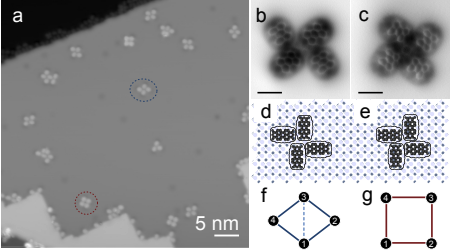
The quest to understand complex materials hinges on accurately modelling the interactions between electrons, and the Hubbard model provides a foundational, though often simplified, framework for this purpose. Oliver Tong, Katherine Cochrane, and Bingkai Yuan, along with colleagues at the University of British Columbia, now demonstrate a physical system that closely embodies an extended version of this model, offering unprecedented control over electron behaviour. By studying small clusters of molecular anions on a surface, the researchers reveal that electron occupation and energy levels align with predictions from the extended Hubbard model, even exhibiting asymmetry driven by subtle electrostatic interactions. This achievement represents a significant step forward, as it provides a tangible platform for exploring more realistic and complex fermionic Hubbard models, potentially unlocking new insights into the behaviour of electrons in a wide range of materials.
Single Molecule Charge States Probed by nc-AFM
Scientists are exploring the behaviour of single molecules to understand and control their electronic properties, with potential applications in future electronic devices and quantum technologies. This research focuses on organic molecules, such as perylene bisimide and perylenetetracarboxylic dianhydride, placed on insulating surfaces and investigated using non-contact atomic force microscopy. This technique allows researchers to image surfaces at the atomic scale without physically touching them, minimizing disturbance and enabling precise measurements of electrostatic forces and charge distribution. By carefully measuring the force between a sharp tip and the molecules, scientists can determine the energy levels within the molecules and how they respond to changes in voltage.
The team successfully mapped the charge state of individual molecules, identifying those that are neutral, positively charged, or negatively charged, and observed how the charge state changes depending on the applied voltage and molecular structure. Notably, the researchers observed periodic charging of molecules, suggesting the creation of ordered arrays of charged molecules. The research extends to observing entangled excitonic states within charged molecular assemblies, a phenomenon with potential implications for quantum information processing. These findings open avenues for developing new molecular electronics, highly sensitive sensors, and even spin sensors, leveraging the unique properties of single molecules.
PTCDA Clusters Imaged by STM and Spectroscopy
Researchers investigated the behaviour of small assemblies of molecules to understand fundamental principles of electron interactions. They focused on clusters of 3,4,9,10-perylene tetracarboxylic dianhydride deposited on a sodium chloride layer supported on a silver surface, providing a simplified model for studying more complex materials. The team carefully prepared the sample and then used scanning tunnelling microscopy to reveal the structure and arrangement of the clusters. To understand the electronic properties, scientists combined scanning tunnelling spectroscopy and electrostatic force spectroscopy, revealing the energy levels within the molecules and how charge is distributed across the cluster.
The team focused on two common cluster shapes: a lower symmetry “diamond” and a four-fold symmetric “clover”. Analysis of the data revealed that the “clover” clusters behaved uniformly, while the “diamond” clusters exhibited distinct characteristics between different sites, indicating differing local electronic environments. This variation in behaviour allows for a detailed investigation of how the arrangement of molecules influences their electronic properties and provides a platform for testing theoretical models of electron interactions. The combined approach enables precise measurements of charge distribution and energy levels, providing a foundation for understanding more complex materials.
Hubbard Model Validated by Molecular Cluster Experiments
Scientists have demonstrated a strong connection between experimental observations of molecular clusters and the predictions of the Hubbard model, a fundamental theory describing the behaviour of electrons in materials. Using advanced microscopy techniques, the team investigated small clusters of molecular anions, specifically 3,4,9,10-perylene tetracarboxylic dianhydride, deposited on a sodium chloride layer on a silver surface. The results demonstrate that the occupation and energies within these clusters align remarkably well with the predictions of an extended Hubbard model, offering a platform to study complex electron systems. Experiments revealed distinct behaviours in “diamond” and “clover” shaped clusters, differing in their symmetry and electronic properties.
Analysis of the “diamond” cluster showed an asymmetric charge distribution, with more negative charge accumulating on specific sites, indicating that the model must account for differing environments. In contrast, the “clover” cluster exhibited a more uniform charge distribution, simplifying the modeling process. Crucially, the team measured jumps in the data during spectroscopic analysis, corresponding to the addition or removal of electrons from the clusters. These jumps occurred at lower energies than expected, suggesting a reduced effective interaction parameter. Furthermore, the localization of electron addition and removal confirms that the extended Hubbard model accurately captures the charge distribution and electronic interactions within these molecular assemblies. These findings establish molecular anion clusters as a promising avenue for probing realistic models and exploring complex physics.
Molecular Clusters Mimic Correlated Electron Systems
This research demonstrates that small clusters of molecular anions, positioned on a surface, effectively model the behaviour of complex electron systems described by the extended Hubbard model. The team used advanced microscopy techniques to study these clusters and found that the distribution of electrons across the molecules, and their associated energies, align well with predictions from the model. Importantly, the observed asymmetry in electron occupation arises not from the strength of electron interactions themselves, but from subtle differences in the electrostatic potential experienced by each molecule within the cluster. The findings suggest that these molecular systems offer a promising new platform for simulating and investigating the behaviour of electrons, a field crucial to understanding many materials.
Unlike traditional approaches, this method uses singly charged molecules to directly represent the model, and allows for precise control over intermolecular spacing and interactions. The researchers acknowledge that while the model accurately captures the observed behaviour, it is a simplified representation of real materials, and further work is needed to explore more complex systems. Future research could focus on tuning the intermolecular interactions and screening effects, and leveraging scanning probe techniques to investigate these systems in greater detail.
🗞 Extended Hubbard Model realized in 2D clusters of molecular anions
🧠 ArXiv: https://arxiv.org/abs/2509.05868