

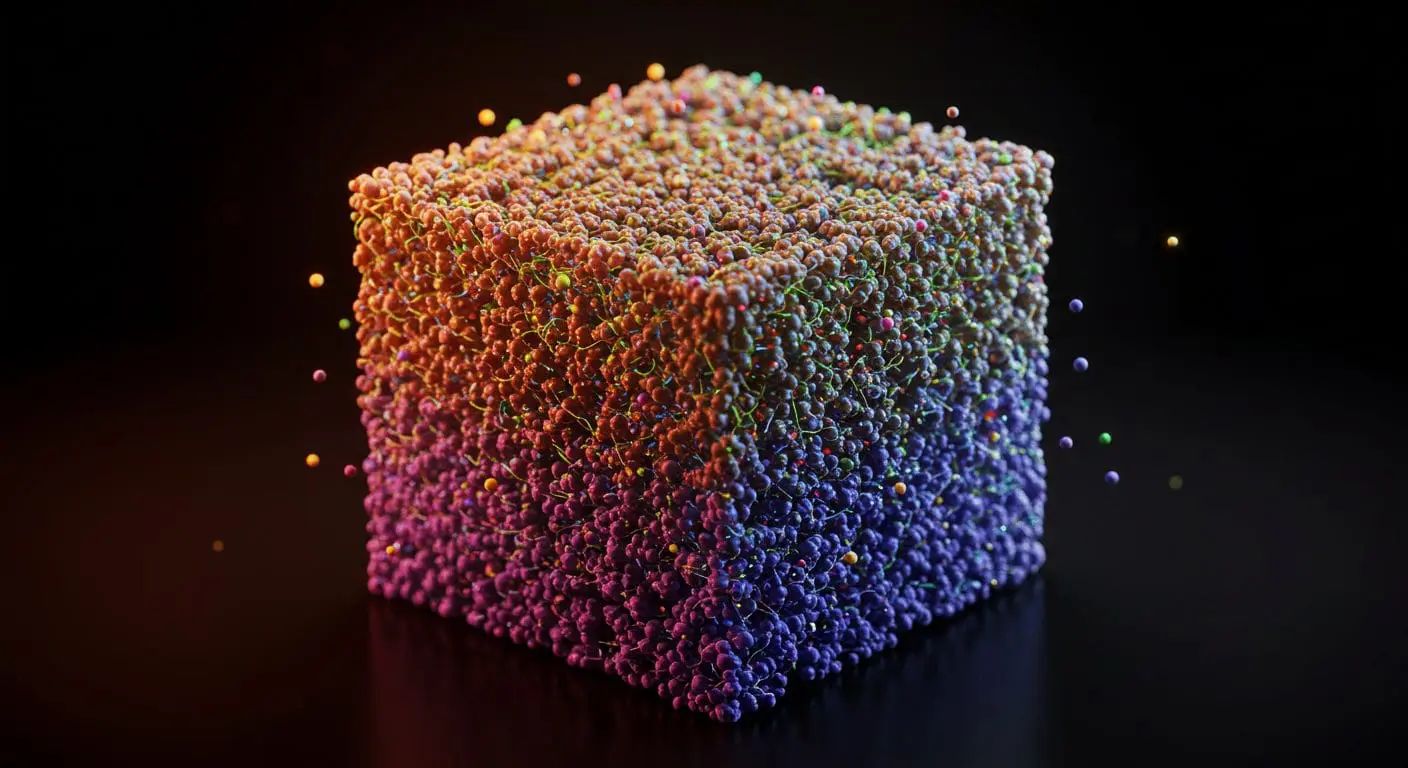
On April 2, 2025, researchers published Observing Spatial Charge and Spin Correlations in a Strongly-Interacting Fermi Gas, revealing novel insights into two-dimensional fermion behaviour. Their study, utilizing advanced microscopy techniques, uncovered correlations beyond traditional BCS theory, offering fresh perspectives on quantum systems and suggesting a paradigm shift in strongly correlated fermionic matter.
Researchers studied two-dimensional attractive Fermi gases using atom-resolved microscopy, observing fermion pairing and analyzing spatial charge and spin correlations. They found discrepancies between experimental results and mean-field BCS theory, revealing a forbidden dip in pair correlation functions confirmed by exact Monte Carlo simulations. The study demonstrated that BCS predictions fail not only in the superfluid crossover regime but also on the weakly attractive side. By measuring two- and three-point correlations, they established pair-correlations dominance and characterized short-range behavior via Tan’s Contact, aligning with numerical predictions. This work provides a novel microscopic understanding of strongly-correlated fermionic matter.
Ultracold Atom Experiments
In a groundbreaking study, researchers have made significant strides in understanding the complex behaviour of ultracold atoms as they transition between two distinct quantum states: the Bose-Einstein condensate (BEC) and the BCS superfluid. This work bridges the gap between theoretical predictions and experimental observations and provides new insights into the intricate dance of quantum particles at extremely low temperatures.
The experiment focuses on a system of ultracold
The experiment focuses on a system of ultracold atoms that can be tuned to transition smoothly from a BEC to a BCS superfluid. This crossover represents one of the most fascinating phenomena in modern physics, where quantum effects dominate and classical intuition often fails. By carefully controlling the interactions between atoms, researchers can probe the fundamental properties of matter in these extreme conditions.
To analyze the system, the team employed advanced computational techniques known as auxiliary-field quantum Monte Carlo (AFQMC) simulations. These simulations allow for precise calculations of complex quantum correlations, providing a detailed map of how particles behave across the BEC-BCS crossover. A key aspect of the study was testing the validity of Wick’s theorem—a foundational principle in quantum field theory that relates higher-order correlation functions to lower-order ones.
Wick’s theorem assumes that certain relationships between particle correlations hold true, regardless of the system’s complexity. However, as the atoms transition from a BEC to a BCS state, these assumptions begin to break down. The researchers found that traditional Wick relations fail in the strongly interacting regime, where quantum fluctuations dominate. This breakdown highlights the limitations of conventional theoretical frameworks in describing such systems.
Despite the failure of standard Wick relations, the team discovered that modified versions of these equations could still provide accurate predictions for higher-order correlations. By leveraging experimental measurements and computational simulations, they developed a novel approach to reconstructing quantum correlations without relying on the assumptions of Wick’s theorem. This method proved remarkably effective, yielding results that closely matched both theoretical predictions and experimental observations.
The findings have profound implications for our understanding of quantum systems
The findings have profound implications for our understanding of quantum systems. They demonstrate that even in regimes where traditional theories fall short, innovative approaches can still provide valuable insights into the behavior of matter at the quantum level. This work opens new avenues for exploring exotic quantum phases and could pave the way for future breakthroughs in fields ranging from quantum computing to materials science.
This study represents a significant step forward in our quest to unravel the mysteries of quantum matter. Researchers have highlighted the complex interplay between particles in extreme quantum systems by combining cutting-edge experimental techniques with advanced computational methods. As we continue to push the boundaries of what is possible in ultracold atom physics, these insights will undoubtedly play a crucial role in shaping our understanding of the quantum world.
🗞Observing Spatial Charge and Spin Correlations in a Strongly-Interacting Fermi Gas
🧠 DOI: https://doi.org/10.48550/arXiv.2504.01885


