

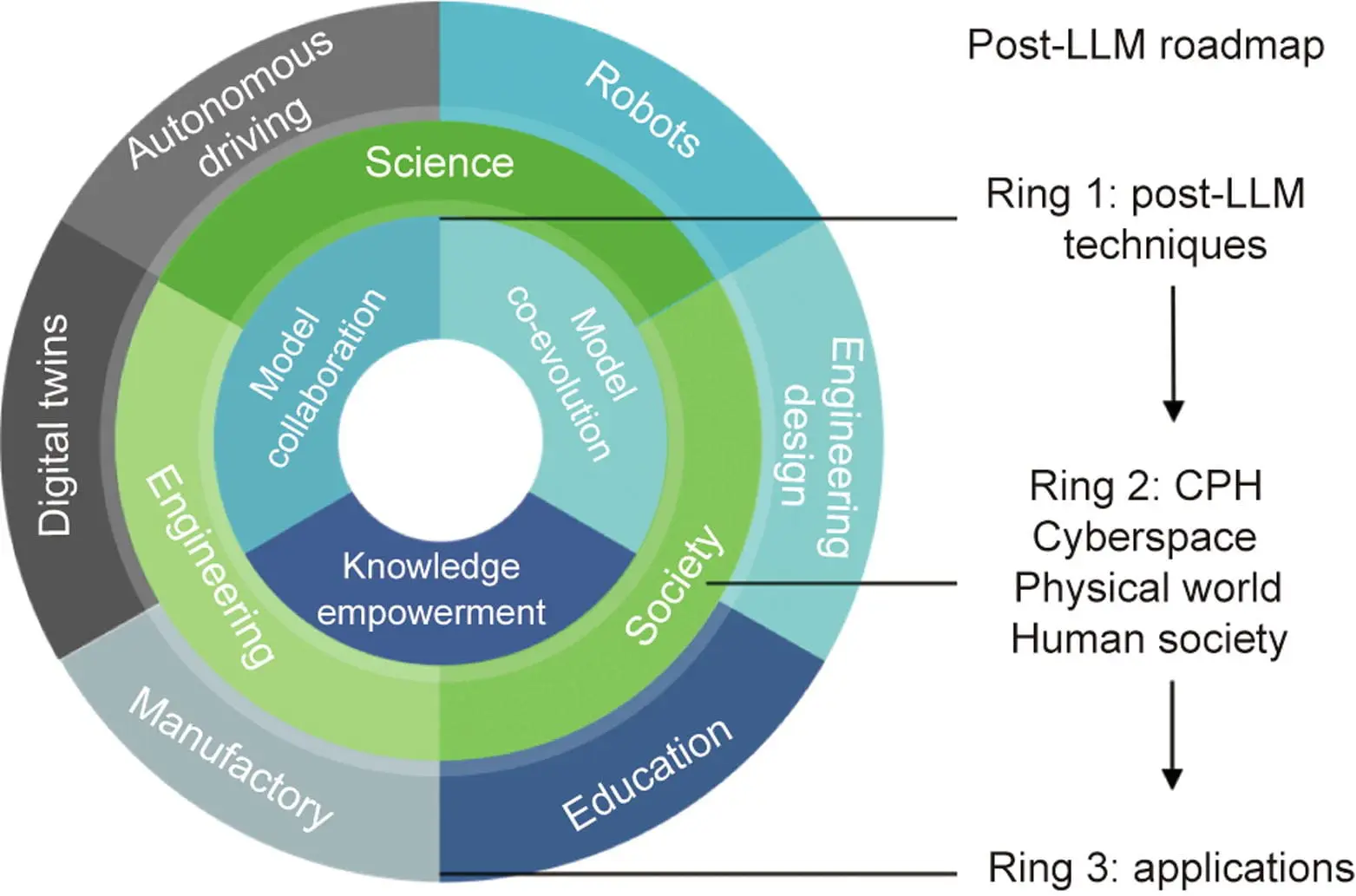
A recent paper published in Engineering by Fei Wu et al. explores the future of artificial intelligence (AI) beyond large language models (LLMs), addressing limitations such as outdated information, inefficiency, and lack of interpretability. The authors propose three key directions for advancing AI: knowledge empowerment, model collaboration, and model co-evolution. Knowledge empowerment integrates external knowledge into LLMs through retrieval-augmented generation, enhancing factual accuracy and reasoning.
Model collaboration leverages the strengths of different models, such as using LLMs to coordinate specialized small models in tasks like image generation. Model co-evolution enables multiple models to evolve together, addressing heterogeneity in models, tasks, and data through techniques like federated learning. These advancements have applications in science, engineering, and society, including renewable energy forecasting and healthcare. The paper also highlights future research directions, such as embodied AI and non-transformer foundation models, emphasizing the importance of integrating knowledge, collaboration, and co-evolution to build more robust AI systems.
Limitations of Large Language Models
Large Language Models (LLMs) have achieved significant advancements in various tasks, yet they are not without limitations. One major issue is their reliance on outdated information, as LLMs are trained on data up to a certain point and cannot dynamically update or access real-time information. This limitation can lead to inaccuracies when responding to queries that require current or time-sensitive knowledge.
Another critical challenge is LLMs’ tendency to generate hallucinations—outputs that contain false or fabricated information. While LLMs can produce coherent and contextually relevant text, they cannot verify the accuracy of their responses, which can lead to misleading or incorrect statements. This issue is particularly problematic in fields requiring high precision, such as healthcare and law.
Additionally, LLMs are computationally intensive, necessitating substantial resources for training and inference. This limits their deployment in resource-constrained environments or real-time applications. Furthermore, the lack of interpretability makes understanding how these models arrive at specific decisions difficult, hindering trust and debugging in critical domains.
Knowledge Empowerment
Knowledge empowerment integrates external knowledge into LLMs to address these limitations, enhancing their capabilities beyond traditional boundaries. This approach incorporates real-time data and verified sources during training, using techniques like knowledge-aware loss functions to improve factual accuracy. Retrieval-augmented generation dynamically fetches relevant information during inference, providing up-to-date responses.
These advancements boost factual accuracy, reasoning capabilities, and interpretability, making AI systems more reliable in healthcare, finance, and education. LLMs can overcome their inherent limitations by leveraging external knowledge and delivering more accurate and trustworthy outputs.
Model Collaboration
Model collaboration strategies combine multiple models to leverage their strengths. Techniques include model merging, ensembling, and functional collaboration, where LLMs work with specialized smaller models for tasks like image generation. This division of labor enhances efficiency and effectiveness, enabling AI systems to handle complex tasks more effectively.
Collaboration strategies can integrate diverse models to address the limitations of individual models, such as computational intensity or lack of interpretability. This approach allows for more flexible and adaptive AI solutions to meet the demands of various real-world applications.
Model Co-evolution
Model co-evolution involves developing and adapting multiple AI models to improve collective performance. Parameter sharing, knowledge distillation, multi-task learning, adaptive optimization, federated learning, and transfer learning address challenges like model heterogeneity, task diversity, and data variability.
These strategies enhance adaptability and efficiency, allowing AI systems to handle diverse applications more effectively in real-world scenarios. Co-evolution ensures that AI systems remain robust and scalable across different domains and use cases by fostering collaboration and co-adaptation among models.
Impacts and Future Directions
The advancements in knowledge empowerment, model collaboration, and co-evolution are reshaping the landscape of AI applications. These innovations address critical limitations of traditional LLMs, such as factual accuracy, efficiency, and interpretability, paving the way for more reliable and versatile AI systems.
Looking ahead, integrating external knowledge, collaborative modeling, and adaptive strategies will continue to drive progress in AI. As these technologies mature, they hold the potential to revolutionize fields ranging from healthcare and education to autonomous systems and beyond, creating a future where AI is not only powerful but also transparent, efficient, and trustworthy.
More information
External Link: Click Here For More


