

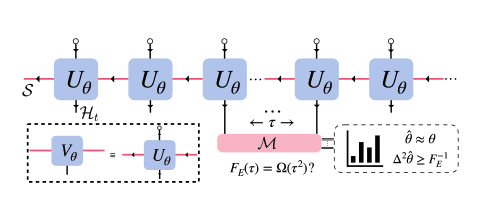
On April 18, 2025, Siddhant Midha and Sarang Gopalakrishnan published Metrology of open quantum systems from emitted radiation, detailing their exploration into understanding Markovian open systems through emitted radiation. Their work highlights how Fisher information scales with time, offering insights into quantum sensing applications.
The research explores learning about Markovian open system dynamics through emitted radiation. It describes the radiation state as a temporally ordered matrix-product state (MPS) and provides analytical expressions for Fisher information (QFI), which scales linearly with time unless multiple steady states exist. The study identifies QFI crossovers near dynamical phase transitions, emphasizing temporal correlations’ role in asymptotic QFI growth rates. It also discusses conditions for optimal measurement of radiation.
In the evolving landscape of quantum technology, precision sensing has achieved a significant advancement through an innovative approach that integrates entangled states and quantum error correction. This development holds transformative potential for fields such as magnetometry and inertial sensing, promising enhanced accuracy and reliability.
Central to this progress is the utilization of degenerate matrix product states (MPS). MPS serve as efficient representations of quantum states, with their degenerate nature enabling multiple states to share the same energy level. This structure facilitates error detection and correction while maintaining the integrity of entangled states against environmental noise, thereby improving sensing performance.
The methodology employs quantum error correction codes to protect entangled states from decoherence, a critical challenge in quantum systems. By preserving these states, the approach ensures sustained measurement accuracy over extended periods. The optimization of joint quantum Fisher information, which measures the information content about an unknown parameter, leads to higher precision.
This breakthrough offers diverse applications. In magnetometry, enhanced sensors could elevate medical imaging and navigation systems by detecting magnetic fields with greater accuracy. For inertial sensing, crucial for drones and autonomous vehicles, this technology could enhance motion detection and orientation systems, ensuring more reliable performance.
The research examines the steady-state spectrum of the Liouvillian superoperator, which describes the long-term behavior of quantum systems under noise. Understanding this spectrum aids in designing effective error correction schemes. Additionally, Hermitian eigenmatrices ensures unbiased measurements by maintaining quantum state integrity during sensing and error correction.
This research successfully merges advanced quantum state representation with robust error correction techniques, resulting in a more reliable and precise sensing method. By protecting entanglement and optimizing system response to noise, this framework could significantly enhance various sensing technologies across different fields, paving the way for future advancements in quantum applications.
👉 More information
🗞 Metrology of open quantum systems from emitted radiation
🧠 DOI: https://doi.org/10.48550/arXiv.2504.13815


