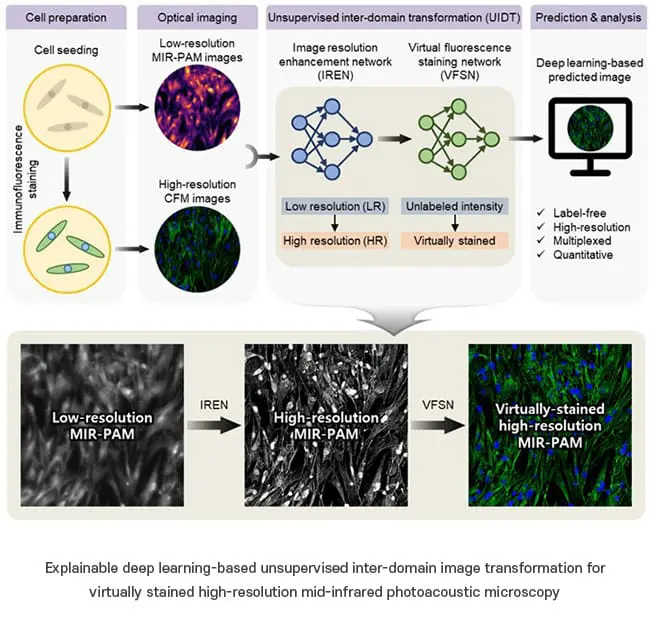
The quest for high-resolution cellular imaging has long been hindered by the limitations of traditional methods, which often require fluorescent staining that can damage cells or rely on longer wavelengths that compromise spatial resolution. However, a recent innovation from a research team at POSTECH has successfully bridged this gap by harnessing the power of explainable deep learning (XDL) to transform low-resolution, label-free images into high-resolution, virtually stained ones.
This pioneering technology, published in Nature Communications, leverages a two-phase imaging process to enhance resolution and produce detailed cellular structures without fluorescent dyes, thereby preserving cell integrity and offering a robust tool for live-cell analysis and advanced biological research. By combining the benefits of mid-infrared photoacoustic microscopy (MIR-PAM) with the precision of confocal fluorescence microscopy (CFM), this breakthrough-free approach has opened up new avenues for multiplexed, high-resolution cellular imaging, poised to revolutionize the field of life sciences and disease model studies.
Introduction to High-Resolution Imaging Technologies
The field of life sciences has witnessed significant advancements in imaging technologies, enabling researchers to visualize cellular structures with unprecedented precision. Confocal fluorescence microscopy (CFM) is a widely used technique for producing high-resolution cellular images. However, it requires fluorescent staining, which poses risks of photobleaching and phototoxicity, potentially damaging the cells under study. On the other hand, mid-infrared photoacoustic microscopy (MIR-PAM) allows for label-free imaging, preserving cell integrity, but its reliance on longer wavelengths limits spatial resolution.
To overcome these limitations, researchers at POSTECH have developed an innovative imaging method powered by explainable deep learning (XDL). This approach transforms low-resolution, label-free MIR-PAM images into high-resolution, virtually stained images resembling those generated by CFM. The XDL technique offers enhanced transparency by visualizing the transformation process, ensuring both reliability and accuracy. By bridging the gaps between different imaging modalities, this technology has the potential to revolutionize live-cell analysis and advanced biological research.
The development of this technology is a result of collaborative efforts between Professors Chulhong Kim and Jinah Jang, alongside their team members. The researchers implemented a single-wavelength MIR-PAM system and designed a two-phase imaging process: the Resolution Enhancement phase and the Virtual Staining phase. This innovative approach delivers high-resolution, virtually stained cellular imaging without compromising cell health, offering a powerful new tool for life sciences research.
Explainable Deep Learning for Image Transformation
The XDL technique is a crucial component of the POSTECH team’s imaging method. Unlike conventional AI models, XDL provides enhanced transparency by visualizing the transformation process, ensuring both reliability and accuracy. This approach enables researchers to understand how the low-resolution MIR-PAM images are transformed into high-resolution, virtually stained images. The XDL technique is based on a cross-domain image transformation technology that bridges the physical limitations of different imaging modalities, offering complementary benefits.
The Resolution Enhancement phase of the imaging process converts low-resolution MIR-PAM images into high-resolution ones, clearly distinguishing intricate cellular structures such as nuclei and filamentous actin. This phase is critical in producing high-quality images that are comparable to those generated by CFM. The Virtual Staining phase produces virtually stained images without fluorescent dyes, eliminating the risks associated with staining while maintaining CFM-quality imaging.
The use of XDL in image transformation has significant implications for life sciences research. By providing a reliable and accurate method for producing high-resolution, virtually stained images, researchers can now conduct live-cell analysis and disease model studies with unprecedented precision. The XDL technique also holds immense potential for applications in multiplexed, high-resolution cellular imaging without labeling.
Mid-Infrared Photoacoustic Microscopy (MIR-PAM)
MIR-PAM is a label-free imaging modality that allows for the preservation of cell integrity. This technique relies on the absorption of mid-infrared radiation by biomolecules, producing photoacoustic signals that can be used to generate images. However, MIR-PAM has limitations in terms of spatial resolution due to its reliance on longer wavelengths. The POSTECH team’s innovative imaging method addresses this limitation by using XDL to transform low-resolution MIR-PAM images into high-resolution, virtually stained images.
The single-wavelength MIR-PAM system implemented by the researchers is a critical component of their imaging method. This system enables the production of high-quality images with improved spatial resolution, making it possible to visualize fine cellular structures with precision. The combination of MIR-PAM and XDL has significant implications for life sciences research, enabling researchers to conduct live-cell analysis and disease model studies with unprecedented precision.
The use of MIR-PAM in conjunction with XDL also eliminates the risks associated with fluorescent staining, which can cause photobleaching and phototoxicity. This makes it possible to conduct long-term imaging studies without compromising cell health, providing valuable insights into cellular behavior and dynamics.
Applications and Implications
The POSTECH team’s innovative imaging method has significant implications for life sciences research. By providing a reliable and accurate method for producing high-resolution, virtually stained images, researchers can now conduct live-cell analysis and disease model studies with unprecedented precision. The XDL technique also holds immense potential for applications in multiplexed, high-resolution cellular imaging without labeling.
The use of this technology can enable researchers to study cellular behavior and dynamics in real-time, providing valuable insights into the underlying mechanisms of various diseases. This can lead to the development of new therapeutic strategies and treatments, improving human health and quality of life. The POSTECH team’s research was supported by several funding agencies, including the Ministry of Education, the Ministry of Science and ICT, and the Korea Medical Device Development Fund.
The implications of this technology extend beyond basic research, with potential applications in clinical settings and biomedical industries. The ability to conduct live-cell analysis and disease model studies with unprecedented precision can enable the development of personalized medicine approaches, improving treatment outcomes and patient care. The POSTECH team’s innovative imaging method is a significant step forward in the field of life sciences, enabling researchers to push the boundaries of human knowledge and understanding.
External Link: Click Here For More