The search for sources of the most energetic radiation in the universe drives innovation in astrophysics, and recent work focuses on identifying potential ‘PeVatrons’ capable of accelerating particles to ultra-high energies exceeding the PeV scale. Andrea Addazi from Sichuan University and INFN, Salvatore Capozziello from the University of Naples, and Qingyu Gan, along with their colleagues, investigate novel classes of exotic astrophysical objects that could serve as these powerful accelerators. Their research explores whether ultra-spinning black hole systems, alongside compact objects like boson stars and axion stars, generate the intense magnetic fields necessary for particle acceleration beyond the limits of conventional sources such as supernova remnants. The team demonstrates that these ‘exotic PeVatrons’ could exist throughout our galaxy and potentially be within reach of current and future gamma-ray observatories, offering a new avenue for understanding the origins of the universe’s most energetic phenomena.
Exotic Compact Objects and Alternatives to Black Holes
Scientists are actively investigating exotic compact objects, exploring possibilities beyond traditional neutron stars and black holes. This research focuses on identifying alternative theoretical objects, such as wormholes, gravastars, and fuzzballs, and understanding how dark matter and dark energy might influence their formation and properties. Investigations also extend to modified theories of gravity, seeking explanations for extreme gravitational environments. A key component of this work involves using advanced telescopes and detectors to search for unique observational signatures from these objects, including gamma rays, cosmic rays, and neutrinos.
Theoretical modeling plays a crucial role, with scientists developing detailed descriptions of the internal structure and properties of these compact objects, particularly their stability and interactions with surrounding matter. Research explores concepts like Stueckelberg theory, scalar-tensor theories, and the behavior of solitons within these extreme environments, aiming to build a comprehensive picture of these exotic objects and their potential role in the universe. Researchers are also investigating the possibility that dark matter itself could form compact objects and how dark energy might influence their structure. Observational astronomy, utilizing instruments like HAWC, LHAASO, and KM3NeT, is central to this effort, searching for multi-messenger signals that could reveal the presence of these objects. This multifaceted approach combines theoretical modeling with observational data to push the boundaries of our understanding of gravity and the universe.
PeVatron Emission From Exotic Compact Objects
Scientists investigated whether exotic astrophysical objects could generate ultra-high-energy gamma rays, extending beyond the PeV scale. They modeled several theoretical candidates, including ultra-spinning black holes, boson stars, axion stars, and Q-balls, to determine if they could produce these powerful emissions. The study focused on how these compact objects interact with millicharged dark matter to create strong magnetic fields and accelerate particles to extreme energies, establishing conditions for PeVatron production. The team calculated emission power based on object properties and dark matter interactions, finding that a relatively small electric charge requirement allows for PeVatron activity.
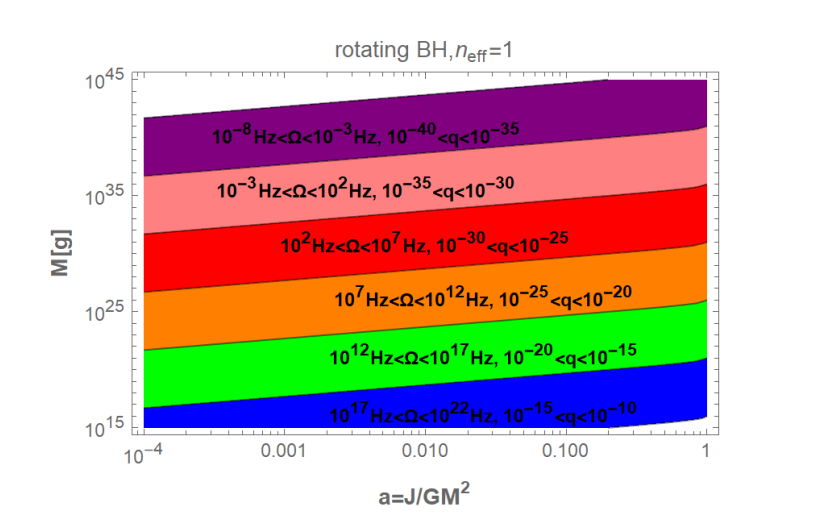
They discovered that Q-balls with specific masses and radii are particularly promising candidates. Further analysis revealed a discrete spectrum of emission power, with black hole vortices exhibiting emission power largely independent of rotation, while gauged axion stars and Q-balls showed stronger scaling with rotation. Researchers also modeled gravitational wave emission from rapidly rotating boson stars, treating them as inspiraling binary systems to estimate the energy density. Calculations revealed the potential for concurrent PeVatron and gravitational wave emission, with characteristic frequencies and amplitudes detectable by upcoming observatories like aLIGO, CE, and ET, offering a multi-messenger approach to understanding these mysterious objects.
PeVatron Sources and Millicharged Dark Matter
This work explores “Exotic PeVatrons”, novel astrophysical sources capable of generating ultra-high-energy gamma rays extending beyond the PeV scale. Researchers investigated several compact objects, including ultra-spinning black holes, boson stars, axion stars, and Q-balls, hypothesizing their existence arises from quantum gravity and interactions with millicharged dark matter. The study demonstrates that these objects can produce powerful emissions through unique mechanisms, surpassing the energy limits of conventional sources like pulsar wind nebulae and supernova remnants. Experiments reveal that rotating boson stars and black hole vortices coupled with millicharged dark matter can generate ultra-high-energy gamma rays with luminosities potentially detectable by current and future observatories.
Analysis of emission power as a function of spin demonstrates distinctive scaling behaviors, with gauged axion stars exhibiting rapidly increasing power, while gauged Q-balls follow a quadratic scaling. Crucially, the discrete emission power spectrum offers a potential method for distinguishing between different exotic compact object classes. Furthermore, the research predicts that rapidly rotating boson stars generate gravitational waves through changes in their vortex winding number. Calculations show that the gravitational wave energy density is within the sensitivity ranges of upcoming detectors like aLIGO, CE, and ET. This multi-messenger signature, combining PeV gamma rays and intermediate-frequency gravitational waves, provides a unique probe of these exotic compact objects.
Exotic PeVatrons and Millicharged Dark Matter Emission
This research establishes a theoretical framework for Exotic PeVatrons, novel astrophysical sources capable of generating ultra-high-energy gamma rays extending beyond the PeV scale, and explores their observational implications. The study demonstrates that exotic compact objects, including ultra-spinning black holes, boson stars, and Q-balls, can produce these high-energy emissions through unique mechanisms involving interactions with millicharged dark matter, potentially generating luminosities approaching 1037 erg/s. The team’s analysis predicts that these Exotic PeVatrons may also emit gravitational waves within the frequency ranges detectable by current and future observatories, such as aLIGO, CE, and ET. This multi-messenger signature, combining PeV gamma rays and intermediate-frequency gravitational waves, offers a unique opportunity to probe the nature of these exotic compact objects and distinguish between different classes. The authors highlight the potential for future observations of ultra-high-energy gamma rays beyond 10 PeV to provide definitive evidence for their existence. Furthermore, the research suggests a connection between Exotic PeVatrons and the production of ultra-high-energy neutrinos, potentially extending the reach of observations to extra-galactic sources, opening new avenues for exploring physics beyond the Standard Model and the nature of dark matter.
🗞 Exotic PeVatrons as sources of ultra-high-energy gamma rays
🧠 ArXiv: https://arxiv.org/abs/2510.00254