Understanding how light and matter interact at the quantum level remains a central challenge in physics and chemistry, and recent work by Iman Ahmadabadi, I-Te Lu, and colleagues at institutions including the Joint Quantum Institute, NIST, and the Max Planck Institute for the Structure and Dynamics of Matter, represents a significant step forward. The team developed a new method for accurately modelling the behaviour of many-electron systems when exposed to light, spanning conditions from weak to extremely strong light-matter coupling. By creating a practical exchange-correlation functional within a theoretical framework called quantum electrodynamics density functional theory, they achieve remarkable agreement with more complex calculations, offering a computationally efficient route to simulating the quantum properties of atoms and molecules in realistic environments. This advancement promises to unlock new possibilities for designing materials with tailored optical properties and understanding fundamental quantum phenomena.
Polariton Chemistry and Cavity Quantum Electrodynamics
This compilation details research into polariton chemistry, cavity quantum electrodynamics (QED), and time-dependent density functional theory (TDDFT). The central theme explores how strong coupling between light and matter, forming polaritons, alters chemical reactions and material properties, establishing foundational concepts and methodologies in this rapidly evolving field. Cavity QED provides the physical framework for these investigations, confining light to enhance light-matter interaction. Researchers employ theoretical modeling and experimental applications, utilizing both TDDFT and QEDFT as primary computational methods.
While TDDFT serves as a standard approach, it often struggles with strong coupling regimes, making QEDFT, which explicitly includes the electromagnetic field, essential for accurately modeling polariton chemistry. Computational methods rely on tools like Octopus and Gaussian, alongside pseudopotentials and basis sets to efficiently represent core electrons and electronic wavefunctions. Techniques like DIIS accelerate calculations, while optimization algorithms identify minimum energy configurations and self-interaction correction improves accuracy. This research spans areas including modifying material properties with cavity QED to engineer topological states and enhance superconductivity, and understanding how strong coupling affects chemical reaction rates, pathways, and selectivity.
Researchers focus on vibrational strong coupling, involving molecular vibrations, and the role of non-equilibrium dynamics. Several studies highlight specific research directions, including engineering material properties with QEDFT, modeling non-equilibrium effects, and improving computational efficiency. A clear trend emerges towards using QEDFT for accurately modeling strong coupling phenomena, recognizing the limitations of standard TDDFT, and developing more efficient algorithms to address computational demands. This interdisciplinary field, combining quantum chemistry, condensed matter physics, and materials science, attracts growing interest and indicates a promising future for polariton chemistry and its potential applications.
Photon-Electron Correlation Functional for Light-Matter Coupling
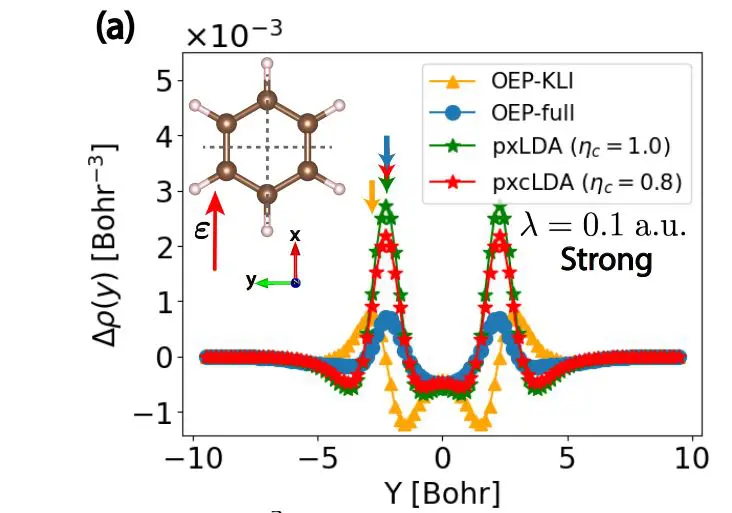
Scientists developed a photon-free exchange-correlation functional, termed pxcLDA, within the local density approximation for quantum electrodynamical density functional theory. This functional accurately describes the electron density of many-electron systems experiencing weak to ultra-strong light-matter coupling. Building upon previous work with one-electron systems, the team engineered a procedure to determine a renormalization factor that accounts for electron-photon correlations and inhomogeneity, particularly in the weak-coupling regime. The team rigorously benchmarked this factor against quantum electrodynamics coupled-cluster (QED-CC) and QED optimized effective potential (QED-OEP) methods, serving as highly accurate references.
They employed a diverse set of atoms and molecules, including Helium, Neon, Lithium Hydride, Nitrogen, Benzene, Azulene, and Sodium dimer chains, to validate the pxcLDA functional across a range of system sizes and coupling strengths. Researchers minimized a normalized squared difference between electron densities to precisely determine the optimal renormalization factor for each system. This approach captures crucial electron-photon correlation effects absent in standard pxLDA functionals, significantly improving accuracy, especially for systems with few electrons. As the number of electrons or effective collective coupling increases, the renormalization factor approaches unity, indicating electron-photon exchange dominates and enhancing accuracy for larger systems. This innovative methodology provides a practical route to applying QEDFT functionals to realistic materials, offering a computationally efficient alternative to wavefunction-based methods for studying light-matter interactions.
Photon-Free Functional Accurately Models Light-Matter Interactions
Scientists have developed a photon-free exchange-correlation functional, termed pxcLDA, within quantum electrodynamical density functional theory (QEDFT) to efficiently describe the electron density of many-electron systems under varying light-matter coupling conditions. Building upon previous work with one-electron systems, the team devised a procedure to compute a renormalization factor that accounts for electron-photon correlations and inhomogeneity, comparing results against quantum electrodynamics coupled-cluster (QED-CC) and QED optimized effective potential (QED-OEP) methods as accurate references in the weak-coupling regime. Across a diverse set of atoms and molecules, including Helium, Neon, Lithium Hydride, Nitrogen, Benzene, Azulene, and Sodium dimer chains, pxcLDA reproduces cavity-modified densities in close agreement with benchmark calculations. The calculated renormalization factor approaches unity as system size or collective coupling increases, indicating a dominance of electron-photon exchange and improved accuracy for larger systems.
Unlike pxLDA, which excludes electron-photon correlation effects, the pxcLDA functional incorporates these effects through a tuned renormalization factor, determined by minimizing a normalized squared difference between electron densities. This captures missing correlation and inhomogeneity effects, demonstrating that as the number of electrons or effective collective coupling increases, the renormalization factor converges towards unity. The study covers systems ranging from weak to ultra-strong light-matter coupling, and the results demonstrate that the pxcLDA approximation performs well across a wide range of materials, highlighting its potential for investigating cavity-induced modifications to material properties.
🗞 Testing electron-photon exchange-correlation functional performance for many-electron systems under weak and strong light-matter coupling
🧠 ArXiv: https://arxiv.org/abs/2512.14655