The growing catalogue of merging binary black holes detected through gravitational waves is now revealing underlying patterns in their properties, and a new analysis of this data suggests the existence of distinct groups within the population. Sharan Banagiri, Eric Thrane, and Paul D. Lasky, all from Monash University, investigated the latest gravitational wave detections and demonstrate compelling evidence for at least three subpopulations of merging black holes, each characterised by a different range of primary masses. This research reveals that these groups exhibit variations in both the ratio of their masses and the magnitude of their spins, indicating that black holes do not form through a single, uniform process. By identifying these subpopulations, scientists gain crucial insights into the diverse formation pathways of black holes and can begin to unravel the astrophysical origins of these powerful cosmic events.
Researchers investigated whether a single population model adequately describes the observed data, or if multiple subpopulations with differing characteristics provide a better explanation. Employing Bayesian inference, the team compared models using Bayes factors, quantifying the evidence for one model over another, and analyzed 152 binary black hole events from the latest catalog. This approach allows scientists to refine their understanding of black hole populations based on observed data.
Bayes factors measure the strength of evidence for one model compared to another, while Bayesian inference updates beliefs about population parameters based on observed data. The analysis revealed significant differences in key parameters, including mass ratio, spin magnitude, spin tilt, and redshift, between the proposed subpopulations. This flexible framework allows for a detailed exploration of the underlying population structure. The multipop model, allowing for multiple subpopulations, is strongly supported by the data, demonstrating a natural log Bayes factor of 12. 3 compared to the single population model.
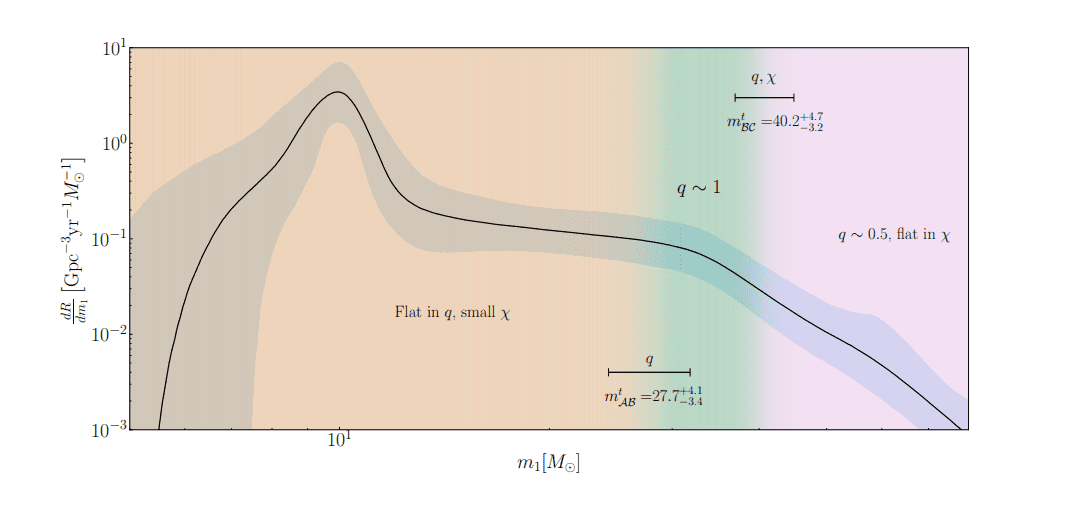
This suggests that the observed population of merging black holes is not uniform but consists of distinct groups. The analysis identified two well-defined transition masses, marking the boundaries between these groups. The researchers found evidence for two transition masses: 27. 7 ±4. 1 solar masses and 40.
2 ±4. 7 solar masses. These transitions are statistically significant and consistent with other recent findings in the field. The subpopulations differ in their mass ratio and spin magnitude distributions, suggesting diverse origins and formation pathways. In essence, the study suggests that the population of merging black holes is more complex than previously thought, with evidence for at least three distinct groups characterized by different masses, mass ratios, and spin properties. Further research is needed to understand the physical mechanisms that give rise to these subpopulations, potentially involving different formation channels for binary black holes.
Three Black Hole Subpopulations Identified in Data
Recent analysis of gravitational wave data reveals a detailed view of merging binary black hole populations, demonstrating the existence of at least three distinct subpopulations. This work identifies differing characteristics in black hole mass ratios and spin magnitudes, suggesting multiple formation pathways are at play. Researchers achieved this by modeling the binary black hole population with a flexible framework allowing for up to three transition masses, separating the subpopulations. The team found strong evidence for three subpopulations, with transition masses measured at 27. 7+4.
1 −3. 4 solar masses and 40. 2+4. 7 −3. 2 solar masses.
Subpopulation A, encompassing black holes up to 27. 7 solar masses, exhibits a nearly flat mass ratio distribution and small spin magnitudes. Subpopulation B, existing between 27. 7 and 40. 2 solar masses, displays a sharper preference for equal-mass pairings while retaining similar spin characteristics to Subpopulation A.
Finally, Subpopulation C, consisting of black holes above 40. 2 solar masses, shows support for larger spin magnitudes and a tentative preference for lower mass ratios. Researchers speculate that Subpopulation B may be associated with chemically homogeneous evolution or even Population III stars, the first generation of stars in the universe. These findings align with recent claims of hierarchical mergers, where black holes merge repeatedly to form larger systems. The measurements confirm a complex picture of black hole formation, with distinct populations exhibiting unique characteristics in mass and spin.
Black Hole Populations And Merger Pathways
Analysis of the latest gravitational-wave catalog reveals a diverse population of merging binary black holes, suggesting multiple formation pathways are at play. Researchers identified at least three distinct subpopulations, each characterized by different ranges of black hole mass and varying distributions of mass ratios and spin magnitudes. Subpopulation A exhibits small spin magnitudes and a relatively flat distribution of mass ratios, while Subpopulation B shows a strong preference for equal-mass mergers. Subpopulation C displays support for larger spin magnitudes and potentially originates from hierarchical mergers, where black holes themselves are the product of previous mergers.
These findings represent a significant step towards understanding how black hole binaries form and evolve, moving beyond simple models to acknowledge a more complex reality. The team acknowledges limitations in definitively linking subpopulations to specific formation scenarios, and further research is needed to refine these connections. Future work will focus on improving models and analyzing additional gravitational-wave events to confirm these findings and explore the underlying physics driving black hole binary evolution.
👉 More information
🗞 Evidence for Three Subpopulations of Merging Binary Black Holes at Different Primary Masses
🧠 ArXiv: https://arxiv.org/abs/2509.15646