

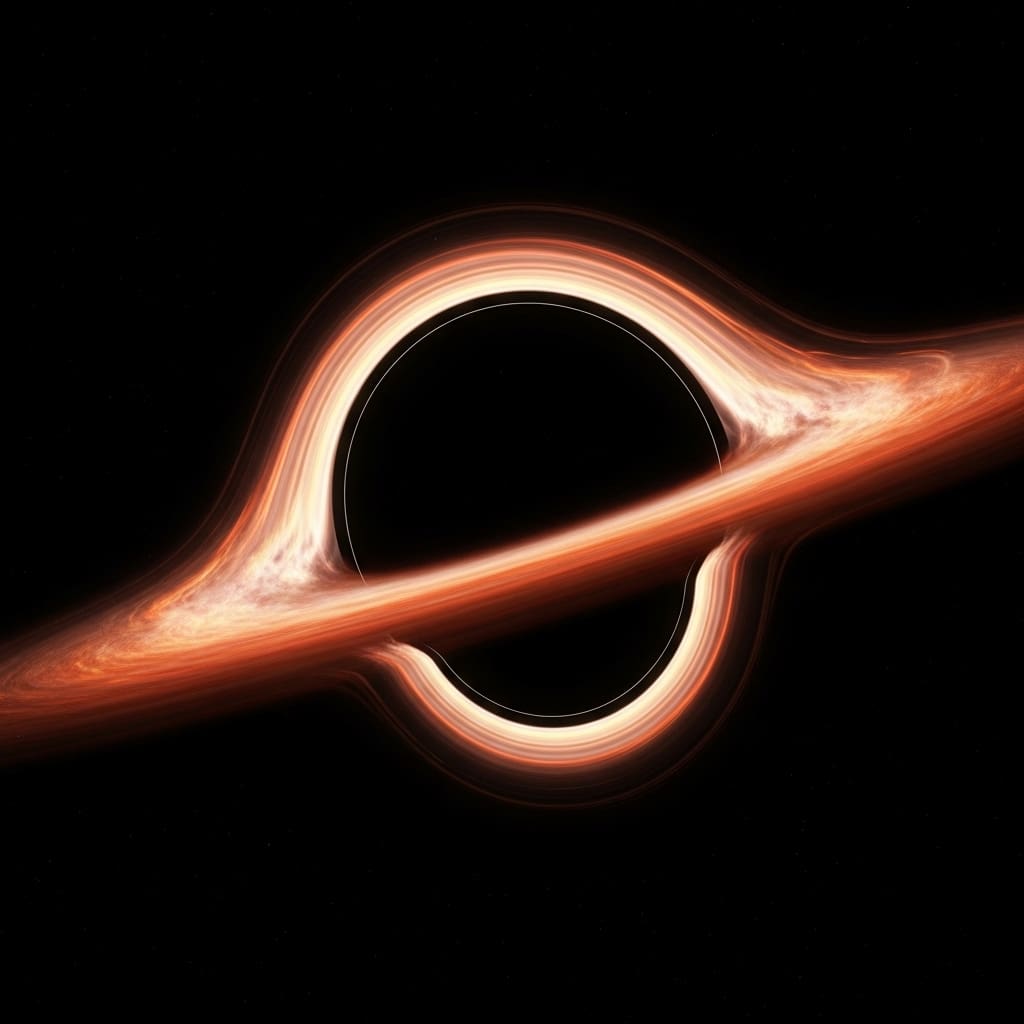
The nature of black hole shadows continues to fascinate physicists, and new research delves into how modifications to general relativity impact their appearance. Khadije Jafarzade, Saira Yasmin, and Mubasher Jamil, from the University of Mazandaran and the National University of Sciences and Technology, have investigated the optical properties of electrically charged black holes within the framework of modified gravity and nonlinear electrodynamics. Their work examines how these theoretical adjustments affect light propagation around black holes, potentially altering the size and shape of their shadows. This research is significant because it explores whether observational data from the Event Horizon Telescope, specifically regarding the supermassive black hole M87*, can constrain these alternative theories of gravity and provide insights into the fundamental physics governing these enigmatic objects. The team’s findings demonstrate a complex interplay between gravitational and electromagnetic forces, with implications for understanding black hole evaporation and the viability of different cosmological solutions.
Through analysis of photon trajectories in this spacetime, they demonstrate how model parameters affect light propagation, resulting in extended ranges for lensed paths and photon rings. The study identifies parameter regions that permit physically plausible black hole shadows, defined by a photon sphere exterior to the event horizon and a corresponding shadow forming beyond it. These viable regions are shown to expand with increases in electric charge and fR0, illustrating the interaction between gravitational and electromagnetic influences. The model’s parameters can potentially be constrained using observations from the Event Horizon Telescope.
F(R) Gravity and Black Hole Solutions
This research explores black hole solutions within modified gravity theories, specifically f(R) gravity, to address issues like dark energy and the accelerating expansion of the universe. The study also incorporates nonlinear electrodynamics, using the Euler-Heisenberg Lagrangian to describe the behavior of photons in strong electromagnetic fields, leading to phenomena like birefringence. They are specifically studying charged black holes, where the charge introduces additional complexity and affects the black hole’s properties. A key prediction of these models is how they affect the black hole shadow and the deflection angle of light rays, both observable quantities. By using Event Horizon Telescope observations of M87* and Sagittarius A*, they are constraining the parameters of their theoretical models, finding which are consistent with the observed size and shape of the black hole shadows.
This research is important because it provides a way to test the validity of General Relativity in the strong-field regime. If the predictions of these modified gravity models differ significantly from observations, it would suggest that General Relativity is incomplete. Modified gravity theories are often proposed as alternatives to dark energy, and testing these theories may lead to a better understanding of the universe’s accelerating expansion. The inclusion of nonlinear electrodynamics allows researchers to explore potential quantum gravity effects near black holes, and the Event Horizon Telescope is proving to be a powerful tool for testing fundamental physics.
Black Hole Shadows in Modified Gravity and Electrodynamics
Scientists performed a detailed analysis of light propagation around a static, electrically charged black hole within modified f(R) gravity coupled with Euler-Heisenberg nonlinear electrodynamics. Varying model parameters significantly alters photon trajectories, leading to a wider range of lensed images and photon rings around the black hole. The team meticulously mapped regions of parameter space that support physically realistic black hole shadows, defined by the existence of a photon sphere external to the event horizon and a corresponding shadow boundary.
Measurements confirm that increasing the electric charge and the fR0 parameter expands these viable regions, demonstrating the interplay between gravitational and electromagnetic influences on shadow formation. Analysis of the shadow radius showed a visible increase with growing fR0, indicating that stronger modifications to gravity enhance the shadow’s boundary. Investigations into de Sitter and anti-de Sitter spacetimes demonstrated how background curvature influences photon orbits, with larger R0 values enhancing shadow size in de Sitter space.
Constraining the model with Event Horizon Telescope observations of M87*, the research determined that de Sitter black hole solutions remain compatible with the data, while anti-de Sitter solutions are disfavored for low electric charge and fR0 greater than -1. The study calculated the angular diameter of the M87* shadow to be 42 ±3 microarcseconds, translating to a shadow diameter of approximately 11.0 ±1.5 gravitational units, falling within a 1-sigma confidence interval of 9.5 to 12.5 units.
Furthermore, the team analyzed the energy emission rate, discovering that a higher electric charge increases black hole evaporation, while stronger nonlinear electrodynamics effects and larger fR0 values suppress it. The researchers established constraints on parameters q, R0, and a, identifying allowed intervals consistent with EHT data. Results demonstrate that the shadow deviation, δ, from a Schwarzschild black hole, is constrained within the range −0.18.
Electrically Charged Black Hole Shadow Geometry
This research details an investigation into the optical properties of electrically charged black holes within a modified gravity framework combining f(R) gravity with Euler-Heisenberg nonlinear electrodynamics. Through analysis of photon trajectories, the study demonstrates how parameters within the model influence light propagation, specifically expanding the range of possible lensed trajectories and photon rings. The work identifies parameter regions that allow for physically plausible black hole shadows, defined by the existence of a photon sphere outside the event horizon and a corresponding shadow.
The significance of this work lies in its ability to connect theoretical predictions with observational data, specifically those from the Event Horizon Telescope’s observations of M87*. Constraining the model using these observations, the researchers found de Sitter black hole solutions remain consistent with current data, while anti-de Sitter solutions are disfavored under certain conditions. The analysis of energy emission rates further indicates that increased electric charge accelerates black hole evaporation, a process mitigated by stronger nonlinear electrodynamics.
👉 More information
🗞 Shadow of F(R)-EH Black Hole and Constraints from EHT Observations
🧠 ArXiv: https://arxiv.org/abs/2601.05040

