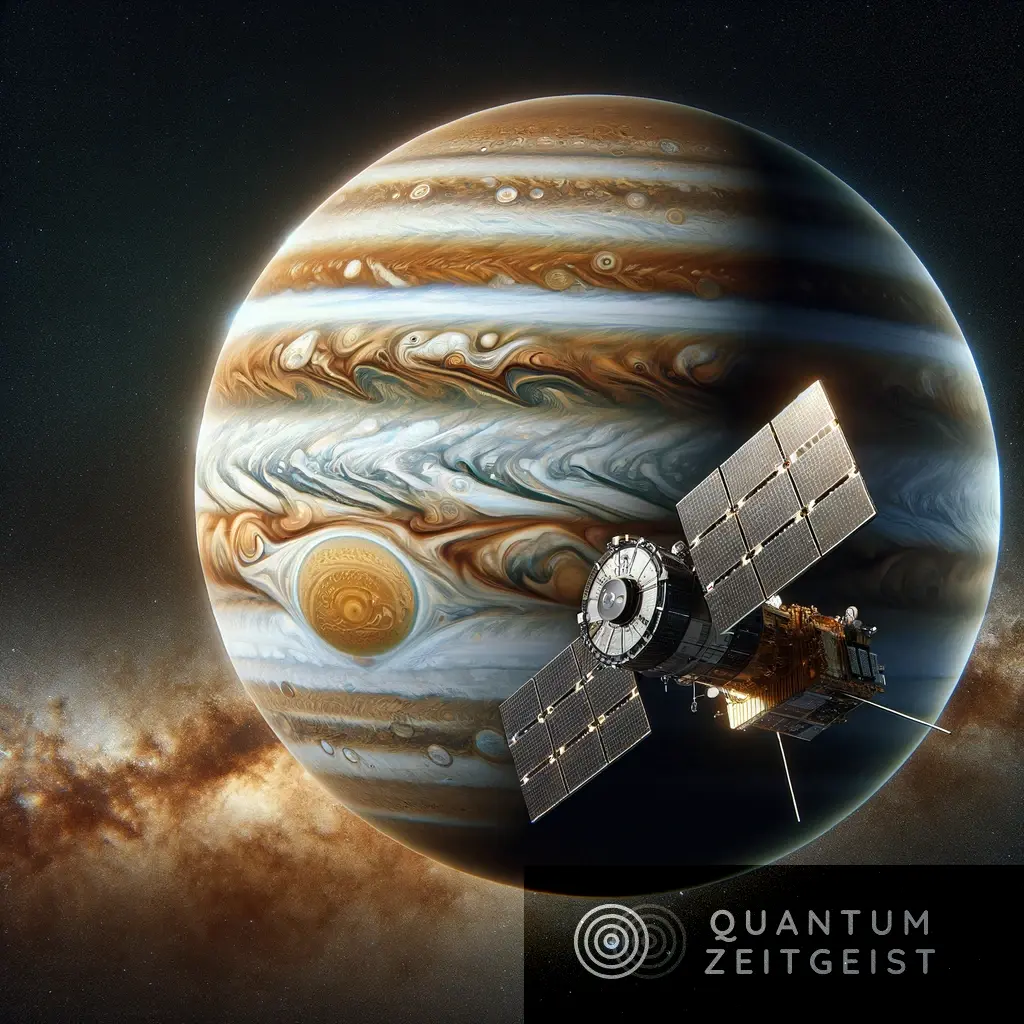
The European Space Agency (ESA) is advancing its quantum technology initiatives, including sending a quantum-enabled probe to Jupiter and developing quantum-based communications. The agency is also planning to fly a quantum clock to the International Space Station. Quantum technology was identified as a strategic priority by ESA Director General Josef Aschbacher. ESA opto-electronics system engineer Eric Wille stated that the agency has been working on quantum technologies for 25 years. The ESA is also collaborating with the European Commission and industry partnerships like the Eagle-1 mission with satellite manufacturer SES to develop quantum key distribution for secure communications.
Quantum Technology: Europe’s Leap into the Future
Europe is currently in the midst of the ‘quantum decade’, a period where the unique properties of matter at the smallest scales are being transformed into practical technologies and products. This transformation is leading to significant advancements in fields such as communications, navigation, computing, and environmental sensing. The European Space Agency (ESA) is at the forefront of this revolution, developing quantum technologies for space exploration and communication.
The ESA has been working on quantum technologies for the last 25 years, steadily increasing readiness levels and achieving significant milestones. This includes participating in record-breaking quantum communications. The agency is also actively collaborating with the quantum research community and is open to new research ideas in this field.
Quantum Physics: The Science of the Very Small
Quantum physics, often termed as the most successful theory of the past century, underpins the workings of everyday items like silicon chips, lasers, and medical imaging machines. At the heart of this theory is the fact that at extremely small scales, atoms, photons, and other particles start behaving like waves. This leads to phenomena such as ‘quantum superposition’, where a particle can exist in more than one possible state at once, and ‘quantum entanglement’, where multiple particles share identical physical characteristics, even when separated by long distances.
Quantum technologies aim to utilise such exotic behaviour as the basis of more powerful computing, ultra-precise timing, secure sharing of information, and high-sensitivity sensors. However, the challenge lies in the fact that quantum states are easily disturbed and prone to collapse.
Quantum Communications: Secure Data Sharing
One of the most mature applications of quantum technology is secure communications based on ‘quantum key distribution’. Current secure data sharing is based on the sharing of ‘cryptography keys’ between sender and recipient. As an alternative, quantum key distribution is being developed where the security of the key exchange is based on quantum physical properties of light particles. Using laser links on satellites allows for bridging much larger distances compared to optical fibres where the quantum signals are more quickly disturbed.
The European Space Agency is collaborating with the European Commission to develop quantum key distribution for governmental applications, and also through the support of industry partnerships. Lessons learned will guide the development and deployment of the European Quantum Communication Infrastructure, which is part of Europe’s Secure Connectivity programme.
Quantum Clocks: Precision Timing and Navigation
Laser-slowed cold atom systems can serve as the basis of highly precise clocks for positioning, navigation, and timing, offering significant improvements on the atomic clocks employed by today’s satellite navigation systems. They are also important for fundamental physics experiments. The ESA’s atomic clock ensemble in space payload will become the most accurate clock ever flown in orbit when it is brought on board the International Space Station in 2025.
Quantum Computing: The Future of Problem Solving
Quantum computers, by harnessing superposition, promise vastly improved computing power for specific search or optimisation problems. While it is unlikely that quantum computers will be flown in space in the near future, this technique could be applied to space-related ‘hard problems’ such as optimising highly complex mega-constellation operations, high-fidelity simulations of a rocket’s interaction with the atmosphere, or processing Earth observation data to exploit large amounts of information more efficiently.
Other areas such as quantum memories, quantum imaging, random number generation and post quantum cryptography are also part of the more than 40 projects planned by ESA’s quantum technology cross-cutting initiative in the coming years. High quality and precision engineering is an essential element for success; it takes complex optical payloads to manipulate systems at the scale of atoms or photons.
“Quantum technology was defined as a strategic priority in the Agenda 2025 of ESA Director General Josef Aschbacher, seen as offering new avenues to commercial success and technical leadership, and we are implementing this vision,” explains ESA (European Space Agency) opto-electronics system engineer Eric Wille.
“This cumulative effort has helped us expand our range of activities, and build links with the quantum research community, most recently through ESA’s latest quantum technology conference in September. To summarise: ESA is really open for business in this field, and if you have ideas for research, we want to hear from you!” – Eric Wille, ESA opto-electronics system engineer.
Summary
Europe is in the midst of the ‘quantum decade’, a period where the properties of matter at tiny scales are being transformed into practical technologies, leading to advancements in communications, navigation, computing and environmental sensing. The European Space Agency (ESA) is actively participating in this revolution, with projects including a quantum-enabled probe to Jupiter, quantum-based communications, and a quantum clock for the International Space Station.
- Europe is in the midst of the ‘quantum decade’, a period where quantum properties are being transformed into practical technologies and products, leading to advancements in communications, navigation, computing and environmental sensing.
- The European Space Agency (ESA) is currently sending a quantum-enabled probe to Jupiter, developing quantum-based communications, and planning to fly a quantum clock to the International Space Station.
- Quantum technology was identified as a strategic priority in the Agenda 2025 of ESA Director General Josef Aschbacher, with the aim of commercial success and technical leadership.
- ESA opto-electronics system engineer Eric Wille explains that ESA has been working on quantum technologies for the last 25 years, achieving major successes including a world record for quantum communications.
- Quantum physics underpins everyday items like silicon chips, lasers and medical imaging machines. Quantum technologies aim to utilise quantum behaviour for more powerful computing, ultra-precise timing, secure information sharing and high-sensitivity sensors.
- Among the most mature applications is secure communications based on ‘quantum key distribution’. ESA is collaborating with the European Commission to develop quantum key distribution for governmental applications, and through industry partnerships like the Eagle-1 mission with satellite manufacturer SES.
- ESA’s atomic clock ensemble in space payload will become the most accurate clock ever flown in orbit when it is brought on board the International Space Station in 2025.
- Quantum computers, while unlikely to be flown in space in the near future, promise vastly improved computing power for specific search or optimisation problems.
- Other areas such as quantum memories (QRAM), quantum imaging, random number generation and post quantum cryptography are also part of the more than 40 projects planned by ESA’s quantum technology cross-cutting initiative in the coming years.