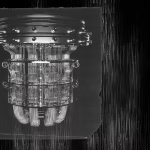
After three years, the pan-European MATQu project has ended, paving the way for the future of quantum computing. The project aimed to establish a complete European value chain for building superconducting qubit chips, including critical elements like Josephson junctions and resonators. Key research technology organizations and leading European companies participated in the project, including OrangeQS, Delft Circuits, imec, CEA-Leti, BESI, and Technic.
One of the notable contributions was the development of a new indium plating solution for the growth of indium microbumps. Researchers also formulated innovative selective wet etchants designed to remove superconducting materials like ruthenium and niobium while being compatible with indium. The project’s 3D design enables dense integration of superconducting qubits, replacing traditional bonding wires with vertical interconnects known as Through Silicon Vias (TSVs). This innovative solution provides faster operation, reduced heat production, and lower power consumption.
The MATQu project demonstrated the capabilities of the European ecosystem to innovate in the fields of quantum elements, assemblies, connectors, and software development. The collaborative works were shared during conferences like SPCC 2022 and ECTC 2024 and published in scientific journals like MicroElectronic Engineering and IEEE.
Paving the Way for the Future of Quantum Computing: The MATQu Project
The pan-European MATQu (Material for Quantum Computing) project has come to an end after three years, marking a significant milestone in the development of quantum computing technology. The project aimed to establish a complete European value chain for building superconducting qubit chips, including critical elements like Josephson junctions and resonators.
Establishing a European Value Chain
The MATQu project brought together key research technology organizations (RTOs) and leading European companies to develop a comprehensive ecosystem for quantum computing. The project’s goal was to create a complete value chain, from material development to chip fabrication, assembly, and testing. This collaborative effort demonstrated the capabilities of the European ecosystem to innovate in the fields of quantum elements, assemblies, connectors, and software development.
Technological Advancements
One of the primary challenges in advancing this technology is qubit densification. To solve this problem, researchers devised a 3D design enabling a dense integration of superconducting qubits. This design replaces traditional bonding wires with vertical interconnects, known as Through Silicon Vias (TSVs), which minimize internal signal connection lengths in silicon. The innovative solution provides several advantages, such as faster operation, reduced heat production, and lower power consumption.
Technic researchers made significant contributions to the project, including the development of a new indium plating solution (Elevate Indium D4900) for the growth of indium microbumps. They also formulated innovative selective wet etchants designed to remove superconducting materials, like ruthenium and niobium, while being compatible with indium. These novel materials are ideal for assembly, thanks to their superconducting properties at very low temperatures.
Cleaning and Fabrication Challenges
Cleaning the TSVs is critical to avoid issues during subsequent processes. The Technic team developed a cleaning solution to remove the fluoropolymer deposited during TSV fabrication (Bosch process). This cleaning formulation, known as TechniClean BOS 390, was assessed and validated along with MATQu partners.
The project’s findings were shared during the SPCC 2022 and ECTC 2024 conferences and published in scientific journals such as MicroElectronic Engineering and IEEE. The collaborative works demonstrated the capabilities of the European ecosystem to innovate in the fields of quantum elements, assemblies, connectors, and software development.
Paving the Way for Future Quantum Computing
The MATQu project has paved the way for the future of quantum computing by demonstrating the feasibility of a complete European value chain for building superconducting qubit chips. The project’s outcomes will have a significant impact on the development of quantum computing technology, enabling faster, more efficient, and more powerful computing operations.
In conclusion, the MATQu project has successfully demonstrated the capabilities of the European ecosystem to innovate in the fields of quantum elements, assemblies, connectors, and software development. The project’s findings will play a crucial role in shaping the future of quantum computing, paving the way for further research and development in this exciting field.
External Link: Click Here For More